
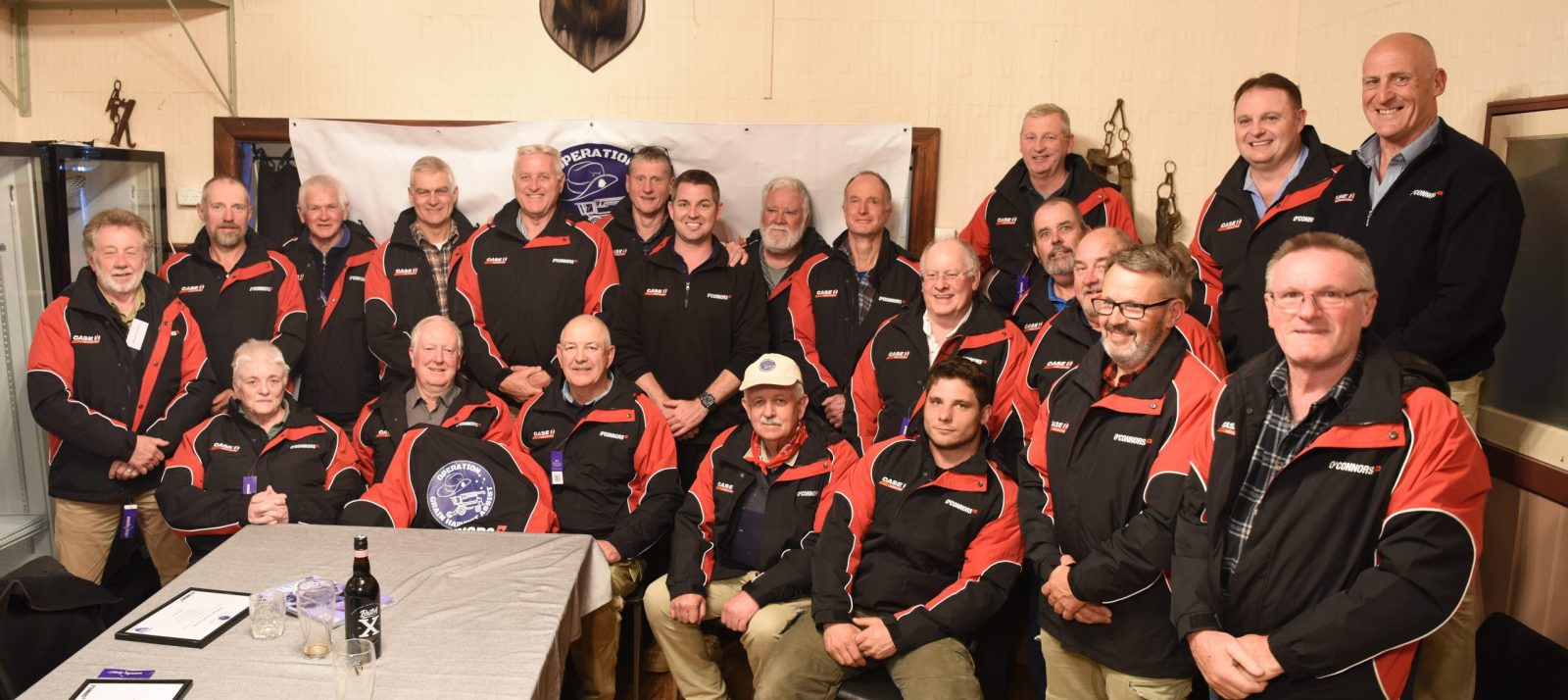
The first of OGHA’s grain-harvesting courses was held at Longerenong Agricultural College. Seated at centre is Garry Spencer, with Chris Maher at far right front, and Mike Welsh eighth from left in back row. In the back row at far right is O’Connor’s CASE-IH executive senior sales manager David Hair, who has since retired. Photo: Supplied
AN INITIATIVE born during COVID has given veterans a pathway into agriculture, and instigator Garry Spencer hopes the pathway will become a highway.
As it moves rapidly towards Veterans Supporting Agriculture (VSA), it is looking to build on processes and relationships started by Operation Grain Harvest Assist (OGHA), which put roughly 200 veterans into Australia’s 2021 harvest workforce.
Mr Spencer now plans to suggest to the 6000 or so personnel who leave the Australian Defence Force each year that they consider a career in cropping and livestock production in rural and regional Australia.
“Our target is 5 percent of veterans who retire every year; it’s a modest target that once proven, just may expand,” Mr Spencer said.
While OGHA appeals mostly to veterans at, or close to, retirement age, Mr Spencer hopes VSA can now help younger veterans transition into a civilian life in agriculture.
“A lot of the younger veterans are aged 25 to 35, and we’re looking at supporting them and their young families move and settle into rural and regional Australia.”
Delivering skills
As a retired Royal Australian Armoured Corps Lieutenant Colonel, and with experience in management at companies including IBM, Mr Spencer knows a thing or two about machinery operation, and the value of training.
Through matching veteran skills in operating tanks, heavy vehicles and trucks with farmers’ needs to find machinery operators for the 2021 harvest, he established his cornerstone connection to agriculture through Grain Producers Australia to create OGHA.
From there, Mr Spencer has found support from machinery dealerships, and tertiary education and service organisations to adapt skills developed in the military to agriculture for permanent as well as casual harvest work.
Ahead of his career in the grain industry, Ron Storey did National Service in the early 1970s, and one Garry Spencer was among his peers.
Their paths have crossed since, and Mr Storey was the guest speaker on the first of three training courses for grain harvest operators Mr Spencer organised at Victoria’s Longerenong Agriculture College near Horsham in 2022.
“We know in agriculture that labour supply is a problem everywhere, and Garry organised this impressive bunch of people for training to help solve it,” Mr Storey said.
“They are highly trained, they understand long hours, and they understand what a mission is.
“These courses are an opportunity to professionalise a seasonal workforce.”
Mr Storey said agriculture tapping into the veteran pool may well ease some of the pressure agriculture is experiencing through a lack of skilled labour in both the casual and seasonal workforce.
“It’s not the solution, but it’s part of the solution.”
Horsham and beyond
OGHA was sparked by the need to fill harvest seats when COVID shut Australia’s borders to visa-holders with machinery operation skills.
The skilled labour shortage in much of rural Australia has not gone away, as evidenced by the veterans who took part in OGHA doing subsequent grain harvests, and other agricultural work.
Mr Spencer said it shows the bigger need from agriculture, and the willingness of veterans to jump into the cab.
Among the veterans who signed up for the 2022 course and subsequent harvests and haven’t looked back are Michael Welsh and Chris Maher.
Mr Welsh’s first harvest gig was with then GPA chair Andrew Weidemann on his farm at Rupanyup, in Vic’s Wimmera.
“Michael was out of the very first batch of veterans that went through the program,” Mr Weidemann said of the initial OGHA course at Longerenong.
With support from former GPA chief executive officer Colin Bettles, it was organised by Mr Spencer, and put Mr Welsh on the Weidemann farm for six weeks.
“I was fortunate enough to get Michael; he was probably the most experienced veteran there.
“His good demeanour and mechanical skills were great to have for harvest, and I set him up with the Burke family at Donald after he left us.”
With the Burke’s BB Harvesting outfit, Mr Welsh worked at Excel Farms’ aggregation at Pinnaroo in South Australia, and has since done a harvest at Nevertire in New South Wales, and another near Esperance in Western Australia.
He also has wide experience in harvesting cotton and now has a total of more than 2000 hours on grain harvesters and cotton pickers.
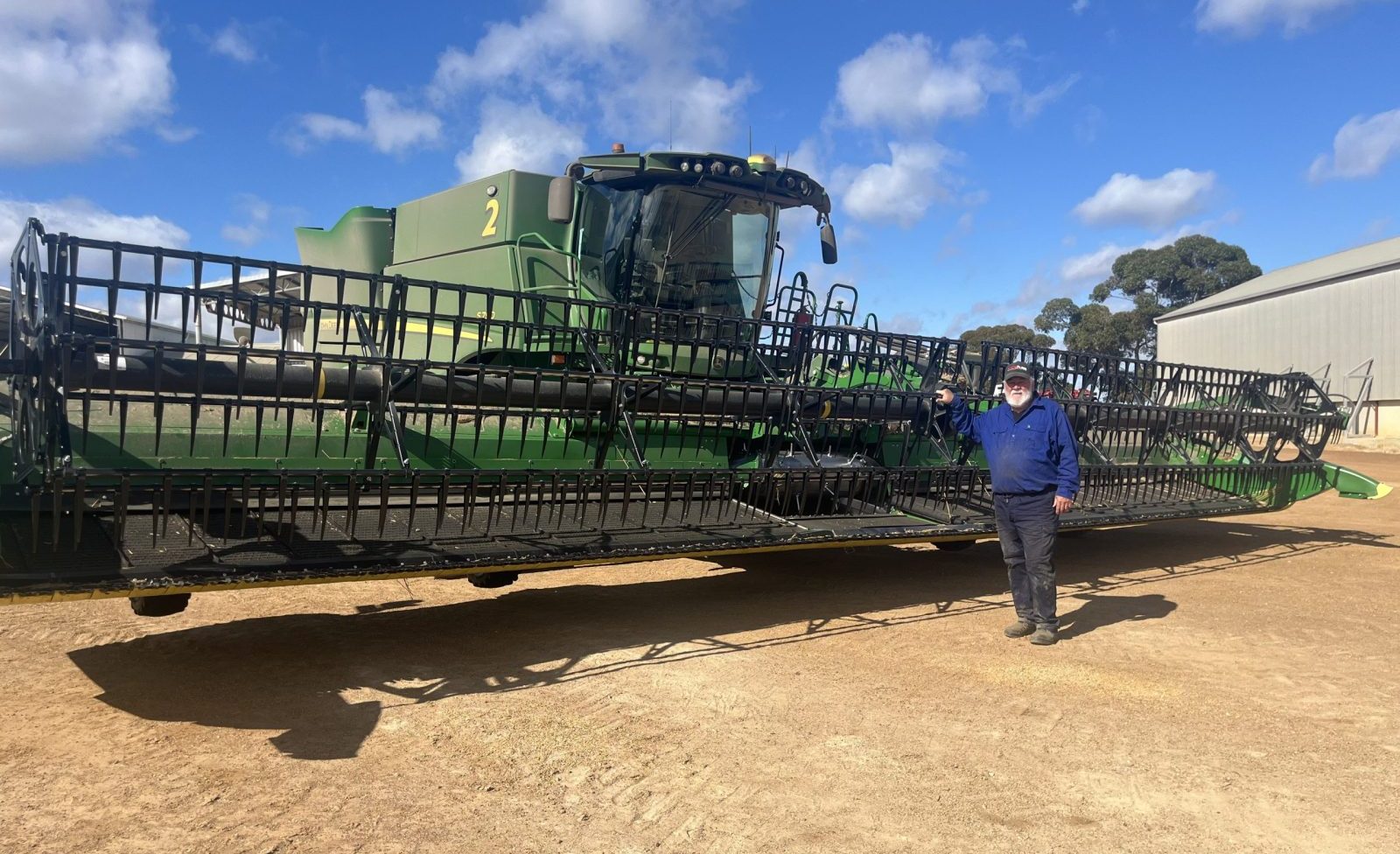
Mike Welsh with one of the headers he has clocked up many hours on in recent years. Photo: Supplied
Originally from Mitchell in Queensland, Mr Welsh joined the Australian Army at 16 in 1975 as an apprentice motor mechanic, and was a member of the Royal Australian Electrical and Mechanical Engineers (RAEME).
“I have an engineering understanding of how machines work and I enjoy being able to maximise their performance,” Mr Welsh said.
After 20 years in the Army, he moved into workshop and service management in Fiji, Malaysia, and Australia, and had a year as the service manager at Hastings Deering’s Lihir gold mine in Papua New Guinea.
He came across OGHA through an Army-linked Facebook page, and answered the call.
“I had the time and the ability, and it seemed like the right thing to do.”
He has found that employment with a harvest contractor or on a large farm suits him best.
“I salary-sacrifice all my wages, so I’m looking for enough work to meet my concessions category but not exceed it, and three months’ works out about right.”
Mr Welsh and his wife live in Bungendore near Canberra, and he likes the north-to-south run of the contractor.
This harvest, he is working with an outfit that has started its run at Meandarra, Qld, and will finish in Vic.
Return to farming
For Mr Maher, the OGHA work has taken him back to the farm.
He grew up on Deepwater Station near Matong in the Riverina, where his father worked, and remembers it as “9000 acres of wheat, sheep, cattle, ‘roos and rabbits”, and an “awesome place” to grow up and explore.
In 1978, aged 16, he joined the army as an apprentice fitter and turner, and graduated into the RAEME.
He trained up to the position of Senior Weapons Systems Artificer, and was posted all over Australia, with deployments to Malaysia and PNG, before leaving the army after 20 years of service.
In civilian life, Mr Maher worked primarily as a service or project manager with technical personnel, and had stints in Asia and Europe.
For Mr Maher too, it was social media that got him into OGHA.
“I was browsing Facebook looking for agricultural roles and suddenly that algorithm popped up [Garry’s] post…and off we went.
“I had an idea to get re-involved with ag as an interim temporary gap filler during transition to full retirement…but, four years later, I am enjoying this far too much to fully retire.”
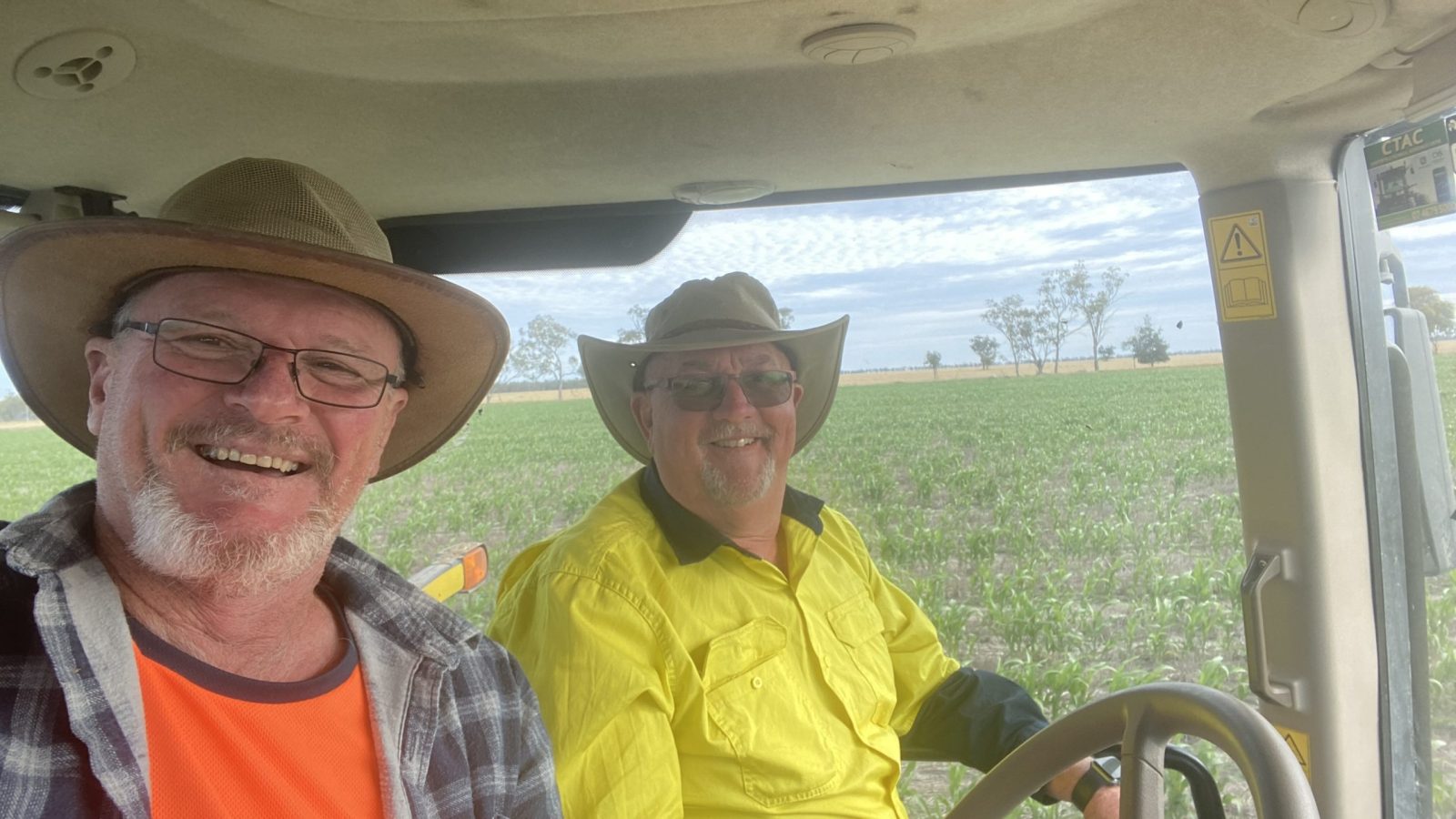
On-farm at Moree in 2022 are Chris Maher and Garry Kennedy, who was the last Commanding Officer of the Royal Australian Navy’s HMAS Tobruk before she was decommissioned in 2015. Photo: Chris Maher
Since finding OGHA, Mr Maher has worked on grain, cotton, sugarcane and cattle properties at Bellata, Moree and Wee Waa in northern NSW, Hay and Tooma in the south, Goondiwindi, Innisfail and Roma in Qld, and Tipperary Station in the Northern Territory.
The farm of the 2020s is vastly different to the 1970s version he remembers.
“Along with comfort afforded to operators now, the technological development since I last drove headers and tractors back in 1977 is simply amazing,
“In some ways, it’s a major advancement but at the same time, I have seen too many instances where an operator selects the ‘magic’ auto button and then picks up that mobile phone and loses focus on actually operating the machine.”
Chris Maher on farm and on the tools during cotton picking.
Mr Maher has settled into a pattern of two months on, then one month off at the home he and his wife built four years ago in north-east Thailand.
He plans to stay on roughly that swing for Jono Phelps and family at Havana Ag at Wee Waa until late-2027 and then continue his extended lap around Australia via the WA Wheatbelt.
“I fortunately have a very supportive wife who accepts that I am enjoying this phase of my life approaching full retirement.”
Mr Maher’s enjoyment of ag work comes in part from the responsibility involved.
“It’s the variety of tasks and trust placed in you as an operator to do a good job and look after the equipment,” he said of farm work.
“These are very expensive items, and repairs through neglect or abuse are just not acceptable.
“The other main attraction is the scenery and the isolation — not having a customer call complaining about a task done by a team member, or having the same team member complaining about customers; I just got sick of managing people.”
Mr Maher is also enjoying meeting machinery operators in Australia on working-holiday visas.
“It’s a realisation when sharing an after-work beer and jokes around a campfire that while we can enjoy the moment, many of our ancestors fired weapons at each other and didn’t get the same chance.”
“I see this as an opportunity to assist highly skilled, well-trained veterans leaving the ADF to take on a new direction where their experience is respected and in demand, whether its in the technical trades, logistics, transport, field engineering, medical or many other transferable skills.
“On many established farms there is a wide range of additional benefits such as housing, work vehicles, and meals; operating in isolated regions just becomes an attractive option to being trapped in a busy and somewhat impersonal city life and trying to establish yourself”.
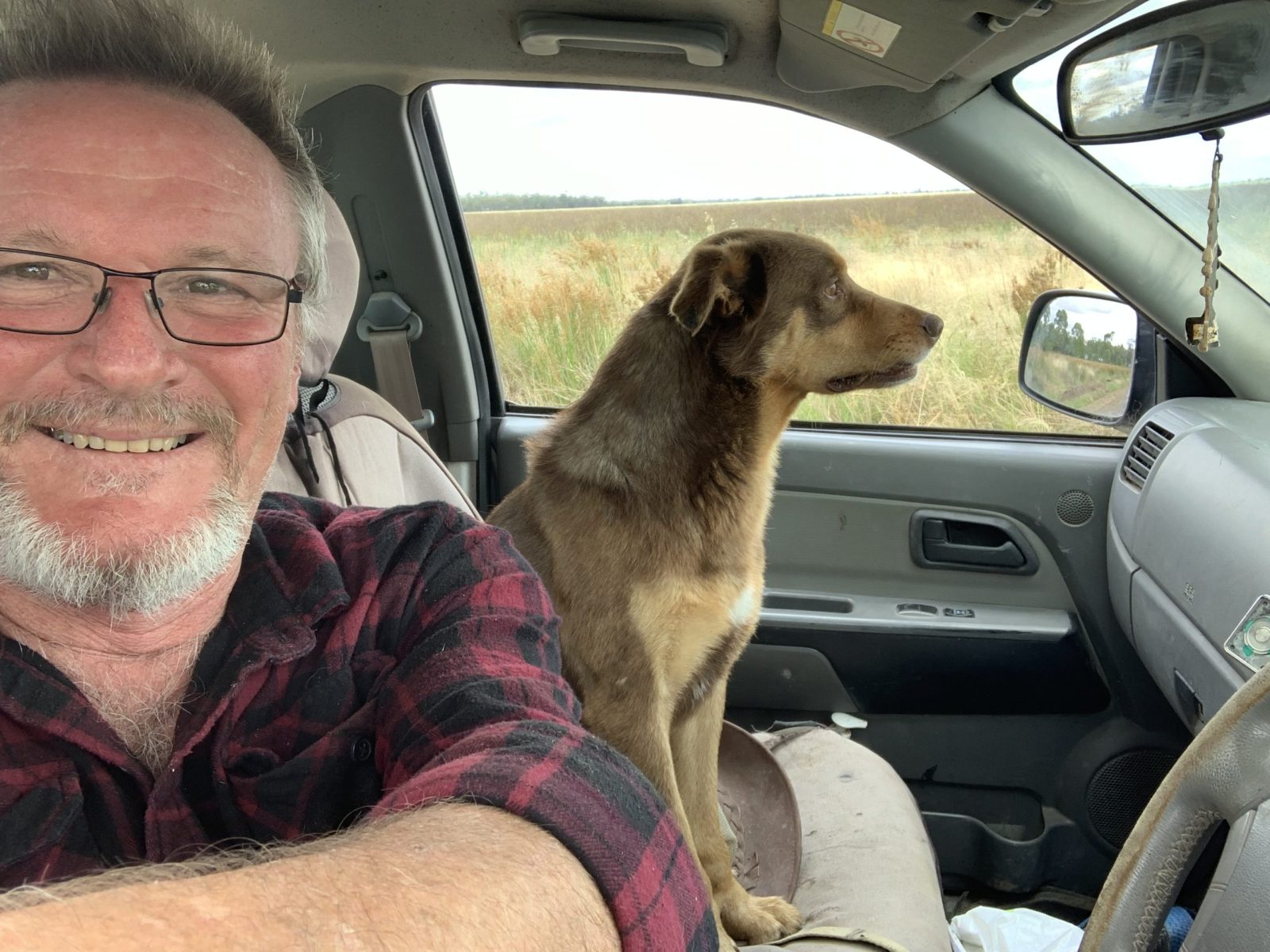
Chris Maher and his sidekick Chomper. Photo: Chris Maher
At 65, Mr Maher said ag work has him in better shape than he was when he was in office-bound management roles, and it has benefitted him mentally as well as physically.
“My self-confidence and energy has returned, and I will happily take on new challenges as they present.”
In 2022, Mr Maher did the first OGHA grain-harvesting course at Longerenong College, and then the cotton operator course at Moree in March 2023, organised by OGHA in response to a request by Cotton Australia to skill workers up for cotton harvesting.
“They assisted me hugely in gaining early positions while I was still relatively inexperienced,” Mr Maher said of the courses.
“Garry has kicked a pebble down the road and its turning into a rolling boulder now.”
Broader ambitions
Mr Spencer said support for the program has come from in-field host Longerenong Agricultural College, CASE IH ANZ and the CASE IH Horsham dealership of O’Connors, which supplies two headers and their chief instructor.
From its headquarters in Toowoomba, RDO Equipment, which sells and services John Deere cotton pickers, has supported the Moree course, with two of its directors flying down from Toowoomba to check out the course run in its Moree dealership boardroom.
The detailed instruction was provided by highly regarded cotton contractor Ross Munro from the BMC Partnership.
“Participants for the courses have come from all three ADF Services; they include a warship captain, an F/A-18 Hornet Top Gun and an operator from the SAS Regiment,” Mr Spencer said.
“We also had a candidate from the Army Band Corps who was the resident pianist for the Governor General on special occasions.”
For the Horsham courses, which are free for veterans, participants have travelled from as far away as the Sunshine Coast.
“We run people through a four-day course, and we are planning to expand it to five days, to include augur training and more time on a 340HP tractor.”
Standards are high, which Mr Spencer said presents no problem for veterans.
“The ADF is the world’s best when it comes to developing human potential; the nature of the work is that there’s no silver medal; you either get a gold medal, or you have a serious problem; careful preparation and planning to get it right the first time is always the aim.”
He is equally clear about what agriculture needs to offer veterans: training, suitable placement, and support once they arrive in cropping or pastoral areas under the VSA program, which is continually being improved and refined.
“These veterans are my military ‘brothers and sisters’, and I’m not going to stuff them around, or see them stuffed around; if we can get it right, this program promises to help create new and lasting value for agriculture.
“In many ways it follows in the footsteps of the revered post-war Soldier Settler Schemes.”
“The ADF assists personnel transition to civilian life by funding training, depending on their years of ADF service; we are hoping that DVA will fund at least the foundation course and also parts of or even the complete six parts of the AMO qualification inclusions.
“This would add value for the veterans and the farmers and prepare the veterans very well for a successful transition to agriculture.
“They would be able to fit in and start to add value from day one on the farm”.
“GPA has been great at getting us going, and we’ve moved through a number of stages to the point that we’re about to now interface with five Federal Government departments.”
Relevant portfolios include: agriculture, defence, veteran’s affairs, employment and workplace relations, as well as the department which includes infrastructure and regional development.
“This could add real value to agriculture and to DVA and Defence; it’s potentially a win for agriculture, a win for veterans and a win for the nation, especially for rural and regional Australia.”
Mr Spencer said it could also help to reverse the skills and population slide evident in some pastoral as well as cropping regions.
“Grain is where we started, and where we need to get the pilot going,” Mr Spencer said of the VSA program in development.
He said discussions were soon to be conducted with Beef Australia, ahead of its 2027 event in Rockhampton, and Meat and Livestock Australia.
“We’re developing pathways into sheep, cattle, grain and cotton on a state-by-state basis to help integrate veterans and add ADF training capability into ag for the very first time.”
To assist in building an ecosystem in country communities to support veterans and their families moving in for agricultural jobs, Mr Spencer is soon to further engage with Rotary, RSL branches and Legacy Australia, as well as expanding the OGHA relationship with GPA and other ag bodies.
TAFE NSW is also in the mix, and together they are looking at how they might jointly prepare veterans for agricultural careers, especially in the more technical aspects of ag machine servicing and repair.
“Veterans who have been servicing complex ADF air and ground machines could bring lots of value to this part of the ag industry.
“We’re bringing in a new trade classification for our veterans: agricultural machinery operator.
“That will give our veterans six boxes to tick on operation of: grain headers or cotton pickers, a tractor, licences for a telehandler, a forklift and a truck and skills and expertise in augur operation.”
Mr Spencer can also see an opportunity for retired or travelling veterans seeking part-time work as a caretaker, where the veteran lives on site, completes a range of minor jobs and keeps the farm secure and tended during the absence of the farmer.
“We call this our We Care program, a chance for farmers to get away, relax and recharge their batteries, secure in the knowledge that a ‘no-nonsense’ veteran is looking after their interests”.
“This could be a solution for veterans, as well as for farmers who currently can’t get away from the farm because they don’t have someone to keep an eye on things and tend to animals.”
Garry Spencer can be contacted at: [email protected]
Grain Central: Get our free news straight to your inbox – Click here
HAVE YOUR SAY