
 Weather: Rain has shifted from helpful to damaging for Queensland and northern NSW cereal quality. Moree has had 49mm in the past week, Mungindi 41mm, Warialda 34mm and Wee Waa 70mm, and forecasts point to at least 100mm over the next two weeks in parts of Queensland and northern NSW as harvest advances.
Black Sea conditions remain the key weather risk for 2027 supply. Russian winter grain sowing is the slowest since 2013, slowed by low soil moisture and occupied fields, and a third of Ukraine’s winter wheat area is in moisture deficit. Baltic storms are set to slow Russian loadings from November, while dryness persists across much of Europe, with Spain likely to struggle for rain.
In the Americas, warm and dry US weather favours harvest, while heavy rain continues in southern Brazil and chilly temperatures persist in Argentina. Southern Brazil has had more than 100mm, raising concerns about soaked fields and disease, while Mato Grosso to Minas Gerais had generally less than 25mm before mid-October. Overlaying all of this is El Niño: the weekly Niño 3.4 index hit +3.3°C, and all 27 models forecast a “very strong” event from OND 2026 through DJF 2026–27.
Markets
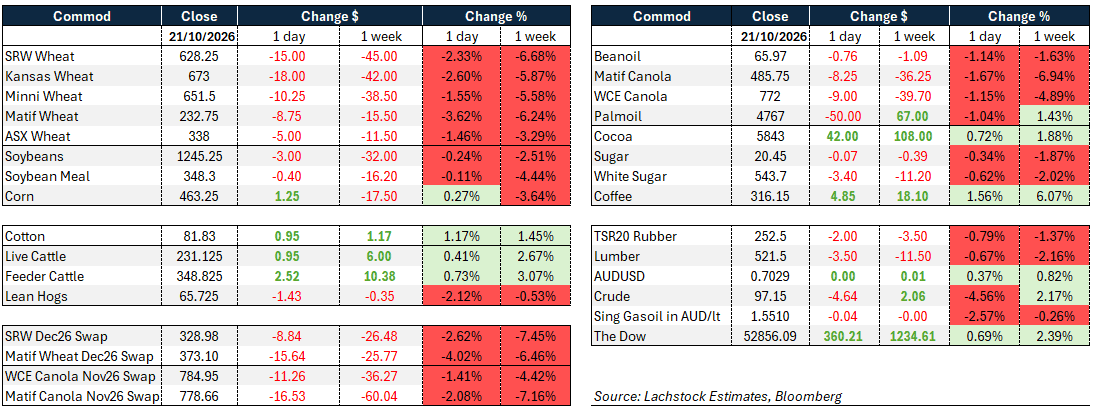
Wheat’s 6–7 percent weekly loss is positioning, not fundamentals. Talks are at least three weeks away, Ukraine’s wheat exports are the lowest since 2011/12, and Russia’s southern terminals are effectively shut, so a bounce is due once liquidation exhausts, with Matif funds still long 137.8k.
Buyers are stepping in at lower levels. Egypt’s first known purchases in months and Jordan’s 120kt tender show demand exists at these prices, and SRW is now competitive into traditional EU and Black Sea destinations.
Corn’s 10c intraday recovery on heavy put buying hints at a more two-sided market. Meal broke its monthly low and still carries too much length against full-throttle crush, so beans need meal to prove it has shed length before they can recover.
Canola liquidation through the 100-day average left the Matif canola Nov26 swap down 7.16pc on the week. Meanwhile diesel is the macro thread running through US fiscal relief, UK inflation and BoE hike pricing, with crude’s fall on Russia diplomacy fragile given Iran’s threats and the AUD’s firming at 0.7029 adding headwind for local prices.
Day Ahead – Australia
There are a few games playing out at once – the plates are shifting. Ag futures markets have seen significant selling across the board. This is where the wires don’t tell the full story. Take Chicago wheat for example – much has been written that we have busted the longs out now – yet, last CFTC, gross longs went up. It was dwarfed by the new shorts entering the market – which, I have to say, feels a little concerning. Fresh shorts entering the market after a 20pc break in flat price.
Locally the rains are a coming – 50-250mm by the time this is all said and done – markets clearly trying to work out what this means – is this adding to feed grain balances, or is this going to create a short?
Like it or not, the Russia/Ukraine negotiations are key to the Aussie wheat grower.
Wheat: Wheat was sold again on peace optimism. Matif broke just as US markets came out of the pause, which gave CBOT reason to drill its lows.
The catalyst was Steve Witkoff’s three-hour meeting with Putin in St Petersburg, after which the Kremlin agreed in principle to restart three-way talks with Washington and Kyiv after 10 November. These would be the first such talks since February. Earlier rounds produced little beyond prisoner swaps, and there is no sign of concessions on core demands. The Kremlin called the Oslo proposals of little real value, and Merz said Ukraine’s surrender is not an option.
Still, funds kept unwinding supply-hedge longs. Matif funds remain long 137.8k even after cutting 5.7k last week. Marex’s Charlie Sernatinger noted CBOT is running out of longs to close.
The physical Black Sea picture points the other way.
SovEcon cut Ukraine’s 2026/27 grain exports by 5.1mt to 33mt. Corn was cut 18% to 17.2mt, wheat 7.7% to 14.4mt and barley to 1.4mt. July–October wheat shipments of 3.8mt are the lowest since 2011/12, and ending stocks balloon to 31.5mt from 26.6mt.
Odesa remains blocked, Danube vessels are being hit in Romanian and Bulgarian waters, and Russia struck a dry-cargo ship bound for Chornomorsk.
On the Russian side, Krasnodar’s governor says Azov-Black Sea terminals have effectively halted after Ukrainian drone attacks, with losses put above 200b roubles (US$2.4b) a month.
IKAR sees Russian November exports near 3mt, but Baltic wind and rain will start to bite on loadings.
Demand is surfacing at lower levels. Egypt’s Future of Egypt bought about five cargoes privately, likely from France and Romania, in one of its first known imports in months.
Jordan is tendering for 120kt of optional-origin milling wheat, with offers due 27 October. EU soft wheat exports are flat year on year. SRW is now as competitive as it has been in a long time, but buyers remain hand to mouth.
US export sales are expected at 400kt.
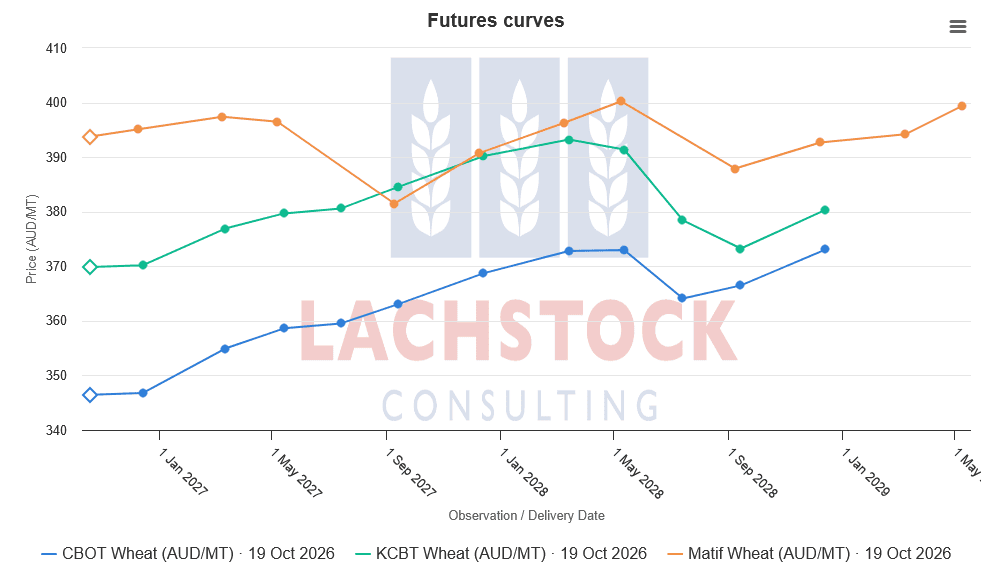
The SRW Dec26 swap fell 8.84 to 328.98, down 7.45% on the week. The Matif Dec26 swap lost 15.64 to 373.10, down 4.02%. ASX held up better, with east coast quality risk underpinning local values.
Other grains and oilseeds: Corn finished modestly higher after being down 10c at its worst. Heavy put buying alongside the futures recovery suggests some are playing a bounce with protection. Further downside toward 420 looks hard to press with crude where it is, but new-crop supply caps the upside.
A clear week across the Corn Belt should push harvest past the five-year average pace.
EU maize imports are up 40% year on year, with US shipments more than tripling. Ethanol stocks rose 2.6% to 24.56m barrels against expectations near 23.9m.
Corn export sales are expected at 1.1mt. Beans dropped early as meal sold hard, then recovered well off the lows.
USDA posted a sixth straight day of flash sales: 134kt to China and a rare 165kt to Spain. Sales have done nothing to arrest the liquidation.
Meal triggered stops below the 344.20 monthly low in December before trading back to close only slightly lower. Meal still looks too long with crush running flat out.
Sinograin will auction 512kt of imported soybeans on 27 October, and EU soybean imports are down 3% at 3.6mt.
Bean oil met selling as diesel came off.
Expected sales are 2.4mt for beans, 450kt for meal and 5kt for oil.
Canola fell C$39.70 on the week. November and January broke their 50- and 100-day averages, triggering speculative liquidation.
Manitoba is 92% combined, with Alberta and Saskatchewan assumed at 80% and 90%.
RBC’s Tony Tryhuk says farmers refusing to chase prices lower is supportive, and flags C$777 in January as a turning level.
Yields have disappointed growers’ expectations but should be near average on a large crop.
Macro: Crude gave back half its weekly gain on Russia diplomacy. Putin offered to discuss restoring US economic ties and to use Moscow’s relationship with Tehran to help end the Iran conflict.
The geopolitical alignment has inverted. Washington is buying Russian diesel and has eased sanctions, which Trump tied to the release of American Stephen Hubbard. Witkoff praised Putin as a “humanitarian”, drawing Republican criticism.
Slovakia resumes energy talks in Moscow on 26 October, and a WSJ report says Musk ordered the recent Starlink slowdown over Ukraine.
Middle East risk remains live. Iran, via Fars, warned that US political targets would be legitimate if strikes resume, and Turkey is moving to deploy troops to Saudi Arabia under its pact with Riyadh and Islamabad. US–Mexico steel and aluminium talks have stalled until after the midterms.
Washington is also fighting diesel costs directly. The IRS will waive red diesel recordkeeping and penalties from 1 October to 1 January 2027, with US diesel averaging about US$6.32/gal, near September’s record. In the UK, September CPI rose to 3.5% from 3.1%, driven by motor fuel up 29.8%.
The BoE is expected to hike 25bp to 4.0% next month.
Public sector net debt passed £3trn (94% of GDP) ahead of the Burnham government’s first Budget.
Local: Bids continue to soften through the west, with canola back A$6/t to $845, wheat back $2 to $378 and barley down $3 to $318 FIS Albany.
In the east, canola was $780, wheat $345 and barley $280 track Geelong.
The Western Downs received 50–100mm overnight, with lighter falls further east around Dalby at 15mm, while Toowoomba received 35mm and Goondiwindi 25mm. Crop losses appear likely in some areas where totals have exceeded 150mm over the past 10 days, although the damage is not widespread at this stage. Plenty of sorghum remains to be planted.
Global markets continue to sell off on apparent progress towards peace. Local wheat and canola basis is holding up reasonably well, although this will be tested as harvest gathers pace through the south.
Southern delivered markets are softening as growers continue to sell, with wheat bid $345 delivered Hanwood and barley closer to $290 delivered Jan onwards.
HAVE YOUR SAY