
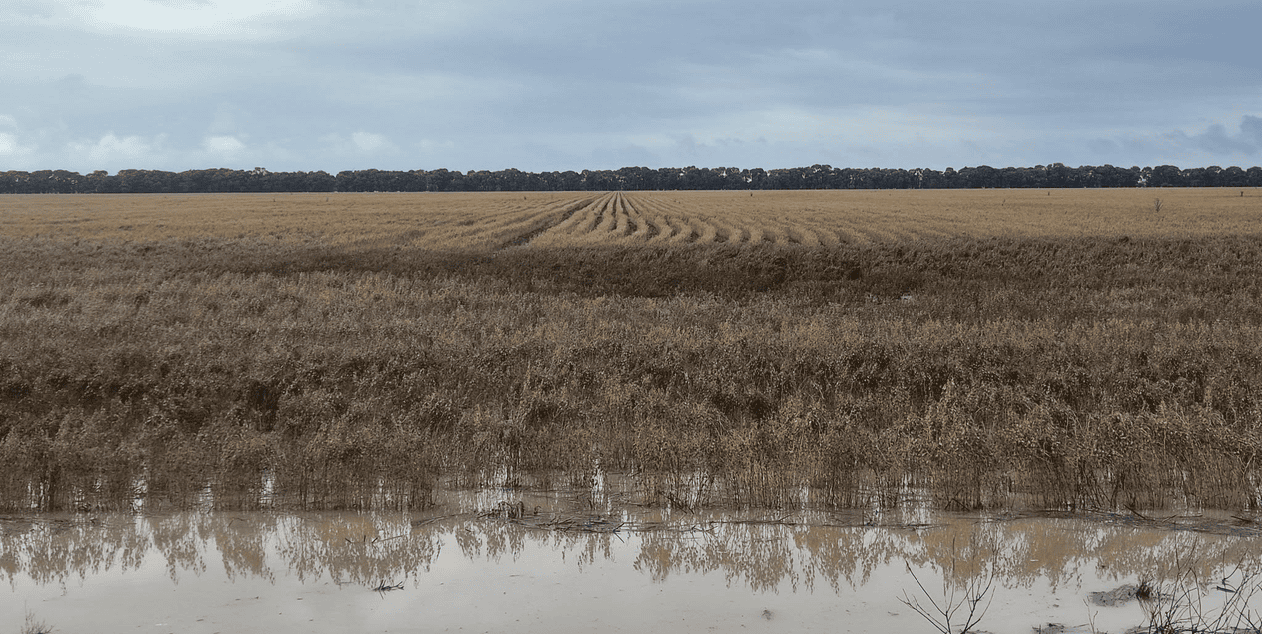
Chickpeas and cereals on the point of harvest on Qld’s Western Downs had 110mm of rain last week. Photo: Cook Farming
RAIN has put the brakes on the northern New South Wales and southern Queensland chickpea crop and downgrading can be expected.
However, the market is yet to kick, which indicates old-crop chickpeas are around to cover near-term export needs.
In Victoria and South Australia, the lentil crop needs no further rain ahead of a bumper harvest already being delivered to bulk-handling sites.
Lentil prices have firmed in the past month, despite growers in SA being willing sellers as the state’s harvest gathers pace.
Faba bean values have softened in the south in response to limited export interest and expected supply-side pressure.
All prices quoted are in Australian dollars per tonne unless stated otherwise.
Chickpeas
After peaking at more than $1000 per tonne delivered Brisbane in the past fortnight, the market has been doing most of its business around $980/t, up roughly $90/t from late September.
The rally indicates a tightening of new-crop availability balanced against export demand coming mostly from Pakistan, but also India and Bangladesh.
While several chickpea cargoes have been booked to load in Brisbane in coming weeks, trade sources say as few as two may be executed if downgrades caused by rain are widespread.
Most chickpea crops in northern NSW and southern Qld have had 100-200mm of rain, and more in places, in the past fortnight, and humidity, showers and storms are lifting the likelihood of mould and discolouration in unharvested seed.
“This rain won’t help quality or yield,” Pulse Australia agronomist Paul McIntosh said.
“We’re seeing mould on chickpea pods, and whether that goes through to grain is yet to be seen.”
Later chickpea crops on the slopes of northern NSW may benefit from the late rain, but for crops that have been desiccated ahead of harvest, downgrading seems unavoidable.
The market’s saviour is that the north and Central Qld chickpea harvest was close to finished ahead of the rain, and that some growers have old-crop stocks on hand.
Old-crop chickpeas are trading at around $25-$30/t below new-crop,
Woods Group trader Steve Foran outlined the extent of the rain for some crops on the Western Downs.
“Some crops had 130-140mm in one night, and over 200mm in the week,” Mr Foran said.
The rain has failed to put a rocket under prompt prices, indicating both modest export demand, and sufficient supply to cover demand from the container and bulk market.
“Considering the rain, the market’s been pretty flat.”
Bulk handlers are expected to open segregations for downgraded chickpeas once harvest resumes, which for most will be next week at the earliest, based on the current forecast and conditions.
Provided downgrading is not too severe, the market expects Pakistan will be in the market for rain-damaged chickpeas at a discounted price.
Sunrise Commodities managing director Scott Merson said with wheat and barley prices relatively low, chickpeas were going to be “the crop that saved Christmas”.
“I don’t think all’s lost…but there will certainly be some lower-spec chickpeas around.”
Mr Merson said growers and traders will be looking for a better handle on the profile of the southern Qld and northern NSW crop before sales are made.
“Exactly what options everyone’s got are not yet known.”
ABARES most recent estimate for Australia’s chickpea crop stands at 1.05 million tonnes (Mt), and a maximum 300,000t is thought to have been harvested, nearly all of it in CQ.
Faba beans
The northern faba bean crop growing in southern Qld and northern NSW is very small this year, and has copped a hammering from the recent rain.
Limited rain in April and May, its northern planting window, meant it was the first northern winter crop to germinate and, along with barley, was scheduled to be the first harvested.
Feedmills in Brisbane are paying close to $475/t for faba beans for prompt delivery, up around $10/t on last month.
In the south, the market for faba beans delivered southern ports has dropped $10-$15/t to around $380/t delivered Wimmera container packer, and $435/t into Melbourne.
The fall is believed to have come in response to the big southern Australian crop coming, and difficulty in accessing Egypt.
It is Australia’s and the world’s major market for faba beans, and ongoing activity by Houthi rebels in the Bab al-Mandeb Strait has made shipping to Damietta possible only via the Cape of Good Hope.
Lentils
Despite volume shipments heading from Canada to South Asia, prices for smaller Nipper-type lentils have firmed by around $50/t in the past month to $600/t delivered port, and $540/t delivered Wimmera packer.
Arya Pulses trader Michelle Penrose said SA and northern Mallee growers have been forward selling lentils, and harvest of Mallee lentils is expected to start from next week.
“Quite a bit has been booked out of SA,” Ms Penrose said.
“That comes with logistics issues, because they don’t get a lot of empty containers.”
Ms Penrose said empties are much more readily available out of Melbourne, which keeps the container path open as an alternative to bulk.
Larger Nugget-type lentils are trading at around $20/t over the smaller types, at least half their normal premium.
In Vic, patchy rain has fallen in the Mallee and Wimmera in the past week, and growers hope the tap turns off about now.
“One grower I spoke to said he had 11mm; I asked him how much he wanted and he said ‘2mm’.”
Registrations in the Mallee in the week to today include: Murrayville 34mm; Ouyen 5mm; Walpeup 13mm, and Woomelang 27mm.
In the Wimmera, registrations include: Dimboola 29mm; Horsham 22mm; Nhill 26mm, and Warracknabeal Airport 39mm.
SA growing areas have also had patchy rain, including 20-30mm over much of the Eyre and Yorke peninsulas where lentils are on track for bumper yields over a record area.
Grain Central: Get our free news straight to your inbox – Click here
HAVE YOUR SAY