
 Weather: Southern Russia is again sowing winter wheat into dry soils, while scattered showers in Ukraine are helping. Russia’s Agriculture Ministry has reduced its winter sowing plan for the 2027 harvest to 19 million ha, and winter sowing had reached 70% of the plan by mid-October. With 2 to 2.5 Mt of export weather risk building, establishment over the next fortnight matters for 2027 Black Sea supply.
In South America, Argentine wheat is carrying frost damage and cloud-related yield risk despite bumper crop estimates, and southern Brazil’s frequent rain is helping wheat fill but causing some flooding. For Brazilian soybeans, October rainfall frequency and coverage has been sparse in central Brazil, where producers rely on it to load soils after months of dry weather. Planting has run slightly behind last year, with 7.3 percent planted by early October against 9.0 percent a year earlier.
Northern hemisphere conditions are mostly benign. Recent rain in the US Central and Southern Plains and across Europe favours winter wheat establishment, while north India and Pakistan stay dry and warm ahead of rabi sowing. In Southeast Asia, El Niño-linked haze is a lagged palm oil risk. RHB noted prolonged haze traps heat at ground level and suppresses pollinating weevil activity, which can crimp fruit set, supporting the firmer palm tone.
Markets
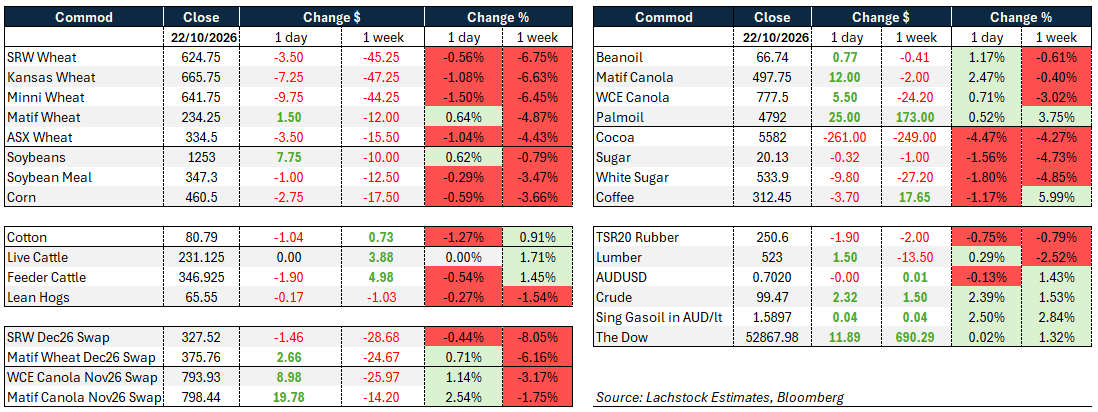
Wheat lost its Black Sea risk premium on peace-talk headlines. US futures fell 6.5-6.8% over the week and ASX fell 4.4%, while Matif held up better at -4.9% as the logical origin if buyers need cover quickly. Weak US sales and larger Argentine crops keep the near-term bias heavy, but positioning is stretched and conviction thin.
Demand is propping up the soy complex. Record-pace Chinese buying ended beans’ eight-day slide and offsets talk of larger US yields, although meal length and weak product exports cap the upside. Corn looks range-bound at 450-470 into the November WASDE, with Ukrainian availability and South American production now the key inputs.
Vegetable oils are trading off energy. Hormuz and Saudi attacks pushed crude higher and lifted Matif rapeseed 2.5% and palm 3.75% on the week. Strong Chinese buying of Australian canola is a firm underpin for local oilseed basis, even as ICE canola trades 3% lower on the week.
Macro has turned risk-off. Treasury haven buying, an AI equity rout and Brent above US$112 are raising stagflation concerns. A 0.70 AUD and the prospect of a fifth RBA hike are a headwind for Australian grain prices in local terms, while elevated diesel and fertiliser costs keep pressure on 2027 grower margins.
Day Ahead – Australia
A growing confidence in the peace talks are going to go, despite the continued attacks and some less that flattering rhetoric from the Ukrainians pointed towards the US.
80mm is pretty common across the downs over the last 24 hours.
Rain forecast through Vic will be well received – despite a bunch of hay on the ground.
Cant see a way through the Russia/Ukraine negotiations – at least not in a straight line.
Iran is getting worse, not better – at some point the derivative clean out comes to a close, but catching knives is a futile and painful exercise.
Wheat: US wheat could not find a bounce and touched a 14-week low as Russia and Ukraine signalled openness to US-mediated talks, possibly after 10 November.
Few believe the talks will be quick, with Russia firing 21 missiles at Kyiv overnight, Ukraine sending hundreds of drones towards Moscow and Zelensky publicly mocking Witkoff’s description of Putin as a “humanitarian”.
AgResource argued that if Russian and Ukrainian exports run at only 40-50% of normal, world exportable supply becomes exceptionally tight in coming months.
Matif outperformed, and the SRW Dec26 swap slipped 1.46 to A$327.52 (down 28.68 on the week) while the Matif Dec26 swap gained 2.66 to A$375.76 (down 24.67).
US weekly sales were a disappointing 239,600 t, down 25% and well short of 400,000 t ideas, with Mexico taking 98,000 t. By class, SRW was 110,000 t, SWW 51,000 t, HRS 39,800 t, HRW 27,400 t and durum 11,500 t.
US spreads firmed late on unconfirmed fresh export business.
In the Black Sea, IKAR sees Russian November exports near 3 Mt, with Baltic storms likely to disrupt shipping. Russia’s Grain Association wants Baltic terminals to handle 1.5-2 Mt a month to divert flows from the Azov-Black Sea basin.
Ukraine finished harvest at 25.5 Mt, almost 3 Mt above last year, although SovEcon has cut its 2026/27 Ukraine export forecast by 13%.
Argentina continues to build supply. Rosario lifted its crop to 23.8 Mt from 21 Mt and Buenos Aires holds 23.4 Mt, even as the exchange warns cloud cover and recent frosts are a yield risk.
Rouen loaded 170,618 t, including 60,200 t of soft wheat to Morocco, and South Korea tendered for up to 65,000 t of feed whea.
Other grains and oilseeds: Soybeans ended an eight-session losing streak on strong demand. Weekly sales jumped to 2.84 Mt, ahead of 2.4 Mt expectations, and USDA announced a further 202,000 t flash sale to China.
StoneX’s Mike Castle noted the 104.4 million bushels sold was the largest weekly figure since November 2023, and cumulative 2026/27 sales are the strongest since 2022.
Beans still need around 436,000 t a week to meet the USDA pace. Products were softer underneath, with meal sales of 242,000 t against 450,000 t expected and soyoil exports of just 900 t.
Soyoil still recovered all of Wednesday’s losses on energy strength. Abiove sees Brazil crushing a record 66 Mt in 2027, up 3.8%.
Corn could not hold Wednesday’s gains. Sales of 1.53 Mt were up 36% and beat 1.1 Mt expectations, but the USDA projection needs 1.35 Mt a week. Mexico and Japan led buying, and the UK took 141,800 t.
Naomi Blohm called the market extremely oversold, with short covering possible as US harvest nears the halfway mark.
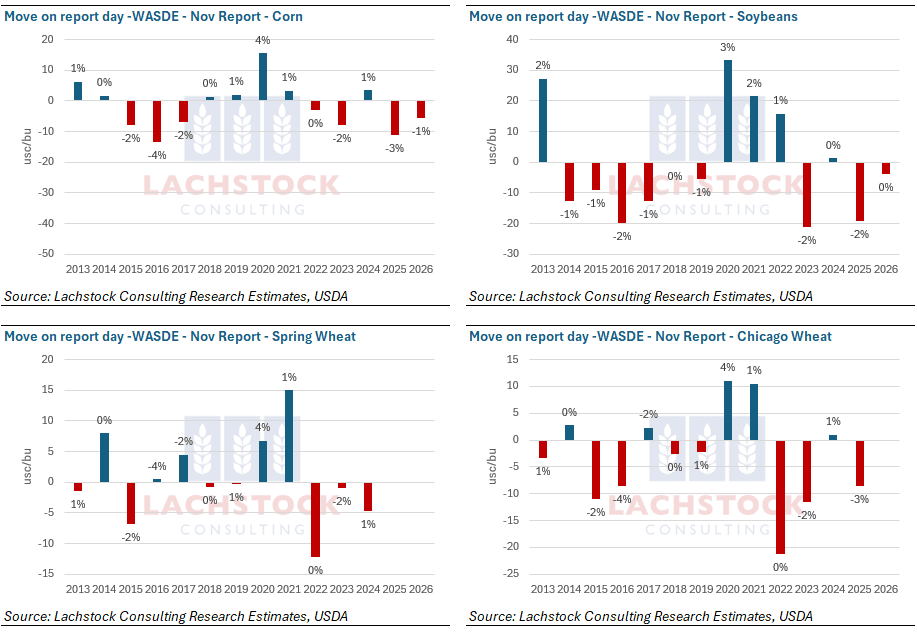
Overnight commentary sees CZ range-bound at 450-470 into the November WASDE, with Ukrainian corn availability and European demand the swing factors.
Stag International expects Brazilian maize shipments to Europe to reach 1.65 Mt in October, up from about 200,000 t a year ago.
Canola turned higher with crude after tanker attacks in the Strait of Hormuz, and soyoil, rapeseed and palm all firmed.
The WCE Nov26 swap rose 8.98 to A$793.93 (down 25.97 on the week) and the Matif Nov26 canola swap rose 19.78 to A$798.44 (down 14.20).
Saskatchewan’s canola harvest advanced seven points to 96% complete.
Wide market speculation that Chinese crushers have bought around 1 Mt of Australian canola in recent deals, helped by warmer bilateral ties, lower tariffs and better margins.
MPOC expects palm to hold above RM4,600/t next month on seasonal output declines and steady biodiesel demand. South Korea bought about 60,000 t of soymeal of optional origin.
Macro: Treasuries had their best day in more than a year, with yields down as much as 20 bp and the 10-year back below 5% for the first time in a month.
Three things drove the rally: a deepening AI equity rout, with the Philadelphia Semiconductor Index down as much as 7.3%, cost-of-living unrest and debt concerns in France, and renewed Middle East escalation.
Brent topped US$112 after deadly attacks in Saudi Arabia, Aramco told staff to evacuate its Dhahran headquarters, and the US ordered some diplomats out of the kingdom over the Houthi threat.
Markets increasingly see the oil shock as a growth drag as well as an inflation risk, and a fully priced Fed hike has moved from December to January.
In Australia, Treasurer Chalmers flagged growth below the 1.75% budget forecast and slightly higher unemployment as rate hikes and inflation bite.
The RBA has lifted the cash rate 100 bp to 4.6% this year and meets in less than two weeks on a possible fifth hike. Chalmers pointed to business investment above 5% and A$278bn of approved foreign investment as offsets.
MIAX launched physically delivered fertiliser futures after extreme price swings since the US-Israeli war with Iran.
USDA confirmed the first New World screwworm detection in US wildlife, an elk in Texas.
Local: Another down day yesterday in the west, with canola back $8 to $837, wheat at $375 and barley $321 FIS Albany.
In the east, canola was back to $770, wheat $336 and barley $278 track Geelong.
East–west barley spreads remain wide at close to $50 track versus FIS, compared with a more “normal” spread of around $25—suggesting one is either too cheap or the other too expensive….
Old crop barley remains a slog in the south, with next to no demand as growers try to clear inventory to make room for new crop.
More photos of sprouted grain are emerging from northern NSW and southern Queensland, where some areas have recorded up to 200mm over the past 10 days. This should keep BAR1 and SFW1 supported through the Downs in the short term. Sorghum bids, meanwhile, have fallen nearly $35 over the same period to around $350 for March/April delivery.
HAVE YOUR SAY