
 Weather: Europe: Dry soils are increasingly affecting winter rapeseed establishment, and the forecast for dry weather in central and south-eastern Europe may further constrain winter-crop establishment. This comes on top of the summer drought already squeezing EU corn supply, with Morocco also reported to be turning dry.
Black Sea: Southern Russia, which grows a large share of the country’s winter grain, faces low soil moisture at sowing for the second consecutive year. Combined with war disruption in Ukraine, this keeps 2027 Black Sea area and establishment a live risk.
South America: Global climate models agree this year’s El Niño, expected to peak in November or December, will be the strongest on record since at least 1950. Southern Brazil is waterlogged and the northern rim too dry, with rainfall frequency and coverage in central Brazil sparse so far in October. In Argentina, 90 percent of wheat has good water availability, but persistent rain, low temperatures and limited sunlight are slowing fieldwork and raising disease risk.
Harvest disruption: Rain or snow forecast across parts of the Prairies on Tuesday threatens to delay the last of the Canadian canola combining. In Australia, patchy rain has slowed harvest in parts of the north while consolidating yield prospects in the south, and rainfall was forecast across much of the eastern two-thirds of the country for 15-22 October.
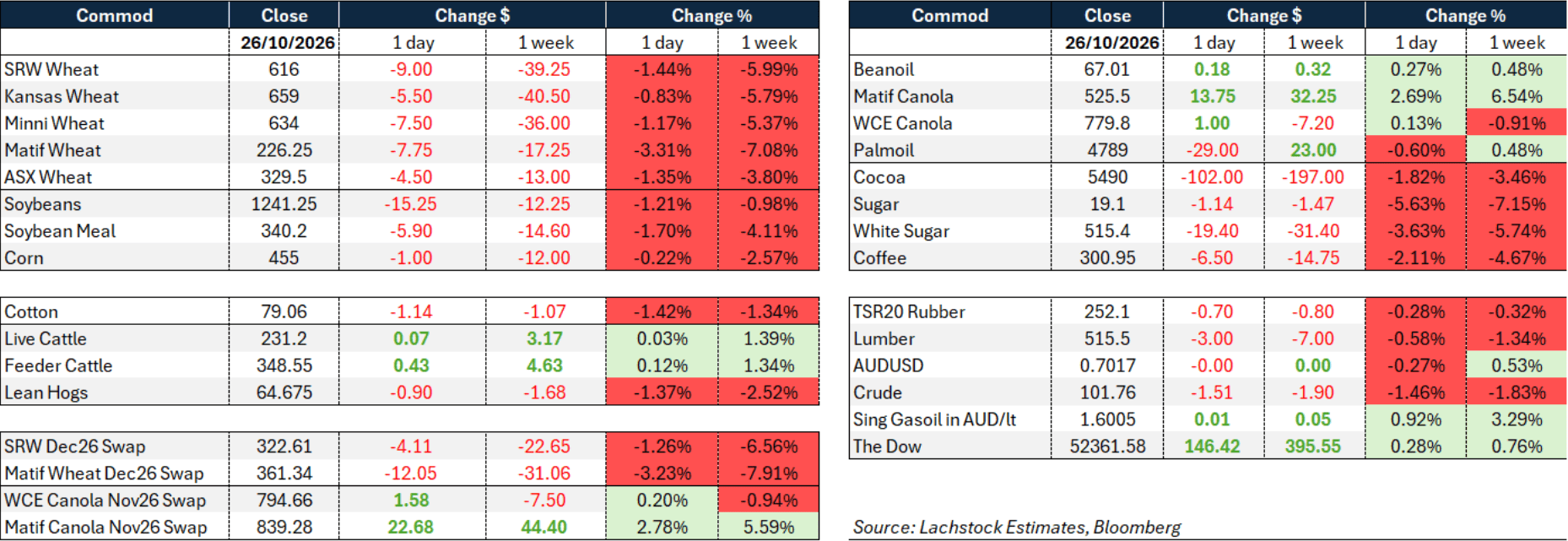
Markets: The roughly 9pc collapse in the Brazilian real was the dominant driver. Soybeans fell 1.21pc, meal 1.70pc, sugar 5.63pc and coffee 2.11pc, as a weaker currency improves Brazil’s export competitiveness and rations non-China demand away from US origin.
Wheat liquidation deepened, with MATIF down 3.31pc on the day and 7.08pc on the week. That flowed into Australian values, with the MATIF Dec26 swap down A$31.06/t and ASX down $13 for the week, even though Russia flatly dismissed any revival of the corridor.
MATIF canola diverged sharply, up 6.54pc on the week to 525.5 and lifting the Nov26 swap A$44.40/t to $839.28, on EU rapeseed establishment problems. WCE lagged under Prairie harvest pressure, which widened the spread in favour of European-priced canola.
Energy remains a two-way risk. Crude eased 1.46pc on reduced pre-election strike odds, but Houthi attacks on Saudi infrastructure and record Hormuz shipping incidents keep the risk of a supply shock high after 3 November. Singapore gasoil is up 3.29pc on the week in AUD terms, adding to harvest input costs for Australian growers.
Day ahead – Australia: Canola’s mini resurgence looks set to continue, with dry conditions affecting rapeseed establishment in Europe, elevated crude oil prices and support across vegetable oil markets. Local harvest pressure is likely to push prices lower in the near term, but the broader market should remain supported once we move through harvest. Wheat continues to decline, with the Black Sea region weighing on the market. Barley remains unloved, although that is nothing new.
Wheat: Wheat started the week where it left off. MATIF led the decline as an overextended long book liquidated on renewed press talk of a Black Sea grain corridor, while US contracts were caught in the broader ag selloff triggered by the collapse in the Brazilian real. The corridor narrative does not hold up. Russian Deputy Foreign Minister Alexander Alimov told Interfax that Moscow currently sees no prospect of reviving the grain initiative, and Russia separately said resumed Ukraine negotiations place no limits on military operations. That was reinforced over the weekend when Russian drones struck cargo vessels bound for Chornomorsk and Odesa.
Ukraine’s grain exports since 1 July total 6.2 million tonnes (Mt), down 32pc year on year, with wheat at 3.54Mt, down 43pc, and Kernel reported its quarterly exports down 54pc to 574,000t.
Russia is rerouting volume through the Baltic, with ProZerno counting 431,700t shipped via Latvia since July. SovEcon puts October wheat exports at 2.8Mt, up from 2.1Mt in August, but says Black Sea constraints still leave Russia 2-3Mt a month short of normal. SovEcon also noted rouble wheat prices rose for a second week as farmer selling slowed.
In the US, HRW spreads held firm on talk of late-week export business, but nothing further was heard on Chinese SRW interest. Inspections were 183,800t, leaving the season down 32pc y/y, and winter wheat planting reached 76pc against 75pc expected and a 77pc average.
The MATIF Dec26 swap fell $12.05 to A$361.34/t and is down $31.06 for the week, while the SRW Dec26 swap lost $4.11 to A$322.61/t, down $22.65 on the week.
Egypt reported 52pc wheat self-sufficiency and lifted its 2026-27 local purchase price to EGP 2650 per ardab. US broker commentary argues the market is not egregiously priced and selling will eventually exhaust, with dryness in Morocco and the EU and Black Sea acreage the weather risks to watch.
Corn and oilseeds: Soybeans took the most damage after Lula’s surprise fourth-term win sent the real down around 9%, which cheapens Brazilian export offers. Losses could have been worse, as many Brazilian growers preferred to hold a USD-denominated asset rather than sell into a falling currency.
Arlan Suderman of StoneX argued Chinese buying is politically driven and unaffected by the currency, but said the move helps ration non-China demand away from the US. Inspections were strong at 2.48mt, up from 2.07mt the previous week and up 113pc y/y. US harvest reached 79pc against 77pc expected.
The USDA attaché in Brasilia put Brazil’s 2026-27 crop at 184Mt, below the official 186Mt, and AgRural had planting 40pc complete as of 22 October. El Niño and inflation remain the main reasons managed money is holding its longs.
Corn held up much better: December traded down to 450.25 early before end users stepped in to close only 1c lower. Inspections fell to 625,000t, now down 49,700 y/y. Harvest reached 60% against 59% expected and a 66% average. Cory Bratland of AgMarket.net said funds are unwilling to defend record net longs while the crop still looks big enough to cover demand. Unlike wheat, corn buyers have few alternatives without Ukrainian supply, and the EU is especially exposed after its summer drought.
MATIF canola was the standout, gaining 13.75 to 525.5 as the EU MARS unit flagged persistently low soil moisture hampering rapeseed establishment. The Nov26 swap rose 22.68 to A$839.28/t, up 44.40 for the week.
ICE canola recovered from early losses as crude cut its decline, though Prairie harvest pressure and the weaker real capped gains. Alberta’s harvest reached 86pc as of 20 October, StatsCan put September deliveries at 2.75mt against 1.92mt a year ago, and analysts see March holding above C$800 as the key level. The WCE Nov26 swap rose 1.58 to A$794.66/t.
Palm eased with Dalian olein and crude while the market awaits confirmation of Malaysia’s export duty waiver, although Intertek had 1-25 October exports up 46.89% m/m. Turkey’s TMO is tendering for 18kt of sunflower oil, closing next Monday.
Macro: Brazilian assets were routed after Lula’s record fourth term, which defied polls and halted a run of right-wing wins across Latin America. Bolsonaro has launched a longshot bid to annul the result, and the farm lobby that backed him now stays in opposition.
In the Middle East, Trump has repeatedly hinted at resuming strikes on Iran after the 3 November midterms and has sent a third carrier strike group and 10,000 additional personnel to the Gulf. The Houthis attacked Saudi Arabia’s East-West pumping stations and Riyadh airport, and October has been the worst month on record for shipping attacks around Hormuz. Bloomberg puts Brent above $115 and up more than 90% this year. Crude still eased on the day as reports that Trump ruled out a pre-election strike lifted equities.
Israel votes Tuesday, and security officials from Saudi Arabia, Pakistan and Turkey met Iranian leaders in Tehran to try to head off another round of strikes.
On trade, Carney described a slight intensification in US talks but held to his red lines, with 50% US tariffs on about US$20bn of Canadian goods in place since 21 August.
Trump lifted 50% tariffs on some Canadian ag and forestry products to benefit Maine. The administration’s $8bn farmer diesel aid will be paid after the election, and from December the CFTC COT will be published twice weekly.
Local: The week started on a stronger note for canola in the west, with bids back up to $845. Wheat was steady at $374 and barley was $322 FIS Albany. In the east, canola was up $10 to $782, with GM trading at a $30 discount. Wheat was $343 and barley $288 track Geelong. Delivered markets in the south continue to weaken, with ASW wheat around $350 Geelong, $320 Bendigo and $320 Murray Bridge for Jan+ delivery. Hanwood remains more resilient, bid around $344, as early harvest results reveal a large proportion of high-protein wheat with high screenings. Another front could move through SA and Victoria this weekend or early next week. Following around 50mm across large parts of northern Victoria and SA, and a cool week ahead, another decent fall could raise quality concerns. The silver lining is that many growers could head into next season with a near-full soil moisture profile.
HAVE YOUR SAY