
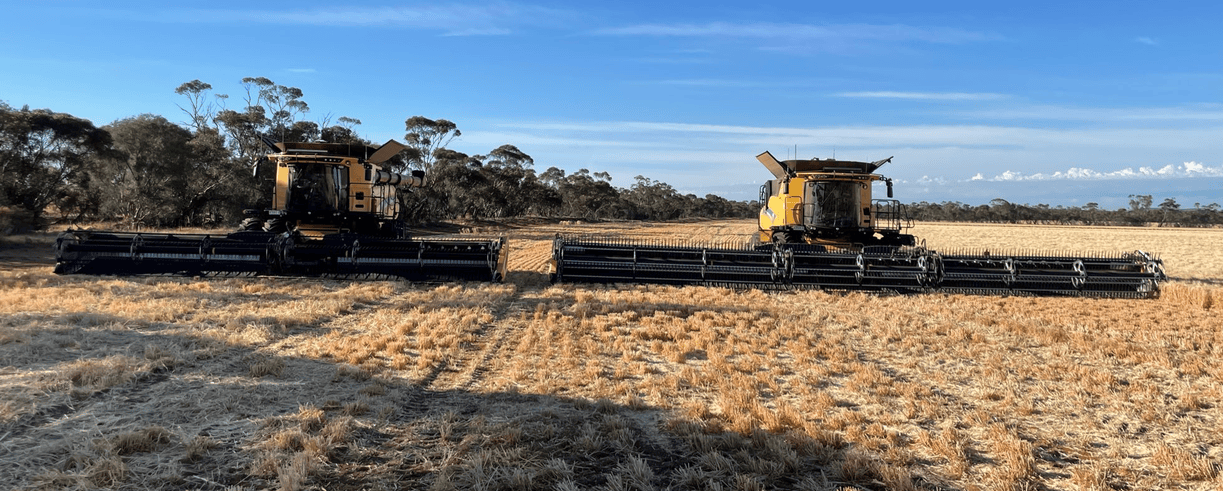
Harvesting barley in the western Riverina of NSW this week. Photo: @GribbleRC
A DRY FINISH in south-western New South Wales and a sodden one in the state’s north, and in southern Queensland, are pushing lightweight barley into the feed market as a blending option for growers and consumers.
On wheat, a low-protein harvest is expected, as evidenced by the already sizeable spread between ASW and APW.
Cheap southern NSW barley continues to funnel north by road to supplement what headers in southern Qld and northern NSW are regaining access to as paddocks become accessible after a wet fortnight for many.
| Oct 22 for prompt | Today for prompt | Oct 22 for Jan | Today for Jan | |
| Downs barley | $405 | $400 | $415 | $400 |
| Downs SFW | $435 | $425 | $435 | $428 |
| Downs sorghum | $380 | 375 | $380 | $358 Mar-Apr |
| Mel barley | $300 | $310 | $309 | $310 |
| Mel ASW | $380 | $380 | $353 | $350 |
Table 1: Indicative prices in Australian dollars per tonne.
North drying out
Growers in southern Queensland and northern New South Wales are resuming harvest with mixed success this week after more patchy rain.
Higher registrations in Qld in the week to 9am today include Dalby 39mm, Jondaryan 46mm, and Mitchell 48mm, while in NSW, total include Coonamble 23mm, Moree 37mm, Mungindi 62mm, and Wee Waa 36mm.
Amid the showers and the bogging, loads are starting to make their way to consumers, and new business is being written at values down on last week.
The sorghum market has taken the biggest tumble in response to the rain which has assured a big plant of the summer grain, and created an inverse for new-crop.
“There’s prompt demand for sorghum, with a bit still going into container packing,” one trader said.
Demand for new-crop is coming from domestic consumers, who are jumping on current offers, although their interest is not expected to prevail for this relatively small market.
Rain has closed some public roads in southern Qld and northern NSW, and many farm roads.
“It’ll be next week before we see better road access, and freight gets going again.”
Harvest for many northern NSW growers, including Tighe Ag at Croppa Creek, has been slow to resume after rain, and getting bogged has been a feature of the past week.
For growers that have them, chickpeas are the hot sell, with the old-crop discount to new-crop evaporating now that traders are short for prompt bulk and boxed exports.
That means quality chickpeas from this or last harvest are fetching more than $1000/t delivered Brisbane, and growers who can truck out are meeting the market.
On cereals,grain quality indications post rain say wheat has held up better than barley.
Very little wheat in southern Qld and northern NSW had been harvested ahead of the rain, and Goondiwindi-based Knight Commodities broker Gerard Doherty said wheat that copped a dousing should find a home in the feed market.
“Wheat’s held up pretty well; most of it will still make SFW,” Mr Doherty said.
“It handled the weather better than barley because it had more weight to start with.”
With pre-rain testweights of more than 80kg per hectolitre, most wheat is expected to at least make SFW with its 62kg minimum.
Mr Doherty said “quite a bit of shot and sprung” wheat was expected.
Qld flour mills are believed to have covered their new-crop requirements out of Central Qld and the Maranoa, which by comparison had a good-quality, if small, wheat harvest ahead of the rain.
“There’ll be next to no milling-grade new-crop now.”
Trade sources have said feedlots and other consumers are in discussions with their nutritionists about how to maximise discounted grain without compromising conversion rates in cattle, pigs, and poultry.
Without blending, unharvested barley in Qld and northern NSW will be difficult to utilise because of its low weight.
BAR2 has a minimum testweight of 60kg, and some barley in “BAR3 territory” of 55-57kg is hitting the bins after the rain.
“Barley’s copped it the worst,” Mr Doherty said of the rain’s impact.
BAR1 has a minimum testweight of 62.5kg, and early indications are that any crops that got 100mm or more recently, as many of them did, will not make the cut.
“Most of the stuff standing in Queensland is either 2 or 3.”
Mr Doherty said consumers and growers “will be looking at every opportunity they can” to blend up with BAR1.
“Consumers will keep an eye on BAR2 and 3 spreads, and a few feedlots will hop into that.”
In the north, spreads between BAR1 and BAR2 and BAR2 and BAR3 are both around $25/t.
Hopes for better weights from south
Harvest in south-western NSW has finished already for some growers, and low testweights have shown the impact of limited rain in the filling period.
It means the BAR1-BAR2-BAR3 spreads in south-western NSW at close to $50/t per hop are roughly double those of the north, where domestic demand is buoyant.
With limited new-crop volume to sell, the northern grower is inclined to hold unless the market rallies.
The southern grower, with fingers crossed for high yields and sound testweights, looks like having a contrasting strategy.
“The markets up here will be moved by what happens down south.
“The northern growers will try and hold this market up, and it’s up to the southern guys to not sell it down.”
While BAR1 ex farm is around $400/t on the Western Downs, it is closer to $300/t ex farm Nyngan, and downgraded barley is said to have sunk to as low as $200/t in south-western NSW.
Loads of low-spec southern barley, plus $130-$150/t road freight, are trading into southern Qld for blending with northern BAR1 harvested ahead of the rain.
“I’m hearing $200/t on farm, and $130-$150/t to bring it up here,” a trader said.
Provided the south does not get significant rain on its ripening barley, testweights are expected to improve markedly once harvest starts next month on the south-west and southern slopes of NSW, and in the Vic Mallee.
On the export front, some solid demand is being seen for BAR1 for containers at around $310/t delivered port.
On wheat, ASW in the southern market is trading at around $25/t below APW.
Wilken Group trader Andrew Kelso said protein spreads for wheat have widened.
“Everyone’s thinking there’ll be plenty of ASW and not so much protein wheat around,” Mr Wilken said.
HAVE YOUR SAY