
 Weather: Eastern Australia: Rainfall was forecast across much of the eastern two-thirds of the country over 22–29 October, with 15–50mm for Victoria, South Australia and central and southern NSW. After last week’s rain in the north-east, those falls are expected to further delay harvest there and raise the risk of quality downgrades. WA cropping regions were forecast to pick up 5–10mm.
Brazil: Rain is shifting back into central Brazil and out of the south, which should help soybean planting and early establishment. Mato Grosso is over 75 percent planted against a five-year average of 64pc, per IMEA. In the south, growers are fitting planting between showers but are worried about disease and weed pressure after the heavy rain.
Argentina: Bage reported 90pc of wheat with good water availability and 58pc at heading or later. However, persistent rain, cold temperatures and limited sunshine are slowing fieldwork and lifting disease risk.
Markets
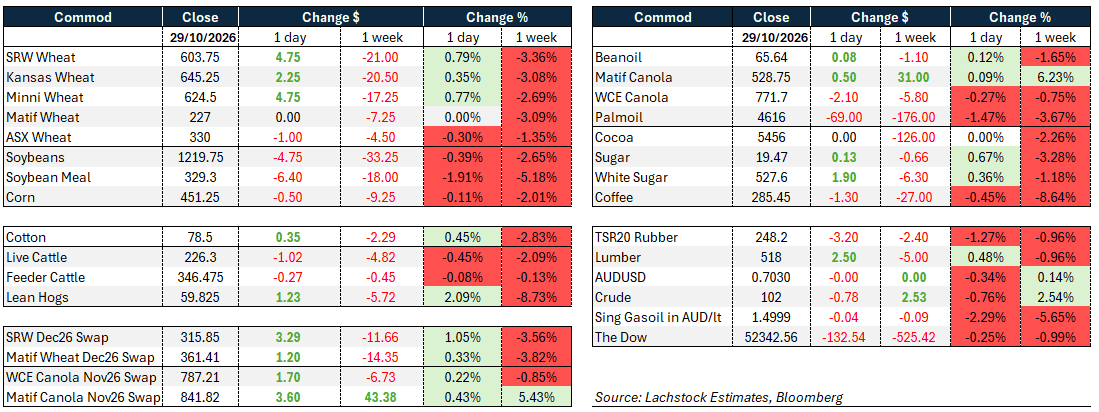
Wheat bounced off the US$6/bu mark after an 849.8kt export sales beat and Bloomberg’s China SRW headline. The complex is still about 3pc lower on the week, and ASX held up better, down $4.50 against a $14 fall in the Matif swap.
The Matif–WCE canola spread blew out. In AUD swap terms Matif Nov26 sits about $55/t over WCE, roughly $50 wider on the week, as Europe firmed and Canadian funds liquidated.
The soy complex was soft into FND, with meal leading lower (down 5.2pc on the week) and the managed money long still unwinding. – Macro turned hawkish. Strong US GDP and PCE point to more Fed tightening and the ECB is eyeing a December hike, while AUD was flat on the week at 0.7030.
Day Ahead – Australia
Dead cat bounce or signs enough is enough. The break in futures has been relentless. Through the 2 months the market has been coming off, I would argue there has been very little change to fundamentals. However, the market is the market.
US demand is the canary in the coal mine to some extent, but we need to see more to get excited. A China SRW purchase would certainly move the needle.
Supply is largely known, demand is the key and i just cant see Vlad and Zelenskyy kissing and making up.
Wheat: Wheat finally found some demand overnight. December SRW pushed back above $6 after looking set to probe Wednesday’s lows early in the session.
USDA weekly export sales of 849,800t were a marketing-year high, well above the roughly 350kt the trade expected. The business was mostly soft white and hard red spring to Asia, with Indonesia taking 50kt of hard red winter.
The real turn came from a Bloomberg report that China was seeking US SRW offers. The rumour had done the rounds last week, but it took a wire headline to move a market dominated by systematic flow.
Even so, wheat looks set to post a ninth straight lower weekly close tonight.
Marex cautioned that any bounce is more likely a correction than a new uptrend, with discretionary traders still inclined to sell rallies.
On the Black Sea, Kremlin aide Yuri Ushakov tied the timing of the next three-way talks to the Middle East conflict, casting doubt on a November meeting. A Russian drone strike on Dnipro’s main railway station killed 13.
SovEcon said Russian winter grain plantings reached 14.9 million hectares as of 23 October, only 1pc behind last year after a 10pc lag a fortnight earlier, though it expects final area to come in slightly lower. It also flagged that weak farm economics could cut input use and leave the 2027 crop more exposed to weather.
Rouen loadings eased to 128kt from 170kt, mostly to Morocco, Mauritania and Cameroon.
Egypt and Russia also held talks in Moscow on grain supply and storage.
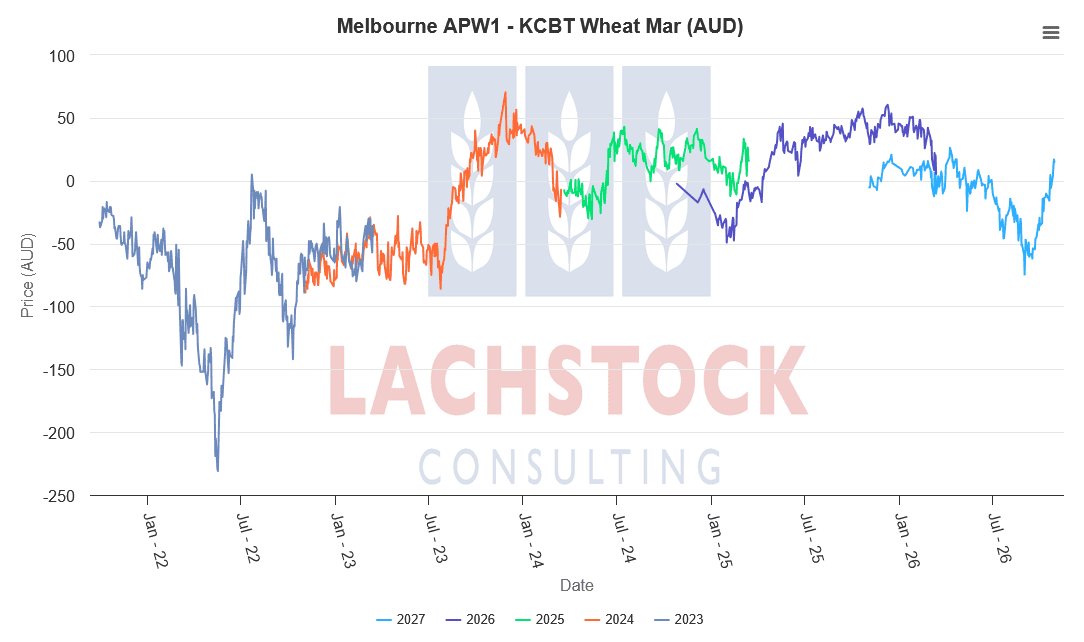
Locally, ASX was a dollar softer at A$330/t, about $31 under the Matif Dec26 swap and $14 over SRW. ASX has fallen only $4.50 over the week, a much smaller decline than Matif, and harvest rain in the east is now the key quality watch.
Corn and oilseeds: Corn remains stuck around 450 in December. Sales of 1.3 million tonnes (Mt) were in line and on track with the USDA export pace.
Near-term direction hinges on Ukrainian corn availability, and so on whether trilateral talks actually happen.
South Korea’s NOFI is tendering for up to 138kt of feed corn.
Argentine corn planting is running ahead of pace, and Brazil’s soybean progress could open the door to more safrinha corn acres.
Soybeans fell for a fourth session as longs exited or rolled ahead of November first notice day.
Sales of 2.58Mt were at the top of expectations, and China is still expected to take another 8Mt US beans by year end.
Meal saw more liquidation, and Friday’s COT should show how much of the managed money length has gone.
Deliveries are due tonight. In canola, ICE extended its losses as speculative funds kept trimming longs with no fresh bullish news.
January settled at 783.10, still below its key moving averages, and a firmer loonie at 71.50 US cents added to the pressure.
European rapeseed edged higher again and is up 6.2pc on the week.
In swap terms Matif Nov26 now sits about $55/t over WCE, a spread that has widened roughly $50 in five sessions.
Malaysian palm oil fell for a fourth straight session on rising October stocks. Malaysia’s finance ministry is weighing a temporary suspension of crude palm oil export taxes to work through record inventories, which would be a bearish risk for the wider vegetable oil complex.
Macro: The ECB held rates and stuck to its data-dependent line, but Lagarde kept a hawkish tone and confirmed a hike was discussed. A 25bp move to 2.75pc is expected in December. Lagarde will step down in February, with Pablo Hernández de Cos and Klaas Knot seen as frontrunners. In the US, Q3 GDP grew 3.4pc annualised on consumption up 3.8pc and a surge in AI-linked equipment investment.
September core PCE rose 0.3oc, with core goods posting their biggest gain since February.
Initial jobless claims are at their lowest four-week average since 1969.
With the Fed on hold this week, the data build the case for more tightening, though Chair Warsh suggested he wants more than one data point between moves.
A firmer US dollar is a headwind for US export competitiveness just as wheat demand reappears.
Ahead of the midterms, cost of living, high fuel and fertiliser prices and tariffs are weighing on Republican candidates in farm states.
ETG plans a US$2 billion fertiliser plant in Mozambique as Iran-war disruptions push prices higher.
Trade frictions remain, with limited progress in Canada–US tariff talks, Mexico criticising US duties on its farm exports, and China vowing countermeasures after Washington added Chinese firms to its Uyghur forced-labour list. CFTC COT and USDA Agricultural Prices are out tonight.
Monday brings export inspections, the grain and oilseed crush reports and Crop Progress.
Local: Bids were mixed in the west, with canola steady at A$840/t, wheat back $4 to $369 and barley at $319 FIS Albany.
In the east, canola was bid at $780, wheat at $333 and barley at $285 track Geelong.
Victorian annual bulk exports have previously peaked around 8Mt. Capacity has arguably expanded since then, potentially allowing closer to 9Mt, but combined wheat, barley, canola and lentil production is expected to reach around 13Mt. That leaves roughly 4Mt to find a home through domestic consumption, containers or carryout. A sizeable carry into next season looks likely, with a similar story in SA.
The next eight days look unfavourable for harvest across SA, Victoria and NSW, with 25–50mm forecast through most cropping regions. Further delays look likely, and quality concerns will build if the wet weather persists.
HAVE YOUR SAY