
 Weather: NOAA maintains an El Niño Advisory, with a strong to very strong event likely through January to March 2027 at better than 83% odds, and BoM says every model it surveys has the warming peaking around November or December, which keeps the risk to Brazilian soybean rainfall and next year’s Southeast Asian palm output firmly in play.
Brazil remains split, with a fairly dry season in central Brazil contrasting with very wet conditions in the south, though rain shifting back into central Brazil and out of the south over the next week should help planting and early crop establishment, while in Argentina persistent rain, cold temperatures and limited sunshine are slowing fieldwork and lifting disease risk for the wheat crop.
In Australia, the next eight days look unfavourable for harvest across South Australia, Victoria and New South Wales, with 25-50mm forecast through most cropping regions, adding to damage in the north-east where barley and wheat still standing face sprouting, mould and grain on the ground, while harvest continues to ramp up in the west.
In the Black Sea, southern Russia is again sowing winter wheat into dry soils while scattered showers are helping Ukraine, and Russia’s Agriculture Ministry has cut its winter sowing plan for the 2027 harvest to 19 million ha, whereas in Western Europe a run of large late-October storms is expected to improve establishment before dormancy and in the US Midwest weekend rain is set to slow the final stretch of the corn and soybean harvest.
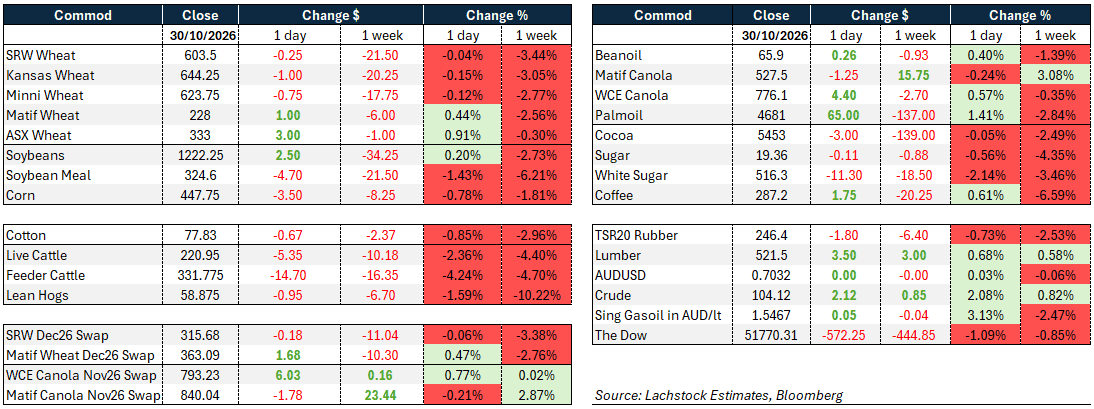
Markets: Wheat posted a ninth consecutive weekly loss, with SRW down 3.44 percent and MATIF down 2.56pc on the week, but managed money is now short every US class (Chicago 75,000), so an unconfirmed China SRW inquiry and any stalling of the Istanbul ceasefire push leave the market primed for short covering, while ASX, down just 0.3pc on the week, is being supported by eastern harvest delays and quality risk.
Corn closed October down roughly 10pc, its worst month since June 2023, as Brazil undercuts US export offers and funds exit, while soybean meal fell 6.21pc on the week on continued long liquidation and Dec crush hit its lowest since February, leaving Brazilian weather through November and December as the key test of whether beans can hold $12.30.
Crude at US$104.12 per barrel is up 2.08pc, and Iran strike risk has underpinned vegetable oils and canola, with MATIF canola Nov26 swap gaining 2.87pc on the week to $840.04/t against a flat WCE Nov26 swap at $793.23, keeping European parity the better reference for Australian canola into harvest, while record Malaysian palm stocks are capping the upside.
Risk appetite is deteriorating ahead of Tuesday’s midterms, with the Dow down 1.09pc, the Nasdaq down 2.9pc and gold off 3.9pc, and the combination of possible post-election strikes on Iran, December rate-hike expectations and a near-final US-Canada trade deal points to elevated volatility across energy, freight and oilseed markets this week, with AUD steady at 0.7032c.
Day ahead – Australia: El Niño keeps giving. Rain continues to plague harvest in many areas. WA looks like it will get a crack and, in many areas, yields are good, if not outperforming.
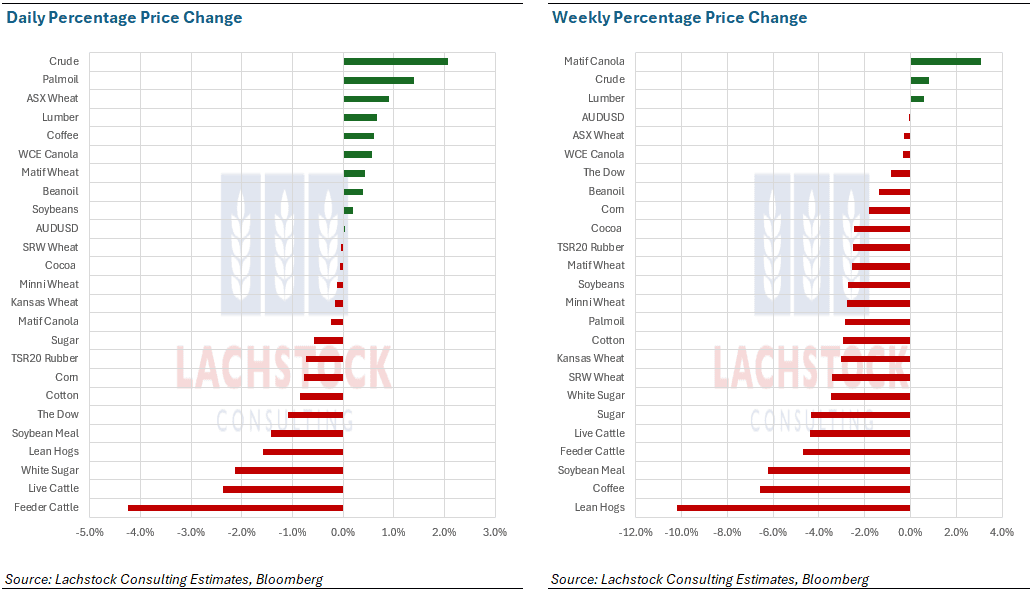
Wheat: US wheat faded into month end after an early bid, settling WZ at $6.03 1/4 and stretching the losing run to nine straight weeks.
A Bloomberg report of China inquiring for SRW was enough to hold Chicago just above $6, though no purchase has been confirmed and the market only reacted once the story hit the wire days after it first circulated, a clear sign of systematic flow dominating price.
Escalation headlines kept coming, including Ukraine seeking an emergency UN Security Council meeting, continued refinery strikes and a possible US$2.1b Patriot sale, but Black Sea ports are moving enough grain to keep importers hand to mouth, and Southern Hemisphere supply is adding to buyer confidence.
Over the weekend, Zelensky said he is ready to meet Putin and Trump in Istanbul with an unconditional ceasefire top of the agenda, while ruling out any recognition of Russian claims to eastern Ukraine or Crimea.
The SRW Dec26 swap closed at $315.68, down 3.38pc on the week, and the MATIF Dec26 swap at $363.09, down 2.76pc, while ASX held up far better as harvest rain in the east is now the key quality watch.
Corn and oilseeds: CZ settled at its lowest level for the move, closing out a roughly 10pc monthly loss, the largest since June 2023. Brazil is undercutting US offers on a weaker real and expectations of larger safrinha area, Argentine planting is ahead of schedule and funds are exiting aggressively.
Ukrainian exports remain the swing factor, with USDA holding its 22-million-tonne projection unchanged for two WASDEs, so the peace process may matter more for corn than wheat.
Midwest rain this weekend is expected to slow the tail end of harvest, and with prices this low farmer selling is thin.
AgResource argues it is hard to be bearish corn under $4.50, wheat under $6 or beans under $12.30 unless favourable Brazilian weather is confirmed through November and December.
Soybeans edged higher as post-FND liquidation eased, with two flash sales of 165,150t and 132,000t to unknown destinations; China bought heavily from Brazil this week but still needs an estimated 7500-8000t of US beans.
Meal continues to liquidate from an overly long fund position, and Dec crush is at its lowest since February.
ICE canola snapped its slide on spillover from crude, soyoil, palm and rapeseed, with January up C$4.90 to $788; weekly deliveries were 445,900t, taking the year to date to 5.43Mt, up 1.32Mt, and cumulative exports reached 1.89Mt against 1.23Mt a year ago.
The WCE Nov26 swap rose 0.77pc to $793.23, while the MATIF canola Nov26 swap at $840.04 gained 2.87pc on the week, keeping European values well clear of Canadian parity.
Palm is on track for its biggest weekly fall since late September on expectations of another record Malaysian stockpile, though a possible temporary Malaysian crude palm oil duty waiver, now with the Finance Ministry, and Indonesia’s cut to its November reference price to US$978.90 are drawing in Indian buyers.
Trump said a US-Canada trade deal is very close after talks with Carney, pitching it as good for US farmers.
Local: The week ended firmer in the west, with canola up $3 to $847, wheat at $371 and barley at $321 FIS Albany. In the east, canola improved to $786 on Friday, while wheat was $340 and barley $288 track Geelong. Harvest is drawing closer in Victoria, with canola deliveries across northern areas likely to begin in earnest later this week. Parts of SA had another cool, damp weekend, although it is too early to assess any quality impact following last week’s rain.
After touching $300, barley delivered Geelong/Melbourne has found some support, with bids now closer to $306. A decent early barley export program out of Vic has left buyers needing coverage, but grower engagement at $300 was limited. It is an awkward window ahead of harvest, with most growers happy to wait and assess their crops before committing. Meaningful harvest pressure is still to come, but the bounce highlights the influence growers can have by holding back.
HAVE YOUR SAY