
 Weather: Eastern Australia’s harvest remains under pressure, with forecasts in mid-October pointing to at least 100mm over two weeks in parts of Queensland and northern NSW, raising the risk of sprouting, lower falling numbers and higher drying costs, while the BOM favours above-median November rain in Western Australia and Qld with South Australia and Victoria forecast drier, and El Niño is expected to peak as a very strong event around November to December, a concern, given GPSA expects a record 13-million-tonne (Mt) South Australian harvest.
South America is split between wet and dry, with the Rosario exchange lifting Argentina’s wheat estimate to 23.8Mt, the second-largest on record but industry concerned a strong El Niño could disrupt the harvest starting mid-November and raise quality issues, while in Brazil central regions are seeing light showers and low soil moisture for early soybeans as fronts deliver heavy rain to the south, where Paraná planting has slowed to 47pc with uneven germination and plant rot, and wheat suffering quality losses.
US winter wheat debuted at 44pc good to excellent against 50pc expected following a drought-hit year, though above-normal November-January precipitation is favoured across the Southern Plains with 33-70% probabilities, while AccuWeather sees a “weather whiplash” risk of a wet Southern Plains and drier northern Corn Belt this winter.
Black Sea and Southeast Asian dryness is the longer-dated supply risk, with SovEcon reporting Russia’s winter grain sowing at its slowest since 2013, 25pc below the five-year average, on low soil moisture and poor margins and a third of Ukraine’s winter wheat area in moisture deficit, while Indonesia’s main palm areas have had less than half normal rainfall since late June and GAPKI flags 2027 output falling almost 9pc to 53.69Mt, though Malaysia looks to be escaping the worst on better-than-expected rainfall.
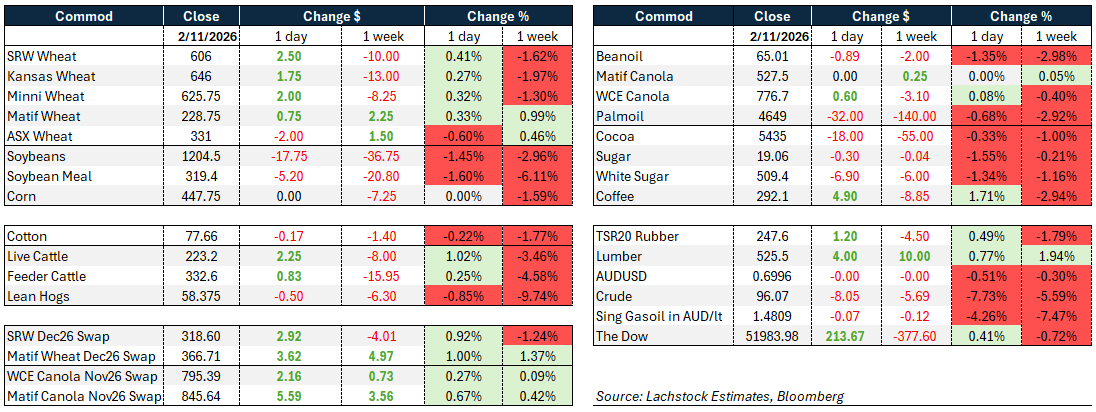
Markets: Crude’s 7.73pc plunge on Iran deal hopes was the dominant driver, pulling Singapore gasoil down 4.26% and dragging bean oil 1.35pc and palm 0.68pc lower, though canola held up on end-user buying and slower farmer selling.
Wheat is showing signs of basing, with SRW up 0.41pc and the MATIF Dec26 swap up 1pc, as escalating Black Sea attacks offset record-low US inspections and a weaker-than-expected US winter wheat rating, while ASX eased $2 under harvest pressure.
Speculative liquidation is concentrated in the soy complex, with meal down 6.11pc on the week and beans 2.96pc, as Chinese buying fails to offset record-crop concerns, while near-flat fund positioning and large Mexican buying leave corn better placed to absorb Ukrainian supply gaps.
Event risk is heavy over the next 24 hours with the RBA decision today and US midterms, the AUD down 0.51pc to 0.6996 and the Dow up 0.41pc, while broader fund selling across commodities is evident with lean hogs down 9.74pc on the week.
Day ahead – Australia: Melbourne Cup, mid terms, RBA. Yep, it’s a turkey shoot. The Iran negotiation talk is an interesting twist – according to the crude market its basically a done deal. According to Vance, the strait is opening any tick of the clock. According to this old bald guy, this all feels a little preemptive. The constant has been the US non-negotiable that the nuclear threat is neutralised.
Liquidity will be challenging today – Melbourne Cup – probably shouldn’t be a surprise but the investment bank Quants and the bookmakers both have the smokey as Point of Law.
Wheat: Chicago held off a fresh low for a third straight session, a notable shift after nine consecutive lower weekly closes, with the algo selling that had hunted stops on every open now absent. The SRW Dec26 swap firmed $2.92 (+0.92pc) to $318.60 and the MATIF Dec26 swap $3.62 (+1pc) to $366.71, the latter now up 1.37pc on the week.
Fundamentals remain soft for the US, with wheat inspections at a record low 75,413t against 195,054t the prior week and cumulative shipments down 36pc year on year.
After the close, winter wheat planting was 83pc against an 84pc average, and first condition ratings came in at 44pc good to excellent against trade expectations of 50pc.
AgResource argued Black Sea war premium should be rebuilt, with Russian and Ukrainian exports curtailed by 50-60pc of normal and winter weather likely to constrain Russia’s higher-cost alternative northern ports.
The conflict intensified over the weekend, with Russia striking a dry-cargo vessel 58km south of Odesa alongside drone attacks on port infrastructure, while Ukraine resumed hitting Russian refineries.
Diplomacy continues in parallel, with Erdogan hosting Zelenskyy for Black Sea security talks and Rubio raising a possible Trump-Putin meeting at APEC in China next month.
Ukrainian wheat exports rose 12.9pc to 202,400t in the week to 28 October within total grain exports of 273,900t.
The EU Commission trimmed soft wheat output to 123.7Mt from 124.2Mt and ending stocks to 10.6Mt from 11.4Mt, holding exports at 29Mt.
ASX slipped $2 to $331 as harvest pressure builds, with east coast rain keeping quality the key local watch, and Agriculture Minister Julie Collins travels to China this week for the import expo in Shanghai.
Corn and oilseeds: Corn found buyers on a 1.73Mt sale to Mexico, the ninth-largest daily corn sale on record, split 1.14Mt for 2026/27 and 594,360t for 2027/28, a sign end users are seeing value.
Inspections rose 39% to 884,766t but cumulative shipments are 13% behind last year.
The bigger swing factor is Ukraine, which shipped just under 250,000t of corn in October against 941,000t a year earlier, leaving room for US corn to fill gaps if peace talks stall.
The EU cut its maize estimate to 47.0Mt from 48.3Mt, harvest reached 74pc against 72pc expected and a 77pc average, and managed funds have now almost fully liquidated their net long.
South Korea’s MFG is tendering for up to 70,000t of South American or South African corn for February arrival.
Soybeans fell 1.45pc and meal 1.6pc as heavy crude losses hit long-heavy markets. A 136,000t flash sale to China added to purchases under its 25Mt annual pledge, but Joe Davis of Futures International said that demand is largely priced in, with the risk being a record US crop outpacing 2026/27 demand.
Inspections were 2.44Mt and are running 56pc ahead of last year, and harvest reached 88% against 87% expected. RCM Alternatives’ Doug Bergman noted speculators remain heavily long beans and meal and are now underwater, so rallies should struggle until that length is unwound, with meal having the furthest to go.
Brazilian planting is past 50pc without major issues.
Separately, Reuters analysis shows Chinese buying of US farm goods other than soybeans tracking a seven-year low.
ICE canola was narrowly mixed after a wide C$780.50-793.00 range in January, with the WCE Nov26 swap up $2.16 (+0.27%) to $795.39 and the Matif canola Nov26 swap up $5.59 (+0.67%) to $845.64.
Crude-driven losses across soyoil, rapeseed and palm weighed, offset by end-user buying and slower farmer selling as the Prairie harvest wraps up.
Funds cut their net long from 86,618 to 49,785 contracts, the smallest in three and a half months.
Indonesia’s January-September palm exports rose 8.1% to 19Mt, China is reportedly sending more cheap soyoil to India at palm’s expense, and Turkey’s TMO bought about 18,000t of crude sunoil.
Local: The week started stronger for canola, with bids around $850, while wheat was $372 and barley slightly firmer at $323 FIS Albany.
In the east, canola was bid around $790, wheat $340 and barley $278 track Geelong.
Farming is a cruel mistress. Just as headers were about to enter paddocks, hailstorms swept through the southern Victorian Mallee and northern Wimmera yesterday, centred over the Wycheproof and Charlton areas. Damage is still being assessed, with reports of losses of up to 30pc.
Harvest is gathering pace in SA, with the Upper Eyre Peninsula now getting stuck in. Early barley yields around Kimba are reportedly 4–5t/ha, with most making malting specifications. Strong yields and a high proportion making malt offer little support for prices as harvest pressure builds.
HAVE YOUR SAY