
 Weather: Australian harvest weather looks more favourable over the coming week, with drier conditions expected to see activity and grain deliveries ramp up. Brazil’s soybean planting is 54 percent versus 51pc on average, with no significant weather threat yet to offer markets support.
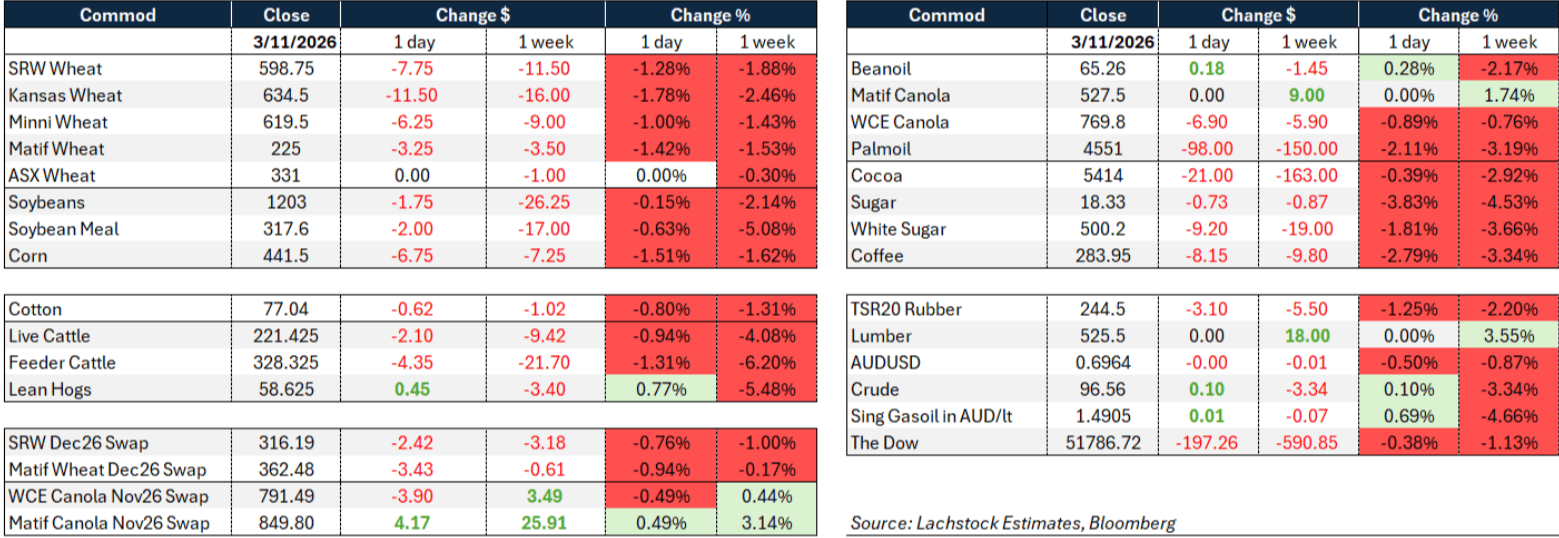
Markets: Wheat fell overnight as Russia–Ukraine peace talks raised hopes of improved Black Sea grain flows, with Paris December down 1.3pc to €225.25/t. Corn hit four-month lows and soybeans softened as US harvest pressure continued.
Canola tested August lows as weaker crude dragged vegetable oils lower. US equities recovered, while stronger jobs data lifted Treasury yields and the US dollar; markets awaited midterm election results and further US–Iran developments.
Day ahead – Australia: Victorians will be licking their wounds after Cup Day, so expect a relatively slow day of trade, with local values likely to ease following the offshore sell-off. A favourable harvest window should see activity ramp up, bringing more grain into the system. With harvest pressure about to build, how much longer can local values hold their ground?
Wheat: Wheat futures weakened as planned Russia–Ukraine negotiations removed further risk premium. The prospect of improved Black Sea grain flows remains a headwind, although talks have yet to deliver any change in physical supply.
Paris December milling wheat fell 1.3pc to €225.25/t, approaching the three-and-a-half-month low of €223/t reached last Wednesday. Chicago wheat also finished weaker.
US winter wheat planting reached 83pc, just one percentage point behind average, with emergence at 65pc. Establishment and weather will become increasingly important as planting winds down
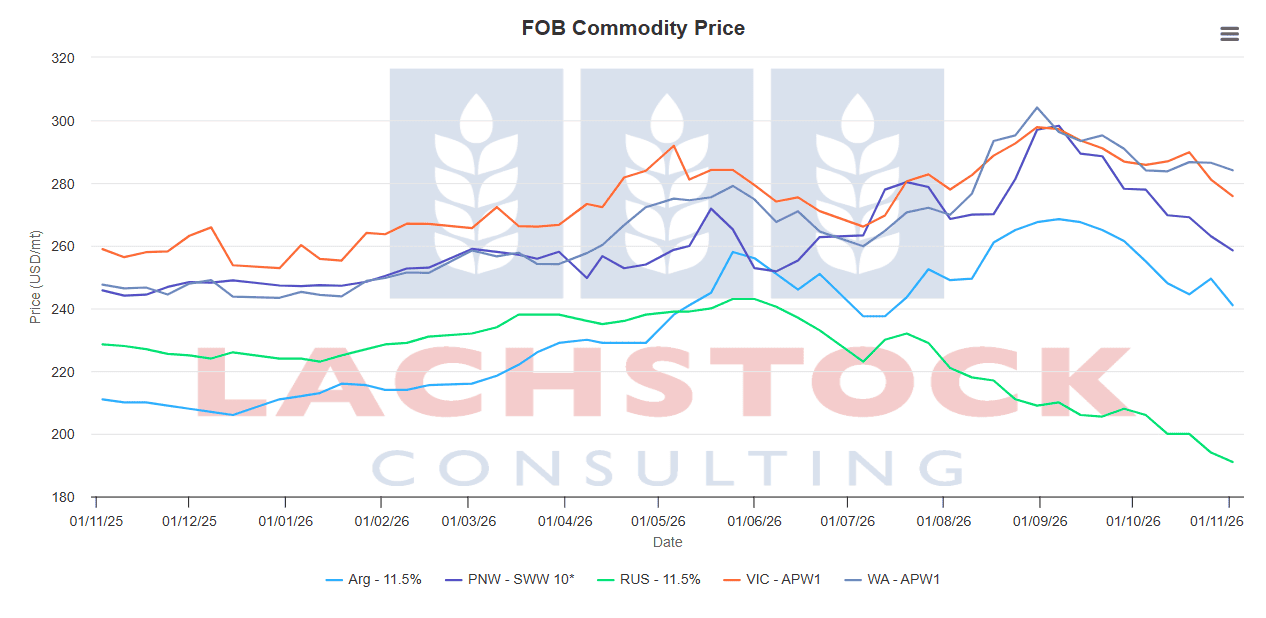
Last week’s southern Australian-delivered markets finished broadly unchanged, despite offshore weakness. Limited harvest selling supported values, while consumers remained cautious ahead of the large crop expected over the next six to eight weeks
Weakness across corn and soybeans added to the softer wheat tone, while a firmer US dollar created another headwind for US export competitiveness.
Corn and oilseeds: Canadian canola fell towards August lows as weaker crude and vegetable oils pressured the complex. Chicago soyoil touched its lowest level since late June, while European rapeseed and Malaysian palm oil also fell sharply; one analyst flagged C$760/t as a possible downside test for January canola.
US soybeans weakened under harvest pressure, with 88% harvested, four points ahead of average. USDA confirmed a 136,000t sale to China, providing some demand support against the seasonal supply increase.
US September soybean crush was 198.8 million bushels, down 5.2pc from August and 3pc year on year. Corn used for ethanol reached 438.4 million bushels, down 8.5pc month on month but slightly above a year earlier.
Corn fell to four-month lows as harvest advanced and crude weakened. Harvest was 74pc complete versus the five-year average of 77pc; larger-than-expected stocks, an October yield upgrade and speculative liquidation have compounded the decline.
Macro: The Reserve Bank of Australia raised the cash rate 25bp to 4.85pc, with six board members supporting the increase and three opposed. Inflation and expectations remained concerns, although the statement acknowledged slowing activity; ANZ expects rates are at or near their peak.
US September job openings rose 333,000 to 7.523 million, comfortably above expectations of 7.164 million. Higher quits and fewer layoffs pointed to firmer labour conditions ahead of Friday’s payrolls report.
US Treasury yields rose following the stronger labour data, with the 10-year yield up 3bp to 4.95pc. The US dollar index edged higher, adding pressure to dollar-denominated commodities.
A recovery in technology shares helped the S&P 500 gain 0.4pc, while the Euro Stoxx 50 fell 0.5pc and FTSE 100 lost 1.1pc. Markets awaited US midterm results, with a potential change in congressional control carrying implications for fiscal policy and the administration’s agenda.
Crude remained volatile as US–Iran diplomacy continued alongside limited military strikes. WTI fell to US$96.60/bbl, while reported oil throughput through the Strait of Hormuz remained only 56pc of pre-conflict levels, keeping physical supply risks elevated.
Energy uncertainty continued to threaten gas availability, with the IEA warning that global tightness could extend into 2027. Copper fell to a three-month low amid concerns over technology investment, while gold eased to around US$3925/oz.
Local: Western bids softened yesterday, with canola back $11 to $840 as offshore losses flowed through. Wheat was steady at $372 and barley at $323 FIS Albany.
In the east, canola fell $10 to $777, while wheat was bid at $342 and barley at $278 track.
Victorian barley has staged a recovery, climbing from $295 to around $310 delivered Geelong/Melbourne. Container export demand, supported by near-zero container freight rates, has driven the uplift, although this demand is likely to be satisfied quickly once harvest pressure builds.
Darling Downs wheat has eased $10–$15 over the past week to around $425, with growers willing to meet the market. Barley remains around $400.
HAVE YOUR SAY