

Weather: South America is split. The Rosario exchange lifted Argentina’s wheat estimate to 23.8 million tonnes (Mt), the second-largest on record, but there is concern a strong El Niño could disrupt the harvest from mid-November and raise quality issues. Central Brazil is seeing light showers and low soil moisture for early soybeans, while heavy rain in the south has slowed Paraná planting to 47 percent. Brazil’s soybean crop is estimated at 53pc planted, ahead of 47pc last year.
Black Sea dryness is the longer-dated supply risk. SovEcon reports Russia’s winter grain sowing at its slowest since 2013, 25pc below the five-year average on low soil moisture and poor margins, with a third of Ukraine’s winter wheat area in moisture deficit.
In palm oil, Indonesia’s main growing areas have had less than half normal rainfall since late June and GAPKI flags 2027 output falling almost 9pc to 53.69Mt.
In the US, winter wheat planting was 83pc complete against an 84pc average, and the first condition rating of the 2027 crop was 44pc good to excellent, with Kansas at 47pc, below trade expectations of 50pc. Above-normal November-January precipitation is favoured across the Southern Plains, which would help a crop coming off a drought-hit year.
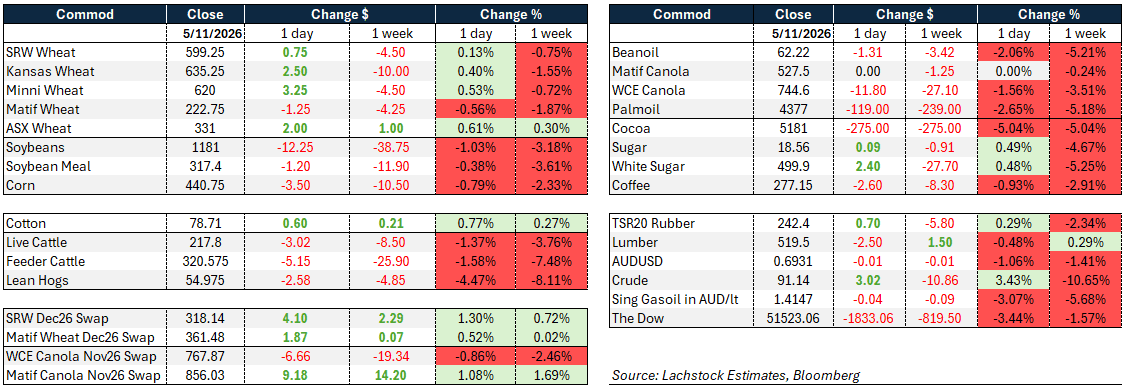
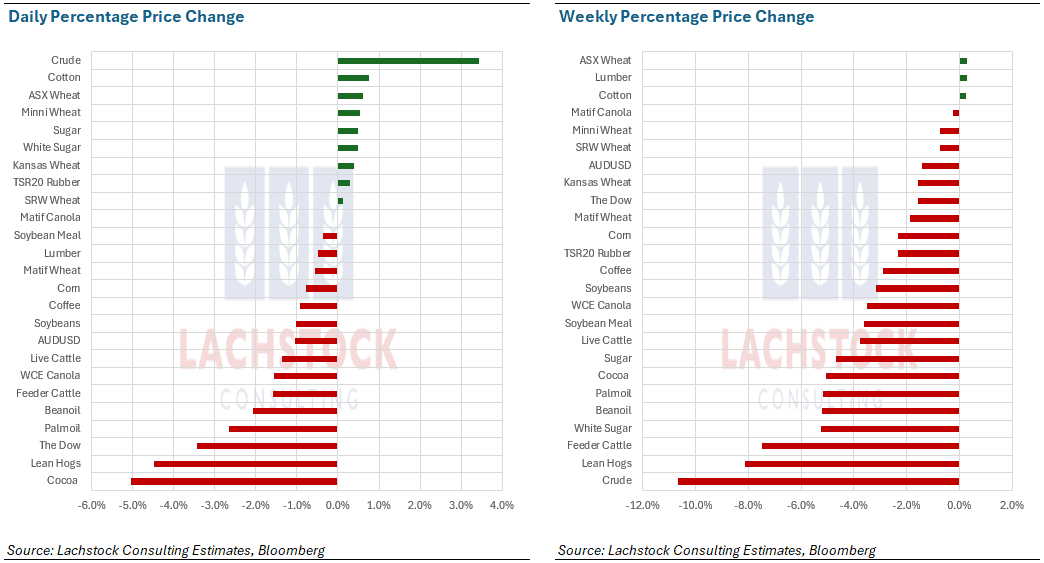
Wheat: Wheat held its ground, with Chicago and Kansas edging higher on better-than-expected export sales while MATIF slipped. Firmer SRW and MATIF Dec26 swaps and a 2.00 gain in ASX wheat to 331 point to steady local values despite seasonal headwinds.
Oilseeds were the weak link. Soybeans fell 3.18pc on the week as export sales slumped and funds liquidated, and ICE canola broke its 200-day average to a four-month low. The MATIF canola Nov26 swap rising 9.18 to 856.03 and China’s canola audit are a constructive offset for Australian canola.
Macro was risk-off. The Dow fell 3.44pc and the AUD 1.06pc, while crude’s 3.02 bounce only partly retraced a 10.65pc weekly fall. Tonight’s US payrolls, the Bank of England’s hiking path and next week’s WASDE are the near-term catalysts.
Geopolitics and livestock add noise. Russia-Ukraine talks in Abu Dhabi next week could reshape the Black Sea risk premium, and the Hegseth impeachment push follows the post-mid-term fallout.
US livestock kept sliding: lean hogs fell 4.3pc to a fresh three-year low and live cattle dropped for an eighth straight session on softer cash trade and heavier carcass weights.
Day ahead – Australia: The aftershocks from the mid term are still reverberating through financial markets. Agriculture is certainly not immune but valiantly tried to ignore the noise. The question marks remain – what happens to the various tariffs in place that directly impact agricultural flows, what happens to the Iran war – does crude literally flow and pull down the veg oil markets?
Local harvest marches on with some pretty mixed results, wheat protein in particular. Big crops provide for all.
Wheat: Wheat had a quiet session. December SRW edged up 0.1pc to $5.99 1/4 after export sales of 538,000t for 2026/27 and 19,200t for 2027/28 beat analyst expectations, although they were below the previous week’s marketing-year high. There were no flash sales across the complex.
Brian Hoops of Midwest Market Solutions said there was little fundamental reason for grains to sustain rallies, and that seasonal tendencies point lower for wheat and corn at this time of year. He noted that slowing farmer selling should firm local cash prices, which usually helps futures.
MATIF lagged Chicago, but the local swaps held up better. The SRW Dec26 swap gained 4.10 to 318.14 and the MATIF Dec26 swap rose 1.87 to 361.48, while ASX wheat added 2.00 to 331.
Corn and oilseeds: Soybeans led the complex lower. January fell 1pc to $11.39 3/4 after weekly export sales dropped 44pc to 1.46Mt. Doug Bergman of RCM Alternatives said the downtrend remains intact but the market is oversold, with buyers emerging under $12 that could steady prices ahead of next week’s WASDE. He also warned that sizeable fund length leaves downside risk if the yield comes in high.
December corn eased 0.8pc to $4.40 3/4 on sales of 1.29Mt, down 1pc on the week. AgMarket.net said corn is consolidating and needs a close above the 10-day moving average at $4.49 1/4.
It also pointed to China’s stated interest in buying more US agricultural products if reciprocal tariffs are walked back. ICE canola hit a four-month low on speculative long liquidation. January fell C$15.10 to C$753.20 after breaking its 200-day moving average around C$766, with spillover from Chicago soyoil, European rapeseed and Malaysian palm.
A rebound in crude offered vegetable oils some support.
Saskatchewan’s final crop report put provincial canola yields at 38.3bu/ac, against Statistics Canada’s 41.9, and 45.2 a year ago, and Statistics Canada updates its estimates in early December.
The WCE Nov26 swap fell C$6.66 to 767.87, while the MATIF canola Nov26 swap rose $9.18 to $856.03.
Closer to home, Agriculture Minister Julie Collins said Chinese officials audited Australia’s canola supply chain in late October. Canberra will push to reopen the market as quickly as possible. Access was cut in 2020 over blackleg and has run on a trial basis since last year.
Local: Canola took another beating yesterday, with western bids back A$12 to $818, while wheat was $365 and barley $324 FIS Albany. In the east, canola fell $15 to $750, while wheat was unchanged at $336 and barley $278 track Geelong.
It will be interesting to see what growers who are undersold heading into harvest choose to cash. With canola likely to have a six in front of it at upcountry sites, growers may be less inclined to sell it heavily and instead take more of a scattergun approach across commodities.
Reports of BAR2/3 coming off through South Australia’s Upper South East and Murraylands are raising a few eyebrows, with low testweights potentially linked to disease or late rain. Canola yields have also been underwhelming in these areas, with many growers who were expecting around 3t/ha seeing closer to 1.5–2t/ha, leaving agronomists scratching their heads.
HAVE YOUR SAY