
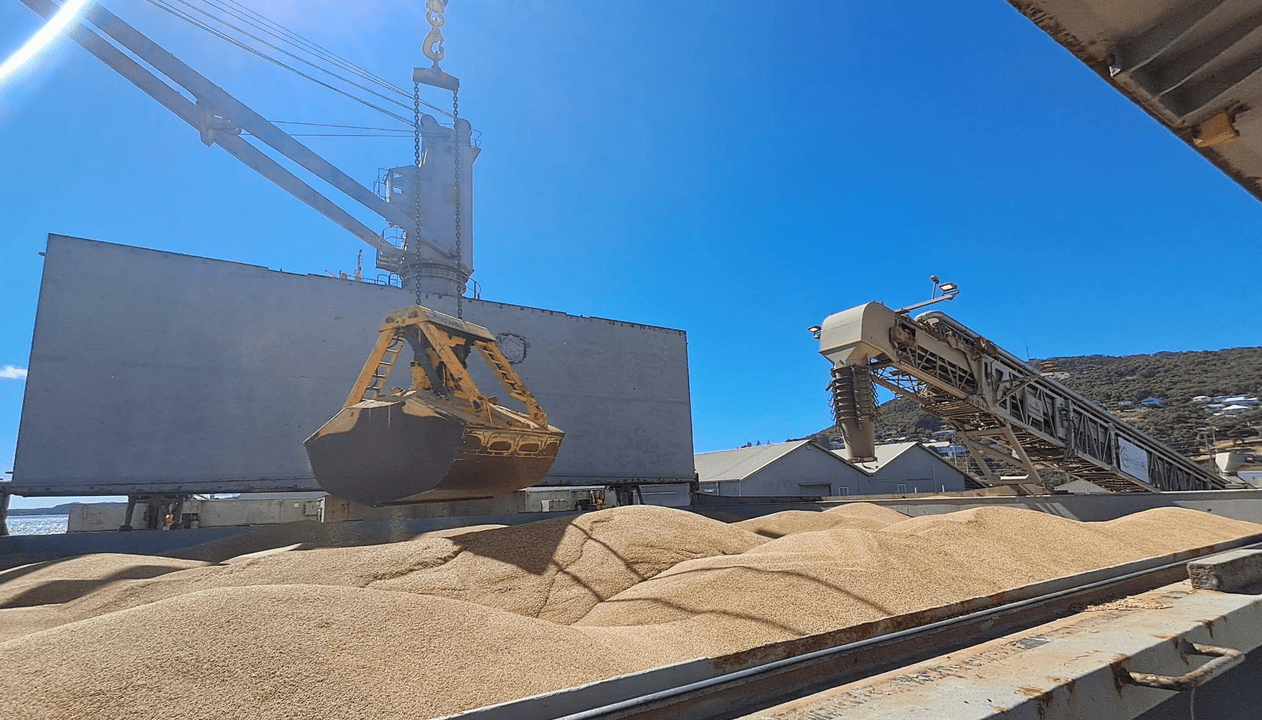
A 30,500t cargo of barley bound for China loads at the WA port of Albany in February. Photo: Commodity Ag
THE AUSTRALIAN Bureau of Statistics released the nation’s September export numbers last week, providing the final data component of another stellar Australian grain-export year, highlighted by record barley shipments that eclipsed the previous benchmark set nine years earlier.
The four major crops grown in Australia each year are wheat, barley, canola and sorghum, and by the end of September, total international shipments, bulk and containerised, stood at 41.13 million tonnes (Mt), an increase of 3.9 percent over the 39.58Mt exported in 2024-25. However, this is still 13.9pc, or 6.63Mt, below the record of 47.76Mt set in 2023-24.
Outside the big four, oats, chickpeas, lentils, and lupins traditionally make significant contributions to Australia’s grain export task each year. The four commodities accounted for an additional 4.98Mt of grain shipments, up from 3.96Mt last season on the back of a big jump in international sales of all except chickpeas.
China was again the primary destination for Australian grain in 2025-26, importing 14.3Mt of the aforementioned commodities, or 31pc of the entire 2025-26 program. Barley and sorghum dominated the Chinese trade, totalling 11.48Mt, or 80.2pc of all purchases. The Philippines, with 9.7pc, and Indonesia, with 8.9pc, were next, while the European Union and Yemen accounted for 7.4pc and 4.5pc respectively.
Western Australia remains the nation’s primary export state, accounting for 51pc of all shipments of the top eight grains. South Australia bounced back after a string of poor crops to claim second place with 15.1 pt, while Victoria outstripped New South Wales with 14.2pc of the national campaign as the poor production outlook and higher prices slowed the flow of grains through most east-coast ports in the second half of the marketing year.
Wheat
Wheat maintained its position as Australia’s primary export grain in the 2025-26 season, with 21.97Mt shipped to 58 destinations worldwide. This is 6.3pc, or 1.47Mt lower than the 2024-25 campaign, despite a bigger crop, and is 9.8Mt less than the wheat export record set in the 2022-23 marketing year.
After assuming the mantle from China in 2024-25, Indonesia was usurped by The Philippines as the biggest buyer of Australian wheat in 2025-26. The archipelagic nation imported 4.43Mt, or 20.1pc of the total, and 900,000t more than the previous season. Indonesia was the second-biggest destination with 4.12Mt, or 18.7pc of the total, 347,000t lower than in 2024-25. Third on the list was Yemen with 1.84Mt, or 8.4pc of shipments, followed by Vietnam with 1.25Mt, South Korea with 1.21Mt, and China with 1.13Mt.
Barley
The pace of barley exports in 2025-26 was phenomenal, with another 386,000t added in September to bring the 12-month total to a record 11.48Mt, 3.24Mt higher than last season and 25.3pc higher than the previous record of 9.16Mt set in the 2016-17 marketing year. April saw barley shipments set a new monthly record of 1.53Mt, just above the previous high of 1.51Mt set just two months earlier.
China’s appetite for Australian barley was insatiable, accounting for 9.23Mt over the 2025-26 season, or 80.4pc of the national barley export program. This is up from 6Mt and 73.1pc of the total in 2024-25. Saudi Arabia, which shipped all its barley in the first half, and Japan swapped places on the podium in 2025-26 with 713,000t and 282,000t respectively for 6.2pc and 2.5pc of barley shipments.
Canola
Shipments of canola, Australia’s primary oilseed crop, were almost the same as last season at 5.37Mt, a handy-max vessel less than the 5.4Mt exported in 2024-25, and the lowest of the past five seasons. April was the third-biggest canola export month on record, with 882,000t shipped in bulk and containers, not far behind the record 904,000t set in March 2025.
The European Union remains the primary destination for Australian canola, purchasing 3.08Mt in 2025-26, or 57.4pc of the entire program. Second on the list was China with 985,000t, or 18.3pc of the total. The United Arab Emirates and Japan were next with 10.9pc and 7.8pc respectively.
China’s canola purchases rose from zero in 2024-25 after relaxed import restrictions allowed trade to resume on a trial basis late last year. Chinese inspectors have recently completed an audit of Australia’s production and supply chains, potentially paving the way for the resumption of full trade in 2026-27.
Other coarse grains
Exports of sorghum, the only summer crop among the major grains, dropped by 188,000t year on year to 2.31Mt, on the back of a smaller crop. This was the third-largest sorghum program on record behind 2022-23 when 2.75Mt was shipped, and last year. At 409,000t, May was the largest month for shipments.
China has been the dominant buyer of Australian sorghum for many years, progressively building its market share from 79.3pc of total shipments, or 955,000t, in 2020-21 to a record 97.3pc, or 2.25Mt in 2025-26. Taiwan was the second-largest buyer with 37,000t, just 1.6pc of the entire program.
International sales of oats jumped 38.5pc to 846,000t in 2025-26, 99.2pc of which were shipped out of WA. China was the primary buyer, taking 714,000t, or 84.4pc of all shipments, followed by India at 85,000t, or 10pc of the total.
Pulses
Chickpeas were the biggest pulse export in 2025-26 at 1.98Mt, just 85,000t less than shipments in the previous season. Suited to more tropical latitudes, Queensland ports with 79.7pc and NSW ports with 19.5pc handled the vast majority of the export task. India was the primary destination, accounting for 1.15Mt, or 58pct of bulk and container exports. Pakistan, with 333,000t, Bangladesh, with 332,000t and the United Arab Emirates, with 97,000t, were the only other buyers of note.
Lentil shipments totalled 1.66Mt last season, 606,000t, or 36.5pc higher than the 2024-25 export year. The southern states of Victoria and South Australia are the key producers, accounting for 35.3pc and 63pc of exports, respectively. India and Bangladesh were the key buyers with 750,000t and 449,000t respectively, or 45.2pc and 27.1pc of the market. Sri Lanka ranked third on the list with 156,000t.
Lupins are third on the pulse list, with exports of 495,000t in 2025-26. This is 34.7pc, or 172,000t, higher year on year, with 94.2pc of the program executed out of WA ports. With a market share of 45.7pc, the EU edged out South Korea as the largest lupin buyer, collectively accounting for 88pc of the season’s bulk and containerised shipments.
HAVE YOUR SAY