

Weather: Brazil: Soy planting has run ahead of normal, with Mato Grosso over 75-percent planted against a five-year average of 64pc (IMEA) by late October. The season has been split between a fairly dry centre and a very wet south, where Conab flagged disease and weed pressure from the rain, and El Niño has yet to cause damage.
Argentina: Improved soil moisture is supporting 2026-27 crops, but persistent rain, low temperatures and limited sunlight are slowing fieldwork and raising disease risk, and Bage expects yields in parts of central Argentina to fall 10-30pc because of tiller abortion and frost. The Rosario exchange still has wheat at 23.8 million tonnes (Mt), the country’s second-largest crop on record, so weather over the first weeks of harvest will decide quality.
Australia: El Niño continues to strengthen towards near-record levels, yet the BOM’s November to January outlook limits below-average rainfall to parts of the far south-east and the northern tropics. October rain in the east delayed winter-crop harvest and raised the risk of quality downgrades from excess moisture. The east gets the heavier falls again this week, while WA and SA cropping regions are forecast to receive 1-10mm.
Black Sea and the US: In Ukraine, October rain replenished soil moisture in nearly all layers, but winter crop development in most regions lags the long-term average by 2-3 weeks because of earlier drought and late sowing. Analysts say dryness in southern Russia is an emerging risk to the 2027 wheat crop, with only limited relief expected in late November and early December. US winter wheat is in better shape at 49pc good to excellent.
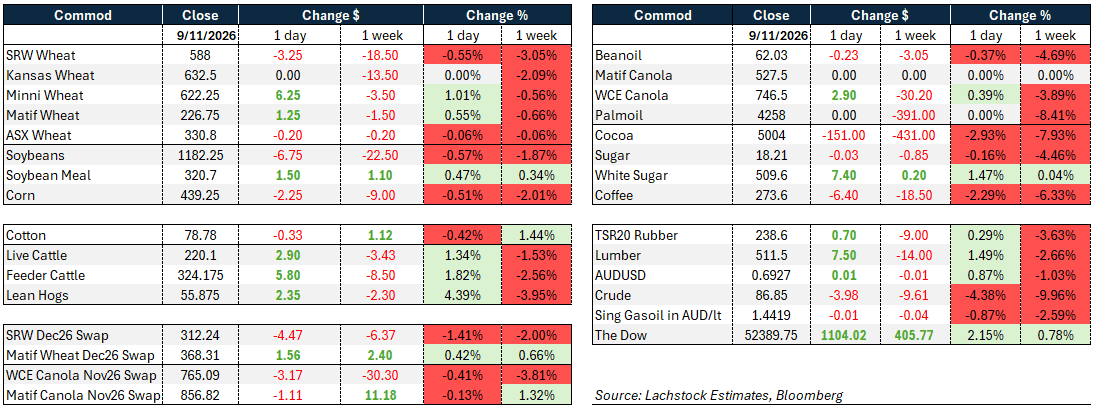
Markets: Energy is driving the complex: crude fell 4.4pc on the day and nearly 10pc on the week as Iran de-escalation took risk premium out, pulling soy oil and palm lower and giving funds more reason to add short positions across grains. Canola’s gain against that backdrop came from strong Canadian export and crush demand.
The next two days are event risk. WASDE lands tonight with modest US stock builds expected, and the Abu Dhabi talks begin at the same time. With managed money heavily short Chicago wheat and corn at fresh lows, any surprise from either has room to trigger short covering.
Wheat leadership has moved to Europe. MATIF gained while Chicago fell, the Dec/March spread widened to a €4 Dec premium, and the MATIF Dec26 swap at A$368.31 is now A$56 over the SRW swap at A$312.24. For Australian pricing, the stronger MATIF-linked value is the one to watch while Chicago stays heavy.
Macro was risk-on: the Dow added 2.15pc and the AUD rose 0.87pc to 0.6927 on lower oil and the China truce extension. A firmer Aussie dollar takes some value off A$ grain prices, but AUD is still down 1.03pc on the week.
Day ahead – Australia: It feels a little like the tide is rolling in – the weight of the harvest is upon us – albeit it still a little stop start. South Australia goes from 30 degrees today to 16 tomorrow.
Downs values continue to bleed lower and the outlook for sorghum production looks amazing. There will be a challenge with the later-planted crop flowering through some heat but, today at least, things look good.
Grower marketing will still be the major driver of value – export margins are there but so is congestion. If the grower unloads to hard, the bid side will get overwhelmed. However, the trade is also looking at export margins.
Managed money kept adding shorts in Chicago, and wheat open interest went into the session just 36k contracts below the record. Chicago is now short enough that any change in sentiment would move it.
Most of the action is in Europe. A second day of rumours had China and Egypt looking at French wheat, and firm EU cash prices give those reports some weight. The MATIF Dec/March spread gained €1.50 to settle at a €4.00 Dec premium.
Algeria tendered and will review offers Wednesday, though French wheat is unlikely to win. Turkey’s TMO will tender for 400k tonnes of soft wheat on November 17, split evenly between Dec 15 to Jan 8 and Jan 15 to Feb 12 loading.
The SRW Dec26 swap fell A$4.47 to A$312.24, while the MATIF Dec26 swap rose $1.56 to $368.31. That widened the European premium in Australian dollar terms, and ASX wheat held at 330.8. US inspections of 249k tonnes matched estimates but leave the export pace down 36pc on last year.
Winter wheat planting reached 89pc against a 90pc average. Condition improved to 49pc good to excellent, up from 44pc and ahead of the 47pc the trade expected. The trade expects WASDE to put US wheat ending stocks at 744 million bushels, up from 740.
The two-day trilateral talks start Tuesday in Abu Dhabi, the fourth attempt at this format. The first session covers ceasefire monitoring and post-war security, the second covers territory. The US has asked Moscow to accept Article 4 and 5-style security guarantees for Ukraine.
Europe will be in constant contact with the US and Ukrainian teams but will not sit down with Russia directly. There has been no let-up in the fighting. Ukraine set Russia’s Kirishi refinery alight, and Russia said it struck a dry-cargo ship 141km southwest of Odesa. If the talks make no progress, importers who have been waiting may all buy at once
WASDE is expected to trim the US yield slightly, but a slow export pace means USDA may cut exports as well. Harvest reached 81%, behind the 84% expected and the 86% average, and inspections of 905k tonnes were in line.
USDA has been using 22 million tonnes for Ukrainian corn exports and is unlikely to move far from that with talks starting.
APK-Inform cut its Ukraine corn export forecast to 18.0 million tonnes from 20.0. It also cut the total grain harvest to 63.7 million tonnes from 65.3 and grain exports to 29.7 million tonnes from 31.9.
Corn is unlikely to change direction unless Ukrainian corn stays stuck behind the war.
Brazil’s Centre-South summer corn is 71pc planted, against 72pc a year ago.
Soybeans were higher overnight but gave it all back to close near the lows. Crude’s fall weighed on the soy complex, South American weather is not threatening, and the market is reluctant to price more Chinese demand than the roughly 5 million tonnes still expected before the end of December. Meal gained 1.50 to 320.7 and soy oil eased 0.23 to 62.03.
AgRural puts Brazil’s soy planting at 64pc, up from 53pc a week earlier and 61pc a year ago.
El Niño has done nothing to Brazilian beans so far, and the market needs South American weather problems for a meaningful recovery.
WASDE is expected to lift the US bean yield slightly, possibly offset by higher exports. Inspections of 1.896Mt were at the low end of expectations but leave the pace up 58pc on the year. Harvest reached 92%, against 93% expected and a 91% average.
China extended its trade truce with the US by two months ahead of next week’s Xi–Trump meeting at APEC. The proposed $60 billion reciprocal tariff package includes about $17 billion of US farm goods and is still not finalised.
ICE canola rose despite weakness in other oils, with January up 2.90 to C$746.50. Strong demand helped: Canadian Grain Commission figures for the week to November 1 showed exports up to 284,900 tonnes and domestic use at 251,100 tonnes. Both are ahead of last year’s pace year to date, with exports near 2.21 million tonnes and domestic use 3.24 million tonnes. The loonie eased to 70.80 US cents.
European rapeseed was mostly higher. Palm was flat at 4258 but is down 8.41% on the week. The WCE Nov26 canola swap fell A$3.17 to A$765.09, and the MATIF Nov26 canola swap eased A$1.11 to A$856.82.
Macro: Crude fell sharply after Trump said new strikes on Iran were “highly unlikely”. After meeting the Qatari prime minister, who has been mediating, he said Iran was “militarily effectively over” and that the US was holding the status quo at the request of its Gulf neighbours. Iran wants the naval blockade and sanctions lifted before talks resume. Washington wants the attacks on Strait of Hormuz shipping to stop and concessions on the nuclear program.
Supply risks remain. Ships near Hormuz are still being attacked, a Houthi strike damaged an Aramco office building in Riyadh, and Iraq’s Khor Mor gas field shut after a suspected drone attack.
Ukraine’s strike on Kirishi, Russia’s second-largest refinery, has reportedly led Moscow to restrict gasoline sales.
Equities rallied hard, and the softer energy outlook and China truce extension helped the Aussie dollar.
US politics remain unsettled after the Republicans lost both chambers in the November 3 midterms, defeats widely blamed on the Iran war and fuel prices.
Republican Thomas Massie has moved to impeach Defense Secretary Hegseth, with a House vote possible Wednesday, though the measure is unlikely to clear the Senate before Democrats take control in January.
A UN report says 2026 is on track to be one of the four hottest years on record, driven by a powerful El Niño.
Local: Bids started the week steady in the west, with canola at $820, wheat at $372 and barley at $326 FIS Albany. In the east, canola was bid at $752, wheat at $340 and barley at $275 track Geelong. Faba beans remain bid around $420 delivered port. Container demand is solid, though there’s still no sizeable bulk program. Egypt, our biggest buyer, is seeing cheaper offers out of Europe, where bean quality is good this year. Harvest is picking up pace across Victoria, with more barley starting to flow. Early reports out of the northern Wimmera point to yields of 5–6 t/ha and good malt selection.
HAVE YOUR SAY