
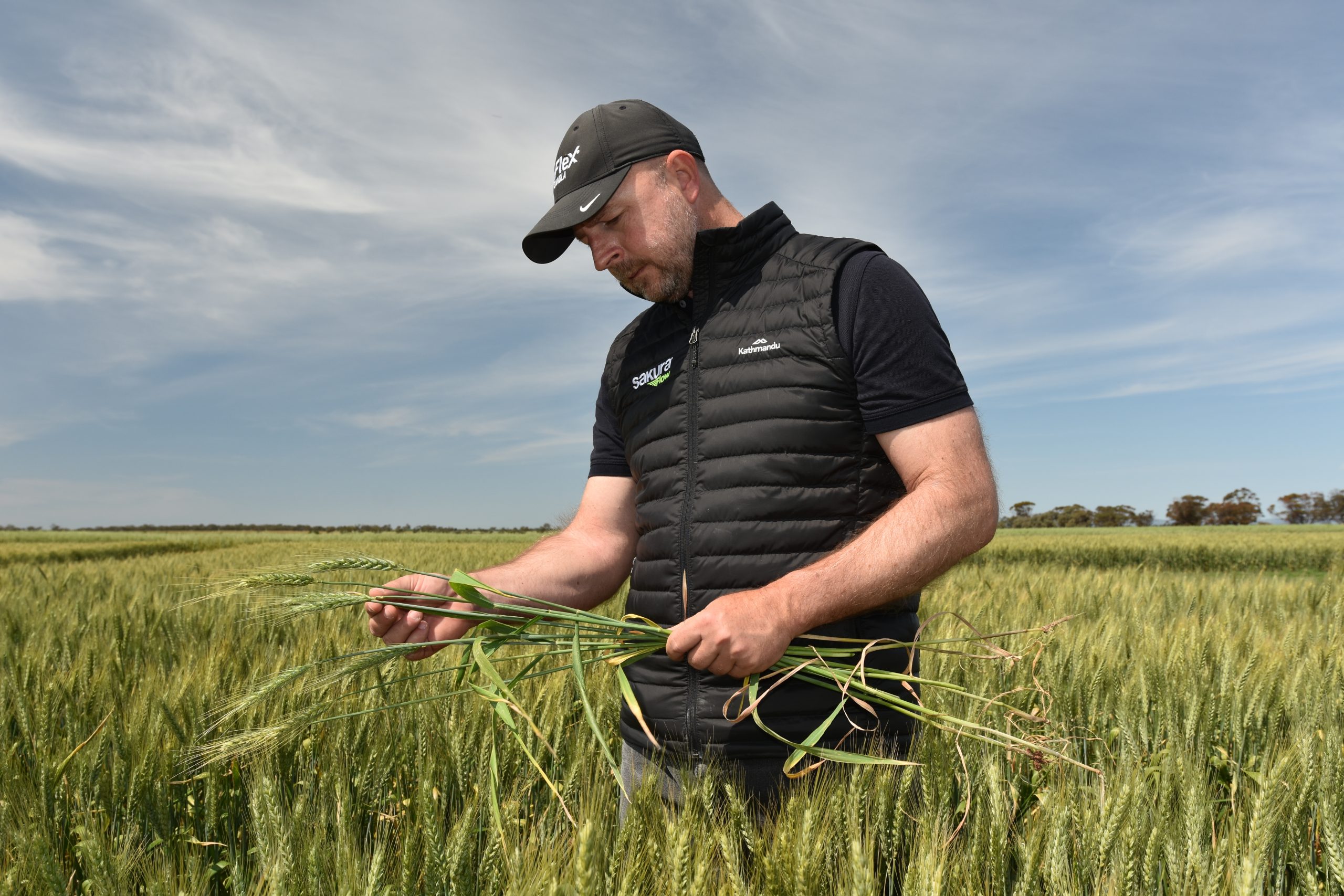
Bayer’s Paul Bogacki inspects cereals at a trial site near Roseworthy in South Australia. Photo: Bayer
A UNIQUE new fungicide offering growers the flexibility to better control leaf diseases in their cereal cropping programs is showing significantly improved control compared with alternative industry benchmark fungicides in trials.
Anticipated to be registered for the 2027 cropping season subject Australian Pesticides and Veterinary Medicines Authority approval, VIMOY iblon is a single-active Succinate Dehydrogenase Inhibitor (SDHI) fungicide that sits alone in a subgroup of Group 7 fungicides.
Developed by Bayer with active ingredient is isoflucypram, VIMO iblon is used in tank mixtures
with prothioconazole to achieve effective disease control and support fungicide-resistance management in growers’ programs.
The new fungicide also features Bayer’s advanced Leafshield formulation technology introduced with its Aviator Xpro fungicide for exceptional leaf coverage, rapid uptake and rainfastness, and which avoids the requirement for an adjuvant.
Combined with the active ingredient, this delivers enhanced green leaf retention to help maximise crop
yields.
Submissions have been made to the APVMA to register VIMOY iblon tank-mixed with prothioconazole for control of septoria tritici blotch, stripe rust and yellow leaf spot in wheat, as well as net form net blotch, leaf scald, and leaf rust in barley.
Trial work has been conducted for future submissions to the APVMA for additional crops and diseases.
Bayer field project keader for VIMOY iblon Paul Bogacki said the ability to tank-mix the single-active SDHI fungicide with other mode of action fungicides was a major benefit for disease resistance management.
“Most of the VIMOY iblon development work has involved mixes with prothioconazole from the Group 3 DMI (Demethylation Inhibitor) group of fungicides, which we have proposed as a compulsory mixing partner,” Mr Bogacki said.
“However, we are also evaluating other mixing partners.
“In future, there is also potential for tank mixes with not just another mode of action, but multiple modes of action.”
He said disease resistance had become more prevalent over the last decade, and growers should always look to partner VIMOY iblon with a fungicide from another mode of action group to aid resistance management, as well as to enhance the disease control spectrum and efficacy.
“While there have been widespread instances of resistance to DMI and QoI (Quinone outside inhibitor) fungicides, resistance or reduced sensitivity to SDHI fungicides are less frequent.”
Compared with industry benchmark fungicides such as Aviator Xpro, VIMOY iblon can also be applied at a later crop growth stage in wheat (up to Z62), helping to extend the disease control window in the crop, while it can be applied up to Z45 in barley, subject to regulatory approval.
VIMOY iblon has been compared alongside other fungicides including Aviator Xpro in trials over three years across the country, where it consistently showed a better level of control across the key cereal diseases.
“It was an incremental step-up in disease control over our benchmark, Aviator Xpro.
“It has been particularly strong on septoria tritici blotch, which has been one of the most damaging diseases of wheat in South Australia and in eastern states in recent seasons.
“It has also been highly effective against yellow leaf spot, which is more prevalent in Western Australia.
“In barley, blotches have been most important to control in recent times, and there has been a high incidence of leaf rust in South Australia this season.
VIMOY iblon partnered with prothioconazole has shown excellent control against both.”
An application for the registration of VIMOY iblon has been made. At the time of publication, VIMOY iblon is not a registered product.
Source: Bayer
HAVE YOUR SAY