

Weather: In eastern and central Australia, low-pressure systems brought rain and storms in the week to 4 November. ABARES warned that further falls would delay the winter crop harvest and raise the risk of quality downgrades. Queensland growers are pushing to finish ahead of heavier rain expected from 13 November. WA and SA are drier: cropping regions in both states were forecast to receive only 1-10 mm in the eight days to 12 November. CBH receivals rose 1.2 million tonnes (Mt) in the week to 9 November despite 5-25mm mid-week, and BoM’s November to January outlook limits below-average rain to the far southeast despite a strengthening El Niño.
Brazil is showing a classic El Niño split. The south has excess rain, which raises replant risk in Rio Grande do Sul and Santa Catarina, while rainfall in the centre-west and north is irregular. Rain has become more widespread across Mato Grosso, easing replant fears, and AgRural had planting at 64 percent as of 5 November.
In the US, heavy rain improved drought across the central and southern Plains, including western Kansas, giving winter wheat better moisture going into the season, while dryness deepened in the lower Mississippi Valley and lower Midwest.
In Argentina, the wheat harvest starts in mid-November after persistent rain, low temperatures and limited sunlight slowed fieldwork and raised disease risk, and Bage expects yields in parts of central Argentina to fall 10-30pc because of frost and tiller abortion.
Markets
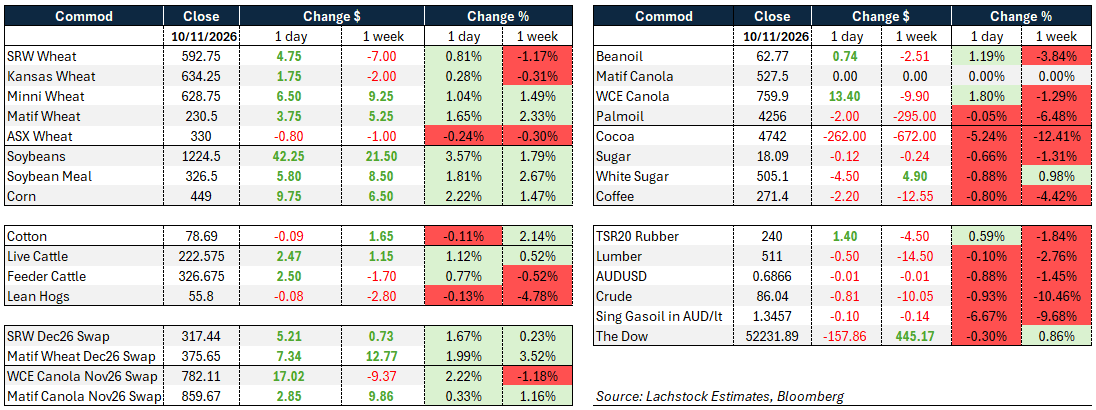
The WASDE was bullish for corn and soybeans. Corn stocks of 1,758 mb against 1,846 mb expected, and soybean stocks of 300 mb against 337 mb, lifted corn 2.22pc and soybeans 3.57pc and Commstock says seasonal lows are in, though export demand still lags.
US wheat was a reluctant follower, with Chicago up 0.81pc and Kansas up 0.28pc, while Matif led with a 1.65pc gain and a 2.33pc weekly rise, taking the Matif Dec26 swap to 375.65 against the SRW Dec26 swap at 317.44.
Soybean strength spilled into oilseeds, lifting WCE canola 1.80pc and bean oil 1.19pc. Palm held flat because record MPOB stocks were still below forecast, and Matif canola was recorded unchanged.
Crude’s 10.46pc weekly fall on hopes of US-Iran de-escalation is the main macro headwind for vegetable oils.
The AUD’s 0.88pc fall to 0.6866 gives local prices some support, but ASX wheat still slipped to 330.
Day Ahead – Australia
WASDE is behind us – support for corn and beans will force the increased wheat short to at least consider a world where wheat doesnt fall every day.
Locally, harvest is gaining momentum. We now get to see if and when the bid can weather the storm of grower selling.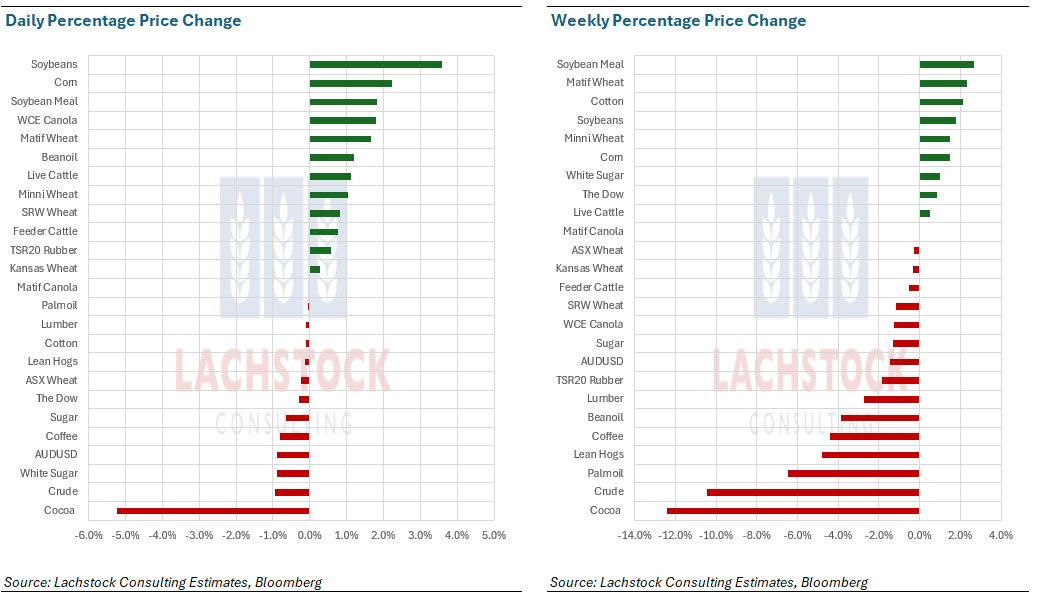
US export inspections were about 249,000t in the week to 5 November, more than double the previous week, although the marketing-year total is still behind last year.
Matif outperformed again, and the Dec26 swap rose 7.34 to 375.65, against the SRW Dec26 swap at 317.44 (+5.21).
That leaves Matif up 2.33pc on the week while Chicago is down.
In the Black Sea, Lithuania is tightening customs checks on Russian and Belarusian grain and will hold clearance until origin is verified, a step up from measures in place since September.
US, Russian and Ukrainian officials met in Abu Dhabi for peace talks. ASX wheat slipped 0.80 to 330.
Ending stocks fell to 1,758 mb against 1,846 mb expected, a stocks-to-use ratio of 10.8pc.
December corn was up as much as 3.7pc intraday, its largest gain in three months, before settling up 2.2pc at $4.49.
For soybeans, production rose only modestly to 4.574 bb, with yield at 53.3 bu/ac against 53.6 expected. Ending stocks were cut unexpectedly to 300 mb, against 315 mb in October and an average trade estimate of 337 mb, after exports were raised 25 mb to 1.72 bb. January beans rose 3.3pc to $12.28, meal gained 1.81pc and bean oil 1.19pc.
Grete said the report should cement seasonal lows for corn and soybeans.
Allendale’s Rich Nelson was more cautious: corn export sales are still well short of what the USDA’s 3.28 bb export forecast (cut 25 mb) requires, and Brazil is now cheaper than the US for every delivery month, which threatens non-Chinese soybean demand.
Mexico remained a steady buyer, taking 312,700 t of corn and 150,000 t of soybeans.
ICE canola followed soybeans higher, with January up C$13.00 to 770.40 and the WCE Nov26 swap up 17.02 to 782.11. ICE is closed today for Remembrance Day.
Matif canola was flat, but the Nov26 swap edged up 2.85 to 859.67. MPOB put Malaysian palm stocks at a record 3.62 Mt in October, up 3pc on September but below the survey.
Palm recovered from a 4pc intraday fall to finish near unchanged. Sunvin’s Anilkumar Bagani said palm needs a large discount to rival oils to attract demand while falling energy prices erode its biodiesel margin.
In Ukraine, Astarta’s soybean crush plant was damaged in a Russian strike on 8 November .
Macro: Crude is down 10.46pc on the week. Losses narrowed late on Tuesday, but the market is still weighed down by expectations of US-Iran negotiations and growing hopes of an end to the war after the midterms, as Trump says further strikes on Iran are unnecessary.
The fall is feeding directly into vegetable oils by eroding biofuel margins.
Singapore gasoil in AUD dropped 6.67pc to $1.3457/lt. On Russia-Ukraine, the trilateral talks continue alongside Trump’s claim that a deal is very close.
Meanwhile, Ukrainian strikes on Russian refineries and logistics have added to a gasoline shortage inside Russia.
The AUD fell 0.88% to 0.6866, the Canadian dollar lost nearly a third of a US cent, and the Dow eased 0.30pc while holding a weekly gain.
Coming up: EIA petroleum data on Thursday, then US export sales on Friday, delayed by the Veterans Day holiday.
Local: Bids were steady in the west yesterday, with canola at $818, wheat at $372 and barley at $325 FIS Albany.
In the east, canola firmed to $756, while wheat was bid $338 and barley $278 track Geelong.
Canola continues to come in below expectations across parts of SA, Victoria and southern NSW. Many growers went into harvest expecting record yields, but some crops are coming off up to 1.5t/ha short of expectations. Some are pointing to the dry spell in September and others to disease. It’ll be worth watching whether the same pattern shows up in later-harvested crops.
Nearby barley demand remains solid, with four vessels on the Victorian stem over the next month and good container demand keeping a floor under the market for now.
Beef processors are cutting shifts as recent rain gives producers room to hold cattle back and put on weight. One large southern plant has cut its daily kill from 1,800 to 1,100 head and plans to run four-day weeks through to Christmas, with dearer cattle and flat export beef prices squeezing margins.
HAVE YOUR SAY