

Weather: In Europe, Germany is counting the cost of an exceptionally dry season: DRV estimates corn yields down 20pc and winter wheat down 14pc, with total grain output down 8.6pc to about 41 million tonnes (Mt). Widespread warmth forecast across the continent next week should slow early winter gas storage withdrawals.
Argentina’s harvest outlook is mixed: persistent rainfall, low temperatures and limited sunlight are increasingly slowing fieldwork and raising disease risks, and the Buenos Aires exchange expects yields in parts of central Argentina to fall by 10-30pc from last season because of tiller abortion and frost damage. Rosario still sees 23.8Mt wheat in the MY 2026/27, marking the country’s second-largest crop on record, and long port queues support the bigger number. In Brazil, Conab reports that rain is accelerating soybean planting in MT and GO but hurting wheat and rice in the South.
In the US, heavy precipitation improved drought conditions across much of the Four Corners, central Plains and southern Plains, while dryness intensified through the lower Mississippi Valley, lower Midwest and Tennessee, with widespread precipitation across western Kansas providing additional drought relief and improved moisture entering the winter wheat season.
Markets
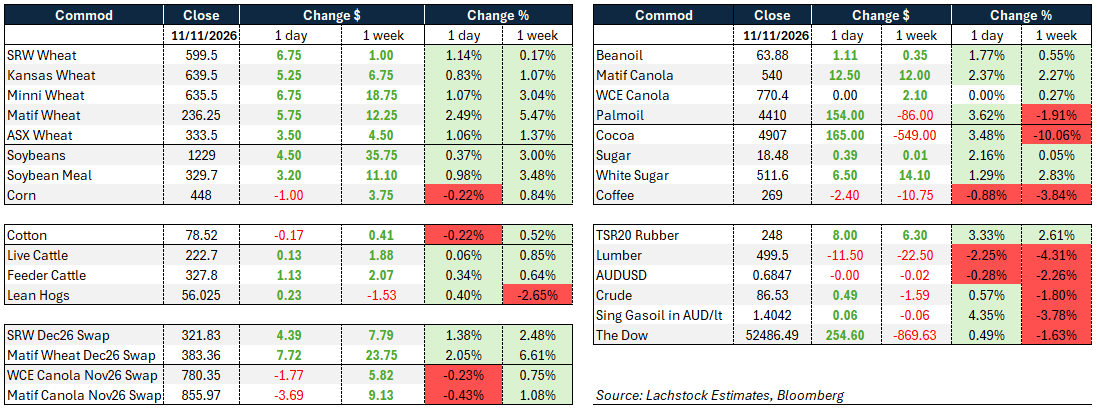
Wheat led the complex higher as the Abu Dhabi talks failed to reopen the Black Sea and a drone strike on Ust-Luga showed Ukraine can still disrupt Russian exports. Matif gained 2.49pc and the A$ Matif Dec26 swap gained 7.72, with Thursday’s Witkoff-Kushner meeting with Putin the next test.
Corn slipped 0.22pc but held most of its post-WASDE rally after ending stocks were cut 91 million bushels to 1,758 million, putting stocks-to-use below 11pc. Ukraine’s export cut and Germany’s drought losses tighten feed grain supply into 2027.
Vegetable oils were the standout. Matif rapeseed rose 2.37pc, palm 3.62pc and soyoil 1.77pc on crude and the USDA’s cut to world soyoil stocks. Winnipeg’s reopening tonight will decide whether local canola holds an expected $10-20 lift at the open.
The AUD’s slide to 0.6847, down 2.26pc on the week, is adding $1-2 to local grain bids as record falls in home lending point to the RBA’s 4.85pc cash rate biting. Iran’s Hormuz strikes keep crude and European gas elevated, which matters for fuel and fertiliser costs.
Day Ahead – Australia
Grain markets remain at the whim of how negotiations are reported. Both conflicts. The worm turned overnight with attacks in the Baltic – a more significant event than the two lines covering it in today’s wires. Additionally, the ideas that the US and Iran could find common ground seems a million miles away today.
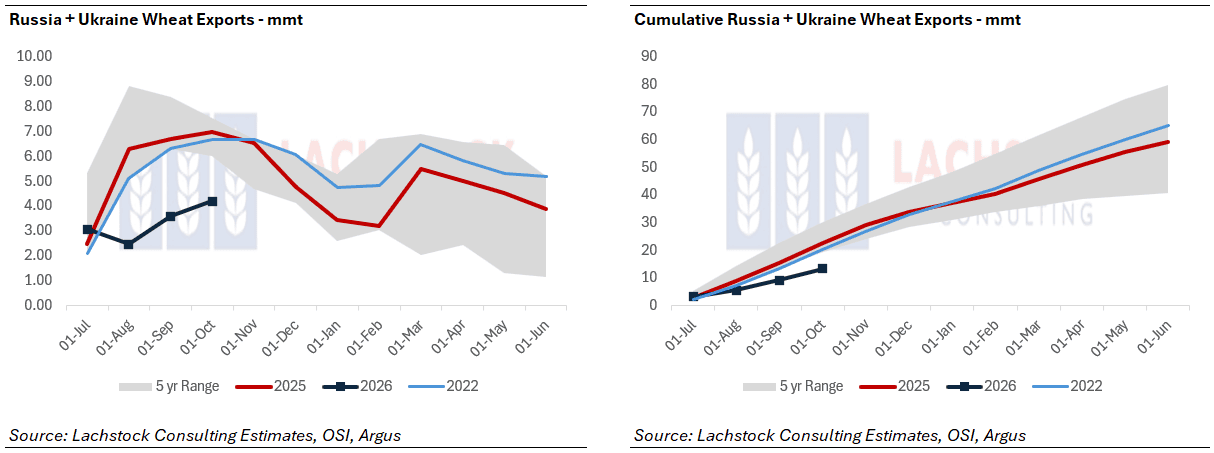
We have been walking the tightrope of harvest pressure vs the fact the Black sea wheat program is around 11Mt behind the 5 yr average. The Asian consumer has played the market well – hand to mouth has served them well and the motivation to get super long just isn’t there today – however, this leaves them an active hand to mouth buyer throughout the year.
 Flags are not a confirmation – and, while there are more flags than a Deni ute muster, the slow, steady approach from the demand side of the market has worked.
That’s despite Russia reporting more than 95Mt wheat in the bin with harvest 97pc complete. AgResource warned both sides may escalate to build leverage, which could cut into Russia’s roughly 3Mt per month of exports.
Ust-Luga showed the risk overnight: a drone strike set fire to grain and oil export infrastructure at the Baltic port and injured three workers, though prices pared gains as the damage was assessed. Witkoff and Kushner meet Putin in Moscow on Thursday, then Zelenskyy in Dublin. Zelenskyy says progress is possible by early 2027, but territory remains the sticking point and the only concrete movement is a prisoner exchange of up to 1,200.
Matif outperformed, with the Dec26 swap up 7.31 to A$382.96 and the Chicago Dec26 swap up 5.18 to A$322.62.
Support came from China booking French and Argentine cargoes and from Germany cutting its winter wheat crop 14pc after drought.
Locally, ASX gained 3.50 to 333.5, and bids should open $1-2 higher on the weaker AUD.
Long queues at Argentine ports point to a large crop that will keep pressure on lower-protein values, while APW-and-better buyers will watch whether Ukraine keeps hitting Russia’s Baltic export capacity.
Naomi Blohm of Total Farm Marketing sees the harvest low as in, with stocks-to-use back below 11pc.
The USDA also cut Ukraine’s corn exports 10pc to 20Mt, and Germany’s DRV has corn production down 17pc at 4.1Mt after yields fell 20pc.
Soybeans added to gains after a smaller-than-expected crop increase and lower ending stocks on stronger exports, with meal up 3.20 to 329.7.
RCM’s Doug Bergman says a bigger move needs crop stress in South America, and analysts expect Conab on Friday to put Brazil’s soybean crop at 181.7Mt.
Vegetable oils led. Bean oil rose 1.11 to 63.88 for a second day of gains on crude and a cut in world soyoil stocks to 6.53Mt, and palm jumped 154 to 4,410, with Malaysia holding its export tax at 10pc for December.
Matif rapeseed rose 12.50, more than a weaker euro and firmer crude can explain. Local canola could open $15-20 higher, though $10-15 is more likely until Winnipeg and the wider vegetable oil market confirm the move.
Barley should gain about $1 on the AUD.
Chinese bids through to June are flat to February, but China keeps expanding malting capacity despite falling domestic beer consumption, which helps offset softer demand from its pork sector.
Thai 5pc rice reached US$510/t, its highest since December 2024.
Macro: The AUD opens another 0.3c lower. Fed comments on controlling inflation lifted the USD, and domestic data softened.
New home loan values fell a record 15.5pc in the September quarter, almost double expectations, with investor lending down 32.3pc and first-home buyer loans down 8pc. That follows five RBA hikes this year to an 18-year high cash rate of 4.85pc and the removal of investor property tax concessions, and CBA reported arrears up 7 basis points.
November inflation expectations at 11am could move the AUD enough to shift bids. If city lending stays subdued, banks may lean towards well-run agricultural borrowers, so a post-harvest conversation about storage, machinery or expansion finance could be timely.
Crude rose on Iranian strikes on Hormuz shipping, with the move reported at up to 2pc overnight against a settlement gain of 0.57pc.
Tehran’s security chief denied talks with Washington.
Dutch gas rose 2.4pc to €86.78/MWh.
The Iran war has removed nearly a fifth of global LNG exports, Europe’s storage is drawing down from unusually low levels, and Orlen cancelled a long-term Qatari contract.
That adds to the case for higher European nitrogen costs into spring.
In Washington, the White House warned the incoming Democratic Oversight chair that some planned investigations may be illegal, a sign of more friction once the new Congress sits.
Local: Bids were firmer in the west, with canola up A$10/t to $825, wheat at $372 and barley at $326 FIS Albany.
In the east, canola lifted to $772, while wheat was $336 and barley $271 track Geelong.
Malt premiums are still surprisingly wide compared with the last couple of seasons. Expect them to narrow as harvest ramps up, with early reports of barley yielding 5–6t/ha and making malt across parts of the Wimmera and Mallee. How much beer can we drink?
Northern markets remain fairly steady, with wheat at $418, barley at $390 for Jan onwards and sorghum at $355 for Mar/Apr onwards, all delivered Darling Downs.
HAVE YOUR SAY