

Weather: Argentina: The Rosario exchange sees 23.8 million tonnes (Mt) of wheat in the MY 2026/27, marking the country’s second-largest crop on record. However, industry contacts are concerned that an unusually strong El Niño event could bring unfavourable weather conditions that disrupt the harvest and raise quality issues, with persistent rainfall, low temperatures and limited sunlight increasingly slowing fieldwork and raising disease risks.
United States: As of early November, most of Kansas and eastern Colorado were drought-free in the wake of widespread fall rainfall, and AccuWeather expects an El Niño-driven subtropical jet to bring heavy rain to Oklahoma and Texas this winter. Meanwhile dryness intensified through the lower Mississippi Valley, lower Midwest and Tennessee, and winter wheat was last rated 46 percent good/excellent ahead of Monday’s update.
Brazil and Southeast Asia: Conab said rain accelerates soybean planting in MT and GO, but hurts wheat and rice in the South.
In Indonesia, the palm oil association warned El Niño could take 3Mt off production, adding to the risks for vegetable oil supply into 2027.
Markets
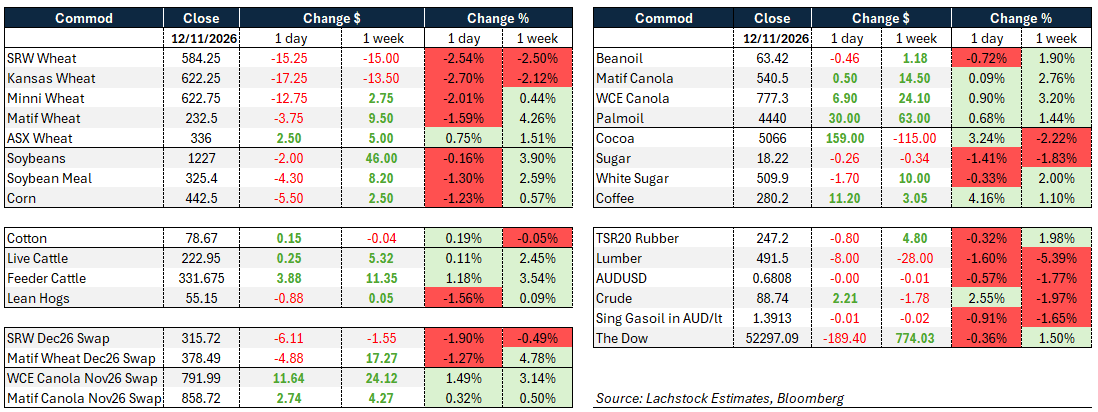
A hot US CPI print and the dollar at a 19-month high drove broad selling in Chicago. Kansas wheat fell 2.70pc after the USDA cut its HRW export outlook, and Chicago fell 2.54pc.
Non-US wheat held up much better. Matif is still up 4.26pc for the week and ASX gained 2.50 to 336, supported by lower Russian exports, Black Sea strikes and Rabobank’s view that prices stay firm into 2027.
Oilseeds outperformed. WCE canola rose 0.90pc on a weak Canadian dollar, palm gained 0.68pc on the Indonesian El Niño warning, and soybeans are up 3.9pc for the week on WASDE tightening and steady Chinese buying.
Crude rose 2.55pc after Trump ruled out needing an Iran deal, while the AUD fell 0.57pc to 0.6808 on Fed hike expectations. Friday’s US export sales are expected to show about 3.2Mt corn and 1.1Mt soybeans.
Day Ahead – Australia
Rain will slow harvest through SA and Vic – BOM not calling for much but from the wheat belt of the Adelaide Hills, things are setting in.
The US inflation print is significant, the other data prints were a little mixed. Jobless claims were higher than expected at 200k. Home sales were better than expected. Federal Budget deficit was bigger than expected. The data points towards a US economy experiencing persistent inflation alongside gradual weakness in housing and some softening in labor demand. The inflation surprises are the most significant developments, potentially reinforcing a cautious Federal Reserve stance on further rate cuts.
Aussie is saving value today. It’s a big part of the reason we have seen the barley bid return as China values start to kick in.
 .
Kansas took the heaviest hit after the USDA trimmed its HRW export outlook earlier in the week, sending buyers to other origins.
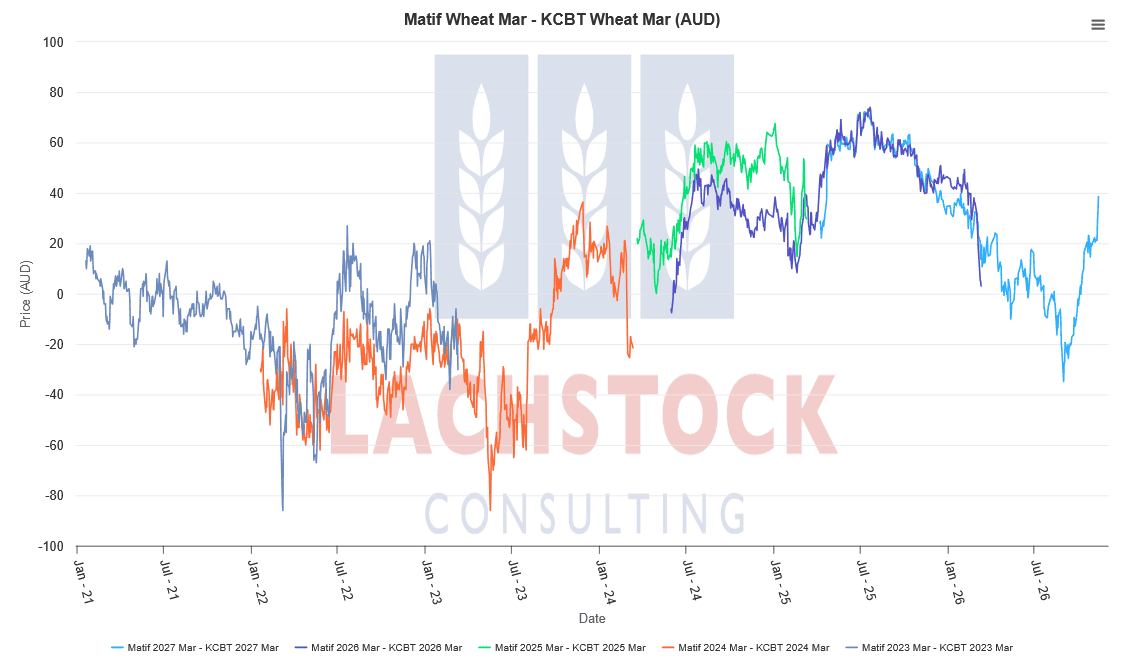
The SRW Dec26 swap fell 6.11 to 315.72. Matif gave back 3.75 but is still up 4.26pc for the week, and the Dec26 Matif swap at 378.49 is up 17.27 over the same period, so the European premium over Chicago keeps widening.
ASX wheat went the other way, gaining 2.50 to 336. Rusagrotrans expects Russian November wheat exports of about 3.15Mt, down from October’s season-high 3.3Mt and well below last year as terminal strikes limit loadings.
Egypt is the largest buyer this season at 1.7Mt followed by Nigeria. Rabobank warned that depressed farmgate prices in Russia and Ukraine could cut next season’s planted area, and that even a quick ceasefire may come too late for winter sowing. It expects wheat prices to stay supported well into 2027.
In Australia, GrainCorp beat forecasts with FY26 revenue of A$7.13 billion and underlying profit of $30.5 million, but guided to lower FY27 revenue and only modest margin gains.
Cory Bratland of AgMarket.net said export pace is improving but needs to speed up further to avoid more demand cuts.
Mississippi barge loadings recovered strongly in the week to 7 November and St Louis barge rates eased to $21.87/st.
Soybeans held up better than the rest of the complex. The USDA lifted the export forecast by 25 m bu to 1.72 bn and cut carryout to 300 m bu, and it confirmed another 136,000t sale to China, although farmer selling capped gains.
Some analysts doubt the 300 m bu carryout given a combined Brazil and Argentina crop of around 236Mt. Meal fell 4.30 to 325.4 and bean oil fell 0.46 to 63.42.
Corteva flagged a credit squeeze in Brazil, where Iran-linked fertiliser costs, high interest rates and rising farmer defaults are limiting what growers can invest.
WCE canola rose 6.90 (+0.90pc) to 777.30, its biggest gain since mid-October.
A Canadian dollar near a one-year low outweighed a larger global rapeseed estimate.
The Nov26 WCE swap gained 11.64 to 791.99 and the Matif canola swap added 2.74 to 858.72.
Chevron’s restart of its Ralston, Iowa biodiesel plant adds to the improving crush demand story.
Palm oil gained 30 to 4,440 after the Indonesian Palm Oil Association warned El Niño could cut output by 3Mt.
Russian strikes on Ukrainian processing are escalating. Kernel has halted all of its crushing plants and suspended oilseed purchases, a soybean plant was hit on Sunday, and Ukrainian military intelligence expects more strikes on silos and sunflower oil plants.
The Black Sea accounts for two-thirds of world sunflower oil exports, and Ukraine’s central bank sees $4.6 billion of farm export revenue lost in the second half.
Macro: The US CPI surprise was the main driver. Expectations of more Fed hikes sent the dollar to a 19-month high, pushed the Aussie down 0.57pc to 0.6808 and kept the Dow under modest pressure.
Crude rebounded after Trump said the US no longer needs a deal with Iran because it has “got their Strait”, and told Vance to drop back-channel talks and focus on domestic issues.
Brent settled about 3.3pc higher near $96.
Trump also told radio host Hugh Hewitt he was ready to resume strikes if the status quo was disrupted.
This comes a week after midterm losses that were partly blamed on war-driven fuel prices. Ukraine continues to hit Russian refineries, which keeps Russian fuel exports restricted.
Local: Bids were firmer in the west, with canola back up to A$845/t, wheat at $377 and barley at $328 FIS Albany.
In the east, canola gained $12 to $785, while wheat was $338 and barley $272 track Geelong.
The softer Aussie dollar is helping local bids, with the AUD now below US68¢ after a hot US inflation print and flat inflation expectations in Australia yesterday.
Cool, wet weather across SA and Vic today is set to bring harvest to a halt in plenty of areas. Poor timing if you’re trying to fill a boat with barley over the next week.
HAVE YOUR SAY