

Weather: El Niño is building toward its peak, with NOAA CPC putting a 63 percent chance on a very strong event at its peak from November 2026 to January 2027. Copernicus reported that October continued the pattern of remarkable global warmth, with record global and surface ocean temperatures.
In Brazil, soil moisture recovered across the Centre-West and soybean planting sped up, with Mato Grosso passing 60pc of planned area. Conab still flagged irregular rain and heat, and longer-range models bringing dryness into Mato Grosso remain the main risk for South American beans.
In Australia, October rainfall was above average across much of the country, but below average in parts of the southwest and southeast. In early November, low-pressure systems brought rain to large areas of eastern and northern Australia while much of Western Australia stayed comparatively dry, which is slowing the eastern harvest and raising downgrade risk.
Argentine wheat avoided the El Niño heat it was expected to bring, with long cool spells helping the crop to a higher 24.3Mt estimate. In Southeast Asia, drought is expected to push palm oil from peak production straight into a low cycle from February. US winter wheat has gone into dormancy with plenty of moisture.
Markets
Chicago wheat ended 10 straight weekly losses as the Black Sea talks stalled and Ukraine hit Russia’s rerouted Baltic exports. Southern Hemisphere harvest pressure and weak US sales mean a large fund short is the main trigger for any sustained rally.
Corn had record weekly US export sales for the period, led by Mexico. With Ukraine’s exports falling and the US harvest finished, US corn is set to pick up more export business, though cumulative sales still lag last year.
Soybeans gained 4.5pc on the week on Chinese buying and hopes for APEC, and El Niño risk in Mato Grosso keeps a weather premium in place. Canola and palm were firmer on a weak Canadian dollar, a stronger palm supply outlook and growing biofuel demand.
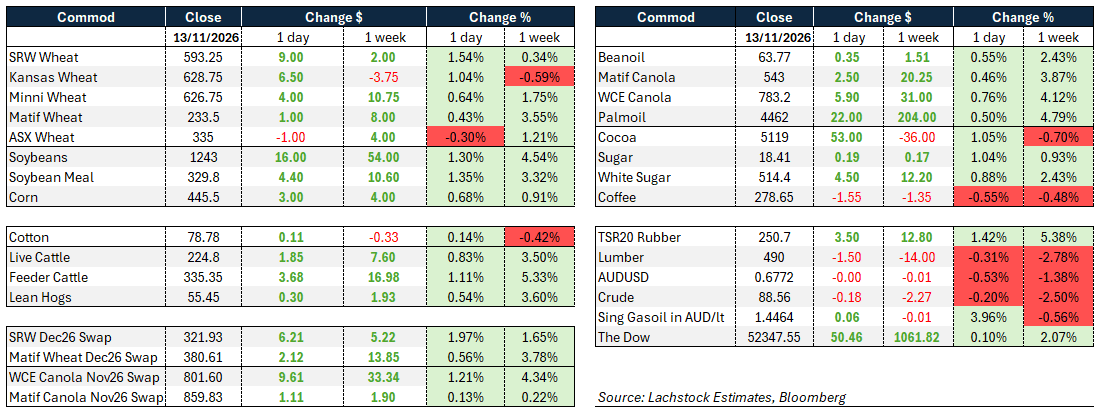
Bets on a Fed hike strengthened the US dollar and cut the AUD by 1.4pc for the week. That lifted local values, with the SRW and WCE canola swaps outperforming their futures, while crude fell 2.5pc on surplus forecasts despite Middle East risk.
Day Ahead – Australia
Predictably the hope surrounding a ceasefire in the Russian/Ukraine conflict fades. An interesting skew – Zelenskyy has proposed not joining NATO if Russia leaves the Donbas – unlikely but he said he would put it to a vote – not sure what Vlad would think of this – I think he is probably a hard no, but we will see.
Harvest is grinding along albeit wearing a jumper. Stop/start but grinding ahead all the same.
Australia’s biggest wheat challenge will be competition from Argentina which, given another production increase, is getting stronger. Another reason that the Asian consumer is not in any rush. Offers keep coming.
Yes the global balance sheet has tightened given the Black sea interruptions but, with Argy and Australian production increasing, the blow has been softened somewhat.
 .
The Abu Dhabi talks produced a prisoner swap and little else, and Zelenskyy said Russia was not ready for a maritime ceasefire. Strikes continued on both sides, including Ukraine hitting Ust-Luga, now one of Russia’s main Baltic wheat outlets after shipping 684kt in October. Russian seaborne grain exports fell 55.8pc y/y to 2.8Mt in October. Black Sea terminal volumes collapsed 94pc to 339kt, partly offset by a jump to 1.72Mt through the Baltic and Arctic, and winter will make that rerouting harder to keep up.
Ukraine’s season-to-date grain exports are 7.13Mt, down 33pc, with wheat down 39pc at 4.1Mt.
US export sales were a marketing-year low of 182.8kt against 500kt expected, though the previous two weeks totalled 1.3Mt.
Lower prices are drawing buyers elsewhere: Algeria took at least 630kt, and China booked French and Argentine cargoes.
On supply, Brazil cut its crop to 5.3Mt from 5.7Mt. Rosario lifted Argentina to 24.3Mt from 23.8Mt because cool weather replaced the El Niño heat it had expected.
CBA’s Dennis Voznesenski said harvest disruption and quality concerns in Argentina and Australia could make US supply more appealing (not sure I agree with this given quality we have seen).
French soft wheat planting reached 93pc, against 88pc last year and an 82pc five-year average, and US winter wheat has good moisture on higher acreage.
Positioning is the best argument for a turn.
The SRW Dec26 swap rose 6.21 to 321.93, the Matif Dec26 swap added 2.12 to 380.61 (+13.85 on the week), and ASX wheat eased 1.00 to 335.
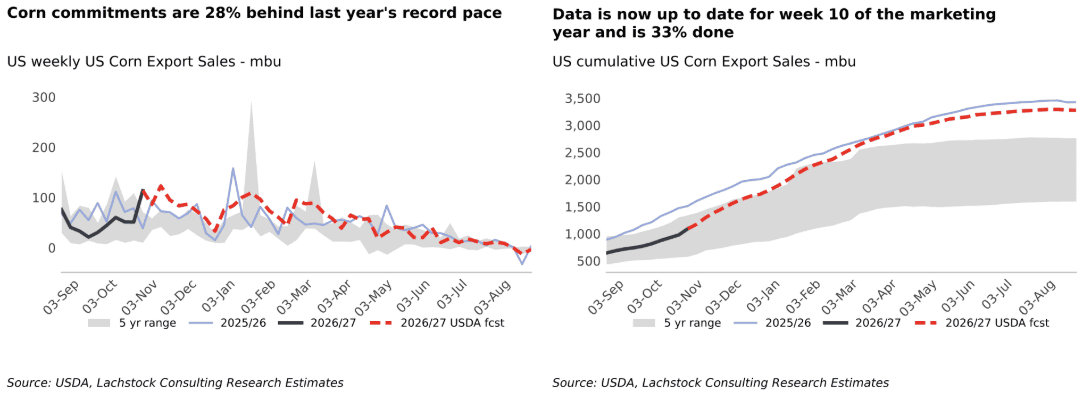
Weekly US sales of 3.48Mt included a marketing-year high of 2.88Mt for 2026/27, led by Mexico, which also took a 303.3kt flash sale.
StoneX’s Mike Castle called it the biggest week since January and a record for the period, though cumulative sales still trail last year by 27.8pc.
The US harvest is nearly done and the roll is over, so if Ukraine keeps falling short, more buyers will turn to US corn.
Conab held Brazil’s total corn crop at 148Mt.
Soybeans were bid for most of the session and gained 4.5pc for the week. Support came from flash sales to China (134kt), Vietnam (120kt) and unknown destinations (100kt), plus optimism before Trump meets Xi at APEC in Shenzhen this week.
Weekly sales of 1.15Mt fell 21pc and missed the 1.4Mt expected.
Conab kept Brazil’s soybean crop at 181.6Mt against a 181.7Mt survey, with planting 66.8pc done.
It still urged caution because of irregular rain, heat and El Niño, and some longer-range models bring dryness into Mato Grosso.
NOPA’s October crush is estimated at 225.4 million bushels, with soyoil stocks rising to 1.079 billion pounds.
ICE January canola settled at C$783.20/t, up C$5.90 and just short of C$790. It was helped by firmer vegetable oils, technical momentum and a Canadian dollar near one-year lows.
Weekly exports rose to 308.5kt from 284.9kt, while domestic use eased to 190.8kt.
Canada and China have extended their deal on lower Chinese tariffs through 2028.
The WCE Nov26 swap gained 9.61 to 801.60 (+4.34pc on the week), while the Matif canola Nov26 swap edged 1.11 higher to 859.83. Palm rose 22 to 4,462 ringgit (+4.79pc on the week).
Dorab Mistry expects the recent sell-off to reverse, with prices holding 4,500 to 5,000 ringgit through April as El Niño cuts output by about 2.7Mt next year. Gapki sees Indonesian output falling 3pc to 59.9Mt in 2027.
Oil World’s Thomas Mielke flagged a 3Mt Indonesian drop and a 300kt fall in Malaysia.
Biofuel demand is building too: the IEA raised its global biofuel supply forecast, and Chevron is restarting its 42 million gallon biodiesel plant at Ralston, Iowa.
Macro: Hotter-than-expected US inflation strengthened bets on a Fed hike and lifted the US dollar.
The AUD lost 1.4pc on the week and the Canadian dollar sat near a one-year low, while the Dow still gained 2.1pc. Crude finished slightly lower and down 2.5pc on the week, as fears over the Middle East conflict were offset by the IEA’s projected fourth-quarter surplus.
Mistry warned that if Hormuz reopens and fuel prices drop, biodiesel would need subsidies, which would be bearish for vegetable oils.
The Washington Post reported that Russia’s negotiating text revives its demands from before the invasion: NATO deployments back to 1997 lines and Ukraine barred from EU defence policy. Zelenskyy said the US had, for the first time, floated NATO membership in exchange for a Donbas withdrawal, and said he would put any such deal to a public vote.
EU leaders agreed in Dublin to send a negotiating team drawn from Britain, France, Germany, Italy, Poland and the EU, and Kushner said no deal could be done without Europe.
Trump meets Xi and Putin at APEC this week.
Separately, Friday’s four-hour FAA ground stop led to more than 12,000 cancellations. It was traced to a router fault during an L3Harris switch from copper to fibre in Arkansas, and Transportation Secretary Duffy is now seeking US$50 billion in emergency funding to modernise the system.
Local: A strange end to the week with outlook outage on Friday curbing activity.
Wheat in the west held firm on Friday despite the pullback in offshore futures. Seems like a life time ago.
Cattle kept rising last week: the EYCI added A6cc/kg to about 1,050c/kg, up 151c on a year ago, as rain held back supply. Lamb indicators held near records with light lambs up 53c, and Naracoorte set a national record of $650/head for first-cross ewes as the flock sits at a historic low. October beef exports eased 8pc year on year to about 129,000t, with China still limited by its 55pc tariff, while lamb exports edged up 2pc to just under 25,000t as the US and Middle East picked up.
HAVE YOUR SAY