
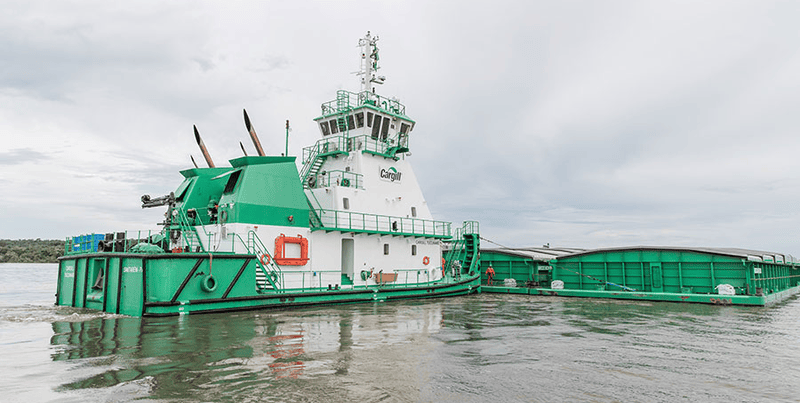
Brazilian and multinational companies including Cargill use Brazil’s Arco Norte to barge corn and soybeans to export vessels. File photo: Cargill
DROUGHT and falling water levels across the Amazon basin are severely disrupting key waterways that function as Brazil’s “grain highways,” including the Tapajos River and the Madeira River, forcing major cuts in cargo capacity and slowing down the transport of soybeans and corn to northern export terminals.
Low water levels choke these crucial water highways. Cargo vessels, grain barges, and passenger ferries struggle to navigate the narrow, winding channels, severely delaying the delivery of food, fuel, and medical supplies to remote communities upstream and slowing the downstream movement of grain to larger export terminals on the Amazon, then on to consumers across the globe.
Logistics transformed
Brazil’s grain exports through its northern ports, collectively known as the Northern Arc, or Arco Norte, have transformed the country’s agricultural logistics over the past decade as production ballooned and export demand skyrocketed, dramatically easing historic bottlenecks at southern ports such as Santos and Paranaguá.
Located north of the 16-degree south parallel, which crosses the middle of Brazil, this network accounted for 39.5 percent of Brazil’s combined soybean and corn export campaign in 2025, moving 58.01 million tonnes (Mt) of grain. The two main river spines feeding the system moved 28.9Mt of grain that year, 16.8Mt on the Tapajós and 12.1Mt on the Madeira. Network volume has increased from 36.6Mt in 2021, and in the first nine months of 2026, total soybean and corn shipments via these northern export corridors reportedly reached 48.7Mt.
In 2025, northern ports handled 48pc of the nation’s corn exports. By September 2026, that share climbed to 51.2pc, making the Northern Arc the primary international gateway for Brazilian corn. Northern terminals moved 36.2pc of Brazil’s soybean exports in 2025, rising further to 38.7pc through the first three quarters of 2026.
Characterised by abnormal warming of the Pacific Ocean, El Niño disrupts atmospheric circulation and suppresses cloud formation and rainfall over the Amazon basin. The weather phenomenon left its mark the last time it was active, causing severe drought between 2023 and 2024.
While water levels in the Tapajós and Madeira remain slightly above the record lows seen in 2023 and 2024, they are well below those seen in 2025. The ongoing navigation limits and transhipment workarounds are increasing grain transit times and logistics costs across the entire Northern Arc trade corridor.
Maritime authorities have enforced strict draft limits and night navigation bans along the Amazon, Madeira and Tapajós rivers. Barge convoys and ocean-going vessels regularly reduce cargo intake by 30-50pc, and more during peak low-water periods, to avoid grounding.
According to Edeon Vaz, executive director of the Agency for Sustainable Development of Waterways and Export Corridors (Adecon), cargo transportation on the Madeira River fell to 70pc of capacity for a short period in mid-October before recovering to 100pc late in the month. However, the Tapajós was hit hardest.
“The river level has stopped falling, but barge operations are running at 60pc of capacity,” Mr Vaz said last week.
Brazil’s northern grain terminals and associated logistics supply network are sized for full water flows. In a dry year, the shallowest few kilometres of its rivers decide how much of that capacity exists. In a high-water environment, a standard Madeira convoy is one pusher and 16-20 barges of about 2000t each, while Tapajós convoys can contain as many as 36 larger barges carrying a total of 110,000t.
Loads restricted
Load restrictions on barges and smaller convoys due to low water levels, combined with daylight-only running when the river gauge falls below 4m, multiply against each other, compounding the situation to such an extent that a river can lose most of its carrying capacity in just a few weeks and win much of it back in a few days, just as the Madeira did in the middle of October, while the Tapajós kept falling. Grain barges on the Tapajós are designed to sail fully loaded in about 4.5m of water. By late October, water levels at Santarém, a major logistical and trade bottleneck for agricultural exports located at the confluence of the Amazon and Tapajós rivers, had fallen to 1.38m, well below the level required for fully loaded barges.
Road, barge, rail transhipment
One of the main drivers of Brazil’s northern grain logistics transformation is the corridor formed by the BR-163 highway and the terminals in Miritituba, Pará. The highway has become central to connecting Mato Grosso’s grain-producing regions with the Amazon waterway system and international markets. Paving stretches of highways like BR-163 slashed trucking times from northern Mato Grosso to river terminals, transforming the northern route from a secondary option into a core pillar of Brazilian agricultural trade.
The growth of the Northern Arc is also increasing pressure for new rail alternatives. In this context, Ferrogrão, or EF-170, stands out as one of the main projects aimed at expanding transportation capacity between Mato Grosso and the terminals in Miritituba. The project calls for a rail connection between Sinop, Mato Grosso, and Miritituba, Pará, creating an alternative to the predominantly road-based transportation currently used along the corridor.
According to Adecon, the transhipment terminals at Miritituba, where thousands of trucks arrive every day to deliver the grain for loading on to the Tapajós barges, have an annual capacity of around 19Mt. The Tapajós corridor moved 16.8Mt in 2025, but all that capacity sits idle when loaded barges cannot navigate the river system below.
One solution being seriously explored, as in other such logistics systems around the globe, is introducing shallow-draft barges. The cheapest and most practical capacity Brazil can add to the Northern Arc network is a fleet that keeps moving when the river level drops: barges that ride higher in the water and require less draft, convoys that remain legal at lower gauges, and vessels that can navigate safely by night.
HAVE YOUR SAY