
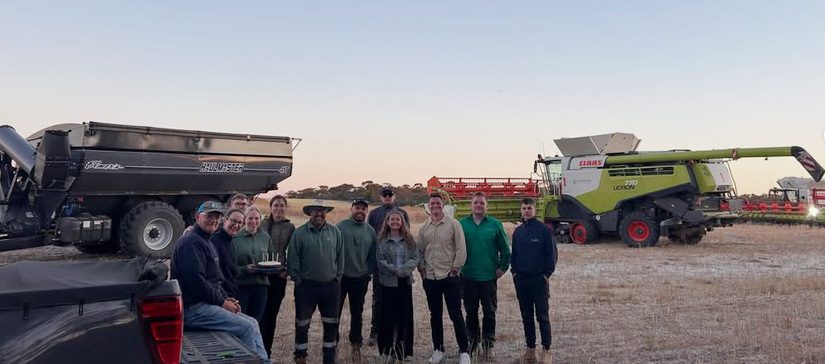
Estonian and German nationals in Australia on WHM visas are an essential part of the harvest crew currently working for Ashley and Megan Reichstein (far left) at Laurina Farms in WA’s Esperance region. Photo: Laurina Farms
THE FEDERAL Government has today announced changes to the Working Holiday Maker visa, including the introduction of a Next Year Regional Work Guarantee.
From 1 March 2027, non-UK citizens seeking one of the 45,000 second visa or 25,000 third visa places in 2026-27 will need to hold a Next Year Regional Work Guarantee.
A portal to register interest in these 70,000 visas in total will open on December 1, and is the path to the required invitation to apply.
After registrations open in December, the first monthly invitation round is expected in mid-January 2027.
Registrations will remain valid until 30 June 2027, and an invitation will be valid for 12 months and will allow a person to apply for a visa.
Current WHM visa-holders have until 28 February 2027 to complete the relevant specified work and lodge a valid application under the existing process.
The specified work requirement for a second visa will increase from three months to four months from 1 March 2027, where the requirement applies, and work completed before that date will count towards the new requirement.
The work requirement for a third visa will remain at six months.
Today’s announcement follows a slowdown in approvals for WHM visa applicants looking to work in agriculture which started with Ministerial Direction 119 dated July 24, and varies from a plan earlier proposed by the government to offer only 5000 third visa places.
Following extensive lobbying from the agriculture and other sectors, Directions 121 and 122 gave priority to WHM visa applicants either booked in or hoping to find work in the current winter-crop harvest.
“Working Holiday Makers make an important contribution to our economy, especially in agriculture, tourism and hospitality and in regional Australia,” Minister for Home Affairs Tony Burke said.
“But when demand grows too fast, the government needs the tools to manage the program properly.
The registration process is a fair way to do that.
“These changes give businesses and Working Holiday Makers clear rules and time to plan, while making sure the program continues to support the regions and industries that rely on it.”
Mr Burke said Australia will continue to welcome WHM visa-holders.
“These reforms make the program fairer, more targeted and sustainable for the long term.”
Ballot of concern: GrainGrowers
GrainGrowers said the Federal Government proposal announced today remains “unnecessarily complex” and fails to deliver certainty that the quantity of skilled workers required by the grains industry will be able to enter Australia.
GrainGrowers deputy chair and Victorian Farmers Federation Grains Councillor and grower Ash Brooks said growers had consistently raised concerns about reduced access to established WHM visas before alternate pathways were in place.
“We’ve appreciated the opportunity to engage constructively with Government throughout this process and its willingness to listen to industry’s concerns,” Ms Brooks said.
“However, under the announced reforms, growers and visa applicants are still being asked to navigate increasingly complex workforce arrangements and seek spots for a Next Year Regional Work Guarantee, which is in essence a ballot.
“Then all they can do is cross fingers that workers will be successful in being granted a visa.”
Ms Brooks said workforce policy must reflect the practical realities of running a farm business.
“Growers are already managing the day-to-day demands of running a business, meeting compliance requirements and responding to seasonal conditions.
“What growers are asking for is certainty that they can get the workers they need when they need them to ensure they can plant and harvest. ”
GrainGrowers said government has heard directly from growers and industry throughout the consultation around workforce requirements.
“Now Government needs to provide viable pathways that guarantee the workers we need to provide a workforce solution growers can rely on that is straightforward, practical and gives growers the confidence to invest, plan and get on with producing food.
“Growers need certainty that enough workers will be able to work in the grains industry for short periods such as harvest.
NFF, VFF see room for improvement
The National Farmers’ Federation has welcomed today’s announcement of proposed WHM visa reforms, saying the changes show the Federal Government has listened to concerns from agriculture and regional Australia.
NFF president Hamish McIntyre said expanding regional work requirements, delaying the proposed ballot, and increasing the number of third-year visas were important steps in the right direction.
Mr McIntyre said while the changes announced today put agriculture in a better workforce position than the one it faced in September, many unanswered questions remain.
“We need more details on the logistical realities of this reform before we can fully throw our support behind it,” Mr McIntyre said.
“We’ve been clear with the government just how important backpackers are to keeping Australian farms running and food on supermarket shelves.”
Mr McIntyre said WHMs fill roughly one in seven farm jobs nationally and contribute an estimated $726 million directly to regional economies each year.
“Getting these visa settings right is important beyond the farm gate.”
Mr McIntyre acknowledged the government’s constructive engagement as it reconsidered its original proposal, including discussions with Mr Burke, Agriculture Minister Julie Collins and their offices.
“Delaying the ballot gives us valuable time to keep working through our concerns with government and get the settings right.
“Increasing third-year places is also significant progress, although we remain concerned that capping places through a ballot risks creating uncertainty and will decrease productivity.”
Mr McIntyre said the NFF would continue working constructively with the government on the detail.
“Our focus will remain on a migration system that has integrity while ensuring farmers can access workers when and where they’re needed.
“We welcome ongoing negotiations in this important space.”
The VFF said today’s announcement shows an improvement on the Federal Government’s original plan, particularly the five-fold increase in third-year places to 25,000.
“This is a solution in search of a problem,” VFF president Ryan Milgate said.
“The working holiday program wasn’t broken, and farmers have spent the past two months dealing with the uncertainty of the government trying to fix it.
“This whole thing has been completely unnecessary and a major source of disruption heading into peak season.”
“These are temporary visitors. They pick fruit, work in packing sheds and spend their wages in regional towns and tourism businesses, and then they go home.
“They’re not settling here, and they shouldn’t be counted in net overseas migration figures in the first place.”
“Lifting the third-year cap means more experienced workers can come back, and that’s welcome, but rationing a program regional Australia depends on, just to hit a migration target, is still the wrong call.”
“Our message is simple: talk to farmers and work with us on our workforce needs, rather than just lobbing out half-baked ideas and causing uncertainty.”
Source: Federal Government, GrainGrowers, NFF, VFF
HAVE YOUR SAY