
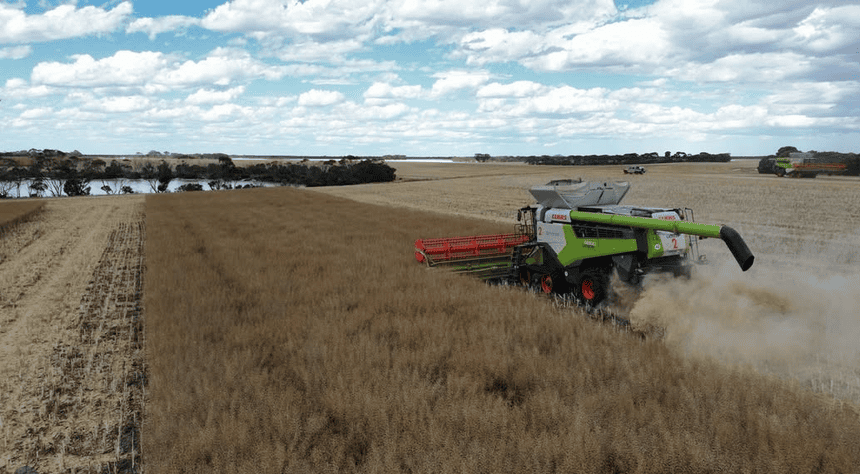
Harvesting canola at Laurina Farms in WA’s Esperance Zone last week. Photo: Laurina Farms
THE GRAIN Industry Association of Western Australia has cut 615,500 tonnes from its production estimate of the WA crop now being harvested.
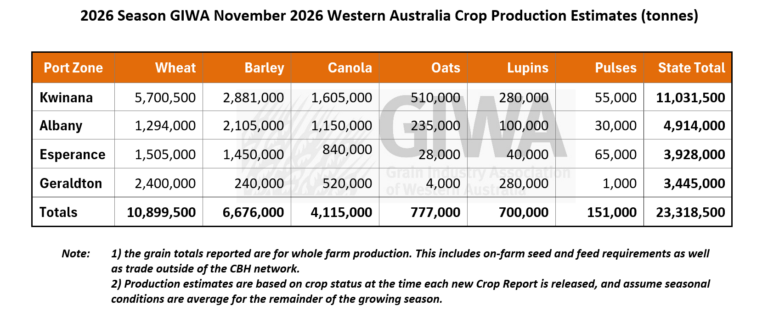
In its November crop report out today, GIWA forecasts a total crop of 23,318,500t, down from 23,934,000t seen in the previous report released October 16.
Most of the cut has come from a drop in the expected canola total, now seen at 4,115,000t, down 10.6 percent, or 485,500t, from the October estimate of 4,600,500t.
GIWA’s wheat estimate has been lifted to 10,899,500t, up 14,000t from October, while barley has dropped 124,000t over the month to 6,676,000t.
GIWA’s lupin estimate is unchanged at 700,000t, while oats has dropped 25,000t to 777,000t, and the pulses figure has climbed 5000t to 151,000t.
In the report, author Michael Lamond said WA’s harvest had been ticking along a little ahead of recent years in terms of percentage of area harvested, but several bouts of storms recently across a wide area of the state have slowed things down.

GIWA report author Michael Lamond.
“Several separate rain events in the south-west and the west coast during October and early November have put those areas behind the remainder of the state.
“Rain this week from Geraldton down to the central and eastern regions has put the brakes on harvest, although overall tonnes in the bin to date is still a little ahead of a normal year.”
Mr Lamond said the early progress is not an indication of a small crop, but more a reflection of the dry finish that evened the ripening of crops earlier than is normally the case.
“Grain yields so far have mostly been above expectations for barley, wheat, lupins, oats and pulses considering the low-rainfall year for most regions away from the Esperance port zone and the northern and eastern rim of the Kwinana North port zone.
“Canola yields have varied depending on the varieties grown and the region, with many in the areas away from the west coast affected by poor main raceme podding which is taking the top off many canola crops.
“This is starting to show up in total tonnes for the state, with both Geraldton and Esperance port zones down on expected tonnes with canola harvesting now mostly completed in these two regions.
“If this trend continues, the expected tonnage across the state reported here may just hit the estimated 4.1-4.2 million tonnes.”
Mr Lamond said barley yields and quality have been very good to date, as they were less affected by the dry finish than wheat in the central and northern regions.
“Wheat in the southern regions has been yielding well and in areas where there was late rain, it is outyielding barley.”
Mr Lamond said lupin yields have been very good out of Geraldton and further south.
“Oat grain yields in the lower-rainfall regions have also been very good, although some loads are being downgraded from OAT1 due to fungal staining rather than grain size.
“This could also be the case further south with the rain that has been about.”
If rain continues during harvest, Mr Lamond said cereal grain quality was likely to be impacted.
“Bright spots so far include the barley yields and quality, lentil grain yields across a large area of the state, faba bean yields in the Esperance area and very good canola yields in the low-rainfall regions, even where there have been problems with podding on some varieties.”
Further detail on crop conditions in individual WA port zones can be found as part of the full report on the GIWA website.
Source: GIWA
HAVE YOUR SAY