
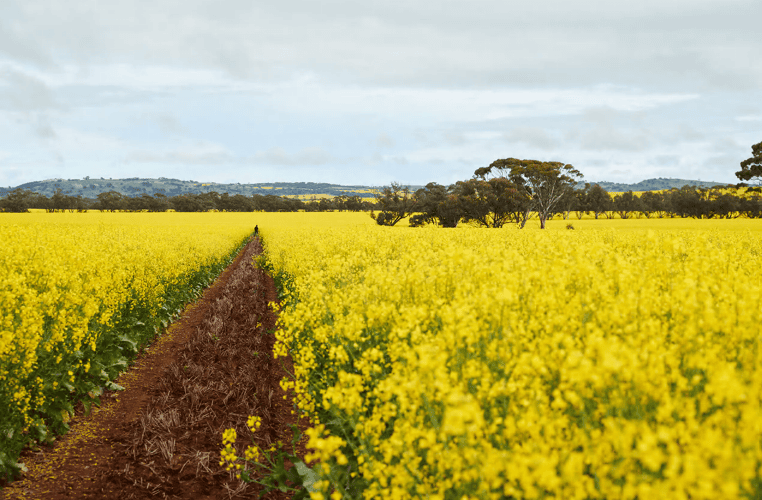
Nufarm’s seed technologies business includes canola, sorghum, sunflower, carinata, and omega-3. Photo: Nufarm
NUFARM has reported record revenue and underlying EBITDA for its seed technologies business in the financial year to September 30, a year after abandoning plans to sell the division and opting instead to restructure and retain it.
Alongside crop protection, the seed technologies division is one of two Nufarm business segments.
It includes traditional seeds such as canola, sorghum and sunflower, as well as newer hybrids such as carinata and plant-based omega-3.
The division’s revenue rose 34 percent to $448.8 million, while underlying EBITDA increased by $72.5M to $86.4M.
Notably, canola revenue alone was a record, driven by Australian and South American plantings.
Nufarm pointed to strong growth in its seeds category, which recorded revenue of $292.8M, up 16pc on the previous corresponding period, and underlying EBITDA of $81.8M, up 22pc.
The renewable oils platform also recorded a turnaround, with underlying EBITDA reaching $4.6M, supported by improved omega-3 pricing and the non-recurrence of the FY25 inventory revaluation.
Nufarm chief executive Rico Christensen said the company was “investing behind” the seed platform, adding that the result demonstrated why.
“Canola grew in both Australia and South America and new product introductions support[ed] the result,” Mr Christensen said.

Nufarm’s Rico Christensen.
He said the renewable oils division was “now profitable” at the underlying EBITDA levels achieved for FY26 due to positive movement in omega-3 and carinata.
“It is mainly omega-3 oil sales which benefited from a better pricing environment, together with the non-recurrence of last year’s inventory impairment.
“What makes this more durable is the work we are doing to lower the cash needed in omega-3 and the extension of our bp carinata agreement.”
He said the overall seed technologies business was now “delivering what we set out to do: growth with better margins and apply more capital discipline in which technologies we invest in”.
“Seed is a focus for investment with high margins and a strong growth track record.
“The demand for edible oils and biofuels together with the economic benefits of these crops is driving the structural demand growth.
“The opportunity is real and we are matching capital with the commercial milestones we reach.”
Mr Christensen said carinata had benefited from an extended offtake agreement with bp to 2050, which would support “the expansion of carinata as a non-food feedstock for biofuels”.
“In omega-3, we reduced cash cost and the capital allocated and our matching investment with the achievement of commercial milestones.”
In May last year, Nufarm launched a strategic review of its seed-technologies arm, with options on the table including the possible sale of some or all the business platforms.
At its FY25 results announcement in November 2025, Nufarm announced it would retain the platform, which was then known as Nuseed.
Group, crop-protection results
Nufarm’s overall underlying EBITDA rose 25 per cent to $378.3M in FY26.
The group’s statutory net loss after tax narrowed to $79.5M in FY26, compared with a loss of $165.3M the previous year.
The crop-protection division’s underlying EBITDA was broadly flat, declining 1 per cent to $364.6M in FY26.
Currency translation headwinds and manufacturing disruptions were partly offset by the impact of US tariffs.
The Asia-Pacific (APAC) region reported flat underlying EBITDA of $97.3M, despite a 10pc reduction in revenue and a manufacturing incident at Laverton.
Mr Christensen said the Laverton incident was a chemical spill on site that was managed with emergency procedures that “kept everybody safe and the issue was resolved”.
He also gave an update on the crop-protection business in Australia.
“In Australia, margin improved on better portfolio mix, which is the strategy refresh at work.
“We are also progressing the closure of our Kwinana plant so that our footprint matches a tighter portfolio.
“Looking further out, we are progressing our new herbicide Attero towards a launch in 2028.”
Attero is a patented, non-selective knockdown herbicide based on the active ingredient flufenoximacil.
Across the overall division, Mr Christensen said the key strategy in crop protection was “margin and mix”.
“We are deliberately reducing lower margin business and putting more effort into higher margin products.
“We are earning more from each dollar of sales, and we are doing it with less working capital and less capital employed.”
Optimistic outlook
Mr Christensen said he felt there was “optimism in the market with seasonal conditions” across Australian cropping regions.
“As it turned out, the El Niño didn’t have a lot of negative effects on the Australian market.
“So, farmers are optimistic about the current season, but also optimistic about what that then means for the next season.”
He said Nufarm has been cautious about impacts of this on the company’s FY27 results.
“For our expectations in FY27, we have not assumed any improvement in market conditions.
“We are relying on the actions we are taking to improve our numbers.”
The company’s outlook expects further improvement in the quality of earnings, cash flow and return on funds employed as it continues to implement the strategy refresh.
Nufarm is forecasting mid-teens underlying EBITDA growth in seed technologies and mid-single-digit growth in crop protection, with corporate costs expected to remain flat year on year.
It’s 2026 cost savings program is on track, and the company expects to achieve $50M of run-rate cost savings by the end of FY27.
HAVE YOUR SAY