

Weather: US: As of 15 November 53 percent of the winter wheat crop was rated good to excellent, 4 points higher than the previous week and 8 points above last year. Conditions have improved in recent weeks on beneficial rain and mild weather.
Australia: Harvest is in full swing across the NSW plains and outer slopes and in southern Queensland after rain delays, with more rain forecast. The Bureau of Meteorology forecasts 25-50mm over the weekend for districts still harvesting.
Argentina: The wheat harvest covers 11.9pc of the area. The Rosario exchange raised its crop estimate to 24.3Mt, while Conab expects Brazil’s wheat crop to fall 33.2pc to 5.3Mt. The Buenos Aires exchange’s agroclimatologist, Eduardo Sierra, is forecasting two weeks of very uneven rain, sharp temperature swings, and storms above 100mm in parts of the cropping belt.
Russia: Dry soils across key winter wheat areas are threatening crop establishment as temperatures fall toward winter. SovEcon reported Russia’s winter grain sowing as the slowest since 2013, 25pc below the five-year average.
Markets
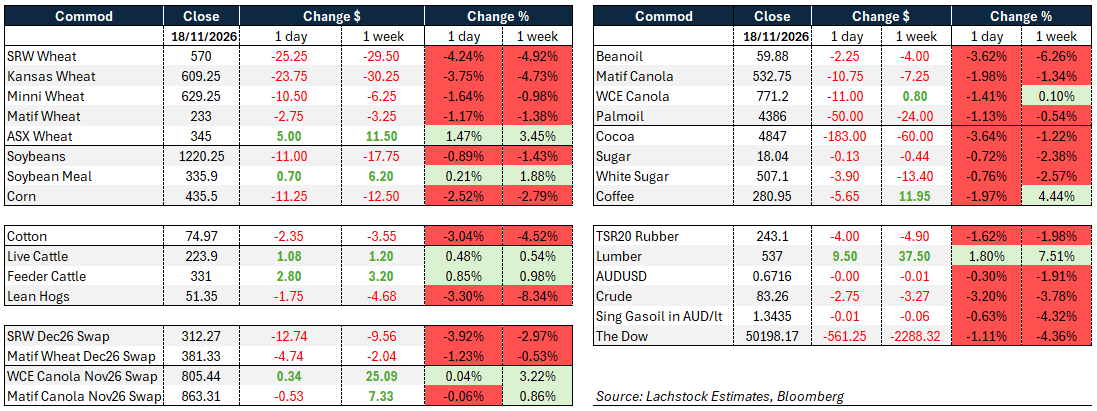
US wheat led a broad commodity selloff. SRW fell 4.2pc and KC 3.75pc, and the SRW Dec26 swap lost A$12.74 to A$312.27. ASX wheat rose $5 to $345, up 3.45pc on the week, as rain delays the east-coast harvest and the AUD weakens.
Corn fell 2.5pc as the market waits to see whether China commits to buying US corn at the Trump–Xi meeting. Soyoil lost 3.6pc as crude fell.
WCE canola fell C$11 on lower crude, rapeseed and palm oil. A weaker AUD held the WCE Nov26 swap steady at A$805.44.
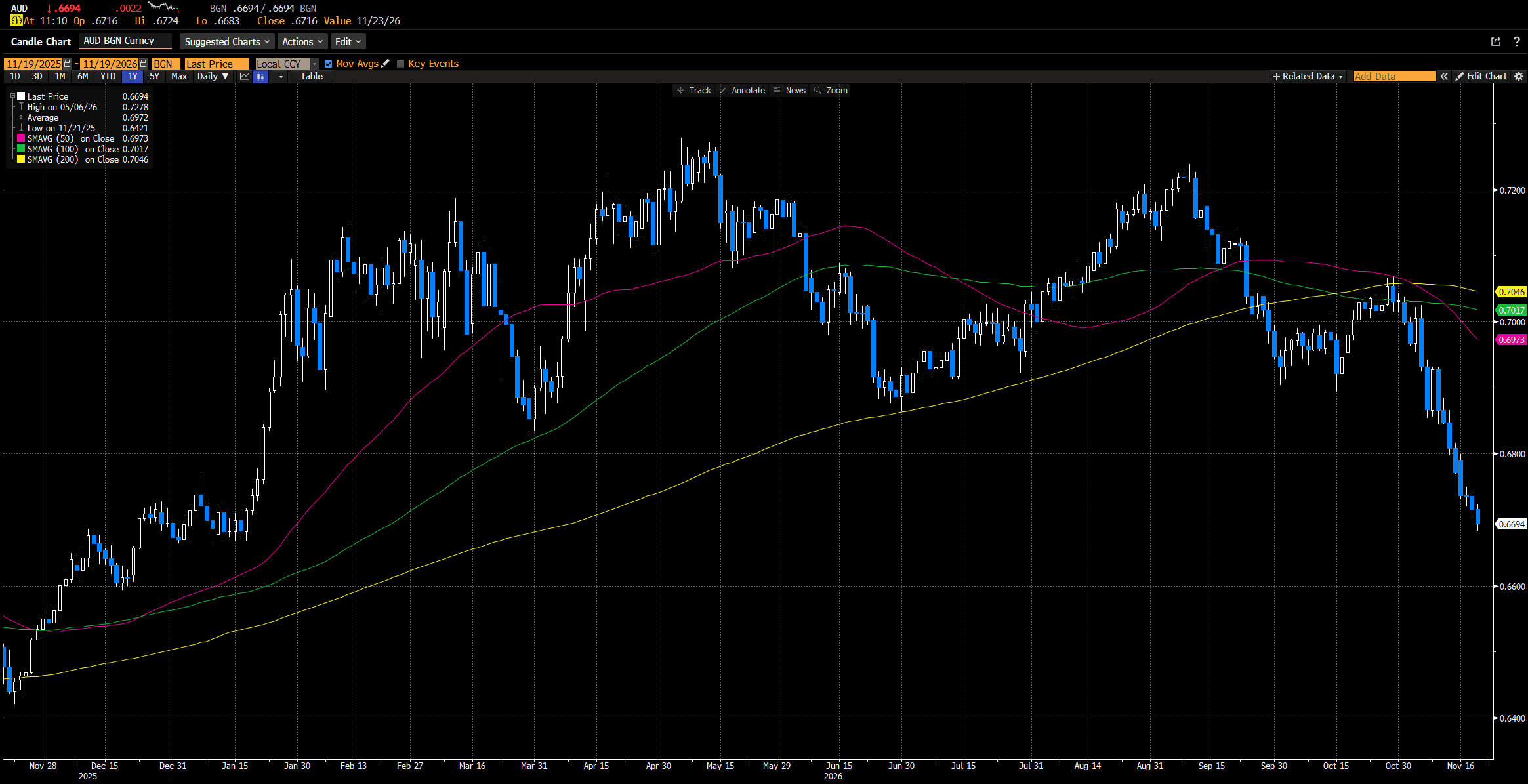
Crude fell 3.2pc and the Dow 1.1pc. The AUD posted a seventh straight loss as Fed minutes and Governor Waller pointed to more US rate hikes.
Day Ahead – Australia
Only 38 cyber attacks until Christmas! That’s certainly what it feels like. The ability for the market to ignore some of the seemingly compelling fundamentals and grab hold of other things is simply amazing.
Locally the jobs data swings the market back to looking for cuts and, more broadly supports a lower AUD.
Crude markets are reacting to the afterglow. Panic buying, restocking and the subsequent consumer demand erosion are all building stocks. I’m simplifying a lot but thats the underlying theme. Meanwhile, the US and Iran exchanged blows again, targeting crude assets.
Despite all of the risks, if you are an Asian wheat consumer – you can still buy wheat…easily.
AUD – Source Bloomberg
.
Futures International said the market has no catalyst to rally and that commodity sentiment is deflating, with big falls in oil and gold.
Traders now treat geopolitical tension as the new normal rather than a reason to buy. Russia’s export picture shows the other side of that: SovEcon expects November shipments to fall to 2.7Mt from 2.9Mt in October because rail congestion and a shortage of grain wagons are slowing deliveries to the Baltic ports Russia has used since the Black Sea disruptions began in July.
Domestic prices moved the other way. ASX wheat gained $5 and now sits about $33 over the SRW swap – although it will be interesting to see how we level out today. H2 and APW gained A$10/t in mid-November on harvest delays, limited grain availability and a weaker AUD.
More rain is forecast for districts still harvesting, so availability of high-protein milling grades remains the main support. Growers are holding grain while they work through moisture and screenings problems.
Total Farm Marketing noted that the firmer US dollar makes US corn less competitive.
In Brazil, Rabobank says fast growth in corn ethanol is absorbing more domestic supply, so less surplus has to be cleared through exports and export parity matters less in setting local prices.
EIA reported US ethanol stocks up 563,000 barrels to 24.9 million, a two-month high.
Soybeans fell 0.9% while meal edged higher, so the losses were in oil: soyoil dropped 3.6% as crude fell.
Canola reversed lower on the same crude pressure, which also pushed rapeseed and palm oil down, with palm at a one-week low on worries about a glut in Malaysia.
Glacier FarmMedia’s analyst puts support for Jan canola at C$740–750 and has lowered resistance from C$800 to C$790.
He expects prices to drift lower over the coming weeks. In local terms, the weaker AUD kept the WCE swap steady at A$805, up A$25 on the week.
Macro: Energy, grains and softs all fell together, and interest rate expectations drove the macro picture. Fed minutes showed almost all officials expect to raise rates in the months ahead.
Bond markets are pricing at least a full 25bp Fed hike in December and nearly the same from the ECB. Governor Waller criticised the FOMC under Chair Warsh for its lack of forward guidance and said the Committee should hike 50bp in December if it will not signal another hike in January. Credit markets are under strain: low-rated spreads are widening, CoreWeave bonds are at distressed levels, and
French borrowing costs are at their highest in more than 20 years.
Crude kept falling. Brent is down about 20% in a month and nearly fell to $90 even though fighting has escalated: the US struck an IRGC missile site on Qeshm Island in the Strait of Hormuz, Iran retaliated against US sites in Kuwait, Bahrain intercepted Iranian attacks for the third time in a week, and the Saudi–Houthi fighting continues. Gulf exports have recovered to 11.4 million barrels a day and US crude and gasoline stocks rose sharply. Bloomberg’s view is that further attacks alone are unlikely to reverse the downtrend while the market moves into surplus.
The main event is at APEC in Shenzhen. Xi greeted Trump at the airport, and Xi, Trump and Putin hold three-way talks on Thursday. The Kremlin says Putin and Trump may also talk informally about Ukraine and Iran. Trump also announced a “very big trade deal” with the Philippines, though Manila described it only as an understanding on economic cooperation.
At home, the labour market weakened sharply. Employment fell 43,500 in October, after a 39,300 fall in September. Consensus had expected 25,000 new jobs. The unemployment rate rose to 4.9% from 4.7%, a level the RBA had not expected until well into 2027 or 2028, given its forecast of unemployment above 5% by mid-2028. Earlier this month the RBA lifted the cash rate for the fifth time this year to 4.85%, the highest in 18 years, on a split 6:3 vote. Governor Bullock described the labour market as still a little tight. Two consecutive large job losses undercut that view. Before the release, money markets priced a 23% chance of a sixth hike by early next year and almost fully priced a cut by Christmas 2027. The data should push the market further toward the RBA having finished hiking while the Fed is still tightening. That is the gap TJM’s Neil Jones cites in calling the AUD toward 65 US cents early next year. The AUD was 0.6718 before the release, after seven straight losses, which equals its longest losing streak since June. A weaker AUD would add to support for local grain prices in Australian dollar terms. Next up is the monthly CPI on 25 November, where a bank preview has headline inflation rising to 4.7% on fuel and electricity and trimmed mean holding at 3.6%.
Local: Bids improved through the west yesterday, with canola back to $850, wheat at $380 and barley at $335 FIS Albany.
In the east, canola was bid at $794, wheat at $345 and barley at $280 track Geelong.
Basis has held up remarkably well so far, helped by a harvest with as many twists and turns as a ball-tampering scandal. Expect some of that basis to erode once headers get a clear run and more grain comes forward.
The premium for protein wheat is widening, with H2 grower bids now around $20 over APW and H2 trading around $395 delivered Geelong. The rain across Vic could make it harder to hang on to the quality that’s still out in the paddock.
HAVE YOUR SAY