

Weather:
Southern Brazil remains waterlogged: a heavy storm hit Rio Grande do Sul on Friday, and Conab reported persistent rain, hail and waterlogging disrupting wheat, rice and soybean development across the southern states, with early signs of bacterial disease in soybean fields, while the Cerrado and Matopiba had their best planting conditions of the season and Vaisala says central Brazil may still need more rain to fully restore moisture.
Argentina has a large but compromised wheat crop: the Rosario Board of Trade raised its 2026/27 production forecast to 23.8 million tonnes (Mt) from 21Mt, but rain and frost have caused some crop damage, high humidity has favoured foliar diseases and fusarium, and persistent drizzle in the north has delayed harvest and raised quality concerns, which is why the trade doubts Argentina can compete for Pakistan’s tender.
In the Northern Hemisphere, a strong blocking high north of the Caspian Sea kept western Russia dry and warm, 3 to 5 °C above normal, into early November, and frigid temperatures now threaten Baltic loadings for January shipment, while US winter wheat condition sits at 54pc good to excellent against a 45pc average.
Markets
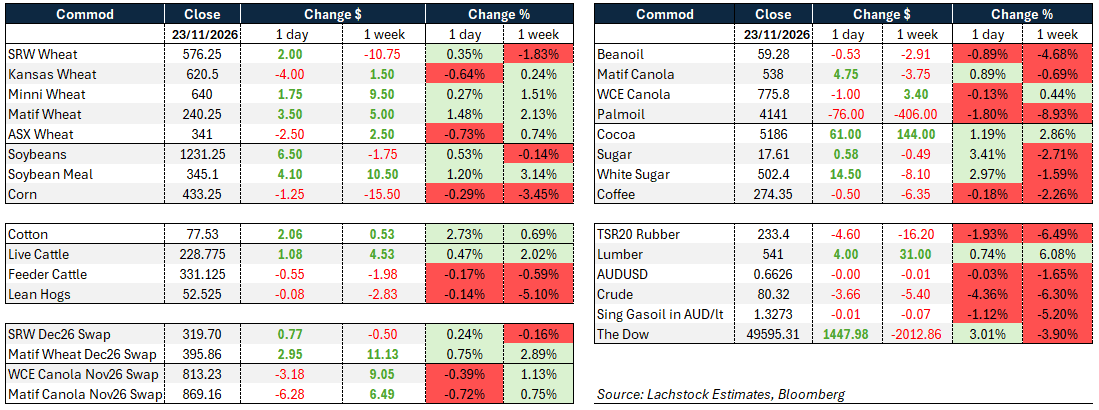
Pakistan’s 800,000t tender gave world wheat its first fresh demand catalyst in weeks and lifted Matif 1.48pc, with Russian Black Sea exports down nearly fourfold year on year, but US wheat lagged as the Dec/Mar spread kept weakening and export pace stayed 33pc behind last year.
December corn is unravelling into first notice day, down 3.45pc on the week, as abundant South American supply and the weak real block any lift in US demand, even with Ukraine largely absent.
Soybeans and meal firmed on Trump’s trade-deal headline and steady export inspections, but palm’s fifth straight loss to a nine-month low and weaker soyoil capped vegetable oils, leaving the canola swaps lower despite Matif futures gaining.
Macro risk appetite swung sharply: Huang’s return to Nvidia drove the Dow up 3.01pc, but crude fell 4.36pc on ample supply, the AUD is down 1.65pc on the week, and Thanksgiving and first notice day should thin volumes for the rest of the week.
Day Ahead – Australia
Wires are all about equity markets and crude weakness. The reapointment of Huang as Nvidia CEO – seems to be a reason to buy things.
The crude market is a little more interesting. JPMorgan sees crude fair value in the high USD$70’s. Middle Eastern supply is recovering faster than expected, Libyan supply is returning with the Sharara pipeline back online and general capital flow is selling the war premium. OPEC meets on the 29th of Nov which has the potential to change the narrative should they cut. Crack spreads are still supporting diesel – ie diesel is falling more slowly than crude if that makes sense.
Quality between Argy and Australia will be key to destination markets – dare we say… are we friendly H2?
.
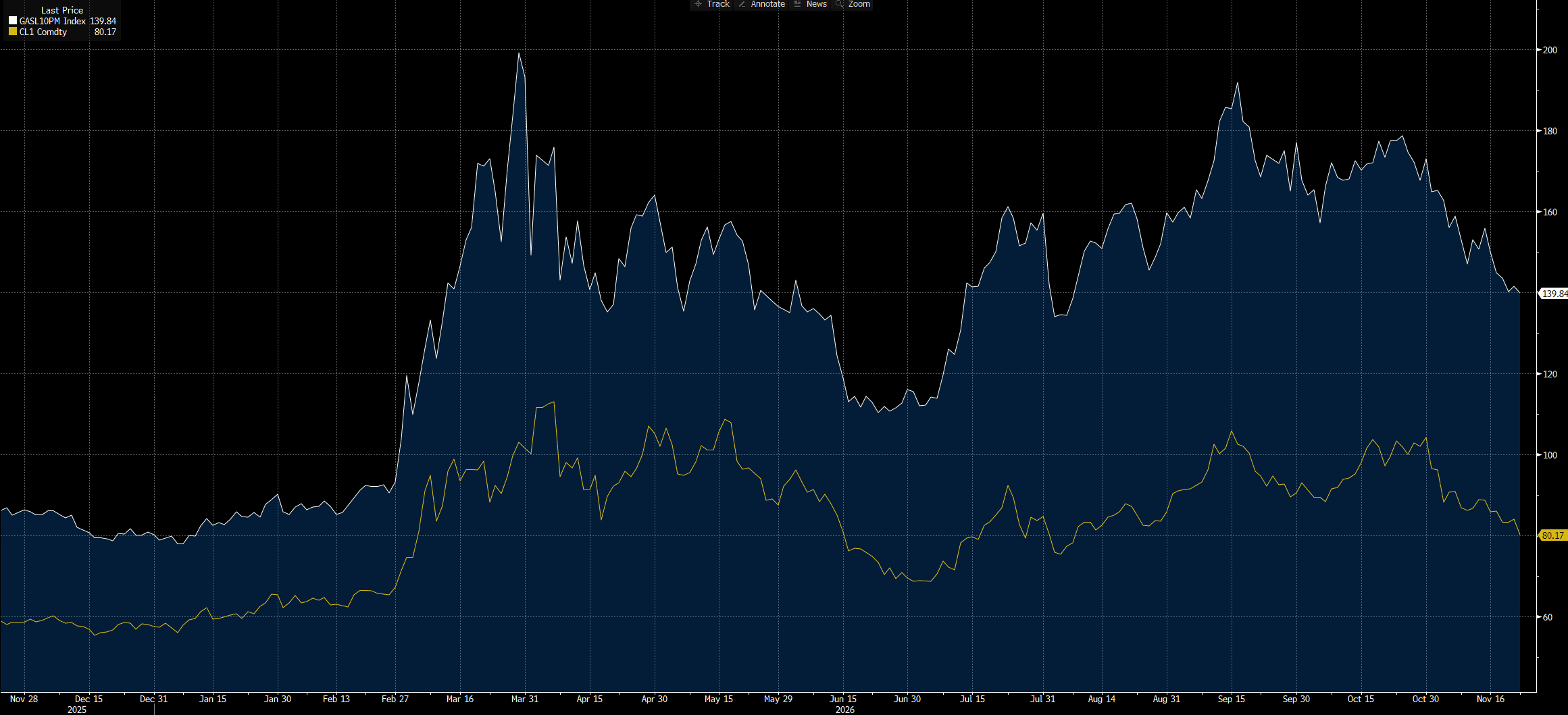
White line = Singapore Gasoil, Yellow line = Spot Crude oil futures. Source: Bloomberg
.
Matif led the gains because it is expected to be in the mix alongside Baltic Russian wheat. A January programme out of the north is exposed to frigid weather disrupting loadings, and Argentine quality may push that origin out. That left the Matif Dec26 swap at 395.86, up 2.95 on the day and 11.13 on the week.
Russian supply remains badly impaired. The Russian Grain Union says 1.1Mt of grain left ports over 1–20 November, 3.6 times less than a year earlier. Wheat shipments fell to 912,000t, and Azov–Black Sea volumes dropped to 179,600t from 3.65Mt, while Baltic loadings rose 3.4-fold, led by Ust-Luga. Sovecon puts total November grain exports at 3.15Mt against 3.5Mt in October. The conflict is moving closer to NATO territory: Finland’s military said Ukraine likely carried out the weekend drone strike on the Russian cargo ship Sparta II, and Ukraine’s own weekly grain exports fell 10pc to 310,200t.
In the US, the Chicago Dec/Mar spread kept weakening after the earlier rally on China speculation faded. March settled at 595.50, and the SRW Dec26 swap ended at 319.70, up 0.77. USDA reported 110,000t of white wheat sold to unknown destinations. Inspections of 344,886t beat expectations, but the export pace is still 33pc behind last year.
Winter wheat condition rose a point to 54pc good to excellent, against a 45pc average.
Elsewhere, the lowest offer in Bangladesh’s 50,000t tender was US$322.92/t CIF liner out, Taiwan’s millers pushed their 89,000t US tender back to 2 December, and Euronext is promoting its new Black Sea wheat and corn futures as a better hedge for regional grain than the Rouen-delivered contract.
Pressure comes from a 450 million bushel move higher in US supply, a collapsing real, and a seemingly endless tail of Brazilian corn.
March edged up 0.2pc to 449.75. RCM Alternatives noted that the market is oversold and momentum has eased, and expects a seasonal turn higher. Inspections recovered to 1.19Mt, but the export pace is still down 22pc year on year, and the harvest is 94pc done against a 96pc average.
Soybeans gained again, led by meal at 345.1 (+1.2pc). Support came from Trump promising an “unbelievable” trade deal involving large soybean purchases, last week’s 100,000t meal sale to Spain, and the Philippines deal. Futures International notes meal commitments are only running in line with last year, and the weak real is eroding US competitiveness into the new year.
Bean inspections of 1.555Mt matched estimates and leave the pace up 58pc.
AgRural has Brazilian soybean planting at 86pc against 81pc a year ago, and centre-south summer corn at 90pc.
Soyoil slipped 0.89pc to 59.28. Malaysian palm fell for a fifth straight session to a near nine-month low of 4141 (-1.80pc), and the industry says the window for an export tax waiver to cut stocks has passed.
ICE January canola closed down C$1.00/t at C$775.80; a softer Canadian dollar supported crush margins and export interest, but weaker soyoil offset it.
The WCE Nov26 swap settled at 813.23 (-3.18), and the Matif Canola Nov26 swap at 869.16 (-6.28).
Macro: Equities had a sharp relief rally after Nvidia’s board reinstated Jensen Huang as CEO less than two weeks after ousting him, following direct pressure from Trump. Nvidia closed 31pc higher, its best day since 2003, the S&P 500 rose 4.7pc and the Nasdaq 100 6.9pc. That reversed much of Friday’s sell-off, but the deeper questions about AI capex funding, circular financing and returns remain.
Anthropic shares are now less than 6pc above their IPO price, an SEC probe into Nvidia’s accounting has been reported, and Huang testifies to the Senate Banking Committee on 3 December. One sell-side desk argues the uncertainty supports measured 25bp FOMC hikes and warns that a 50bp move could reignite the sell-off. The same desk expects the ECB to hike 25bp in December to 2.75pc. Euro area November PMIs pointed to a moderate recovery, but Germany (composite 55.0) and France (46.2) are the furthest apart since COVID restrictions six years ago.
Crude fell 4.36pc to 80.32 and Singapore gasoil eased 1.12pc, as plentiful crude supply masks a persistent diesel shortage nine months into the energy shock.
Middle East risk is still live: Trump flagged possibly resuming the war on Iran next year if talks fail, Tehran vowed to use all its tools against the US naval blockade, and the Saudi-led coalition intercepted a Houthi missile.
In the UK, the bill implementing the EU reset deal, including closer agricultural alignment, goes to parliament on Thursday.
US markets close Thursday for Thanksgiving, with EIA data due Wednesday.
Local: Bids started the week steady in the west, with canola back slightly to A$845/t, wheat unchanged at $375 and barley at $333 FIS Albany.
In the east, canola was $785, wheat $346 and barley $279 track Geelong.
Lower-grade wheat discounts have widened across the east coast, with ASW now $40 under and SFW $70 under. That’s hardly surprising given the rain we’ve had and what’s on the forecast over the next 10 days. If history is any guide, those spreads should narrow once we’re through harvest and, for the most part, wheat becomes wheat again.
Old-crop wheat has found some support as new-crop tonnes have been slow to hit the market in Vic, leaving some consumers and exporters caught short. The old-crop premium over new crop has widened slightly, with prompt ASW likely to trade around $375 delivered Geelong/Melbourne.
Northern feedlots are still chasing cattle ahead of Christmas, with heavy flatback steers fetching 560–580c/kg liveweight into the Darling Downs, up 5–10c/kg over the fortnight. Tamworth’s 589 heavy feeder steers averaged 587c/kg, and more rain across NSW could make cattle harder to move later this week.
HAVE YOUR SAY