
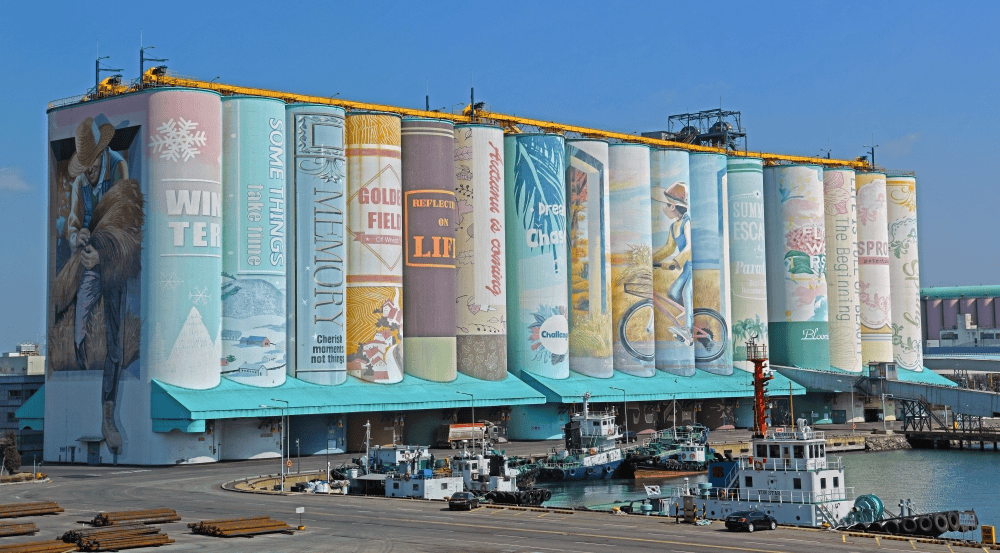
South Korea’s key ports receiving grain include Incheon, home to the world’s largest outdoor mural as declared in 2018, and painted on the Korea TBT bulk grain silo. Photo: Incheon Metropolitan City
SOUTH Korean wheat imports are expected to increase slightly in the year to June 2027 as consumer diets increasingly feature wheat-based foods at the expense of domestically produced rice, and manufacturers expand ramyeon, or instant noodle, production capacity to meet burgeoning export demand.
Wheat production in South Korea is minimal relative to annual demand, with output in 2026-27 expected to be just 29,000t, down from 38,000t a season earlier. This comes despite the domestic wheat price being around three times that of imported wheat, part of its government’s wheat self-sufficiency drive.
According to the United States Department of Agriculture’s Seoul-based attaché, the South Korean government provides subsidies to farmers and has a purchasing mandate aimed at shifting land allocation across to wheat at the detriment of rice, with the specific goal of increasing domestic wheat production to 8t of demand by 2030. Based on consumption projections for 2026-27, that is more than 300,000t, or 10 times, current output.
Home-grown shift
The area planted to wheat for the 2026 harvest actually dropped for the third consecutive season to just 7000ha, down from 9000ha in 2025-26 and 10,000ha in 2024-25. Conversely, the barley area increased by 29 percent to 44,000ha, driven by more favourable farm-gate pricing projections.
South Korea has limited farmland and historically prioritised rice production over other cereals on a national food-security basis. Heavy investment in rice paddy systems and cultural staple status entrenched rice over wheat, especially after the government ended earlier wheat subsidy and a state-based purchasing programs in back in 1984.
Ramyeon noodle export growth
The USDA’s Foreign Agricultural Service is forecasting a slight increase in wheat consumption for food, seed and industrial (FSI) purposes from 2.1 million tonnes (Mt) in 2025-26 to 2.2Mt in the current season. One of the biggest drivers of the rising FSI demand trend in recent years has been the rapid increase in ramyeon output capacity to meet growing sales, particularly to export customers throughout Asia and further afield. Ramyeon production is now the single largest end-use of imported milling wheat, making up around half of total demand.
According to data from the Ministry of Agriculture, Food, and Rural Affairs, nine companies operate 12 flour mills nationwide. Collectively, they can mill around 3.5Mt annually at full capacity. That leaves enough production capability to meet current ramyeon demand without new investment, but limited room for any large increase, providing the catalyst for several new mill proposals slated for completion by 2030.
Feed wheat consumption in the 2026-27 marketing year is pegged at 1.7Mt, consistent with levels recorded in each of the past two seasons. Wheat is expected to remain at around 8 percent of compound feed rations in 2026-27, and 12.5pc of the grain component.
The FAS forecasts South Korean wheat imports of 4.6Mt, including the wheat equivalent of flour and pasta, in the current marketing year, up from 4.5Mt in 2025-26, reflecting the higher milling wheat and static feed wheat demand projections.
Supplier rankings
The US was the dominant supplier in 2025-26 with a market share of 45pc, down from 51.5pc in the 2024-25 marketing year. US feed wheat purchases increased to more than 700,000t, or 42.6pc of feed wheat imports. Milling wheat imports of US origin were 1.3Mt last season, or 46.5pc of international milling wheat purchases. South Korean flour millers purchased 100,000t of milling wheat from the US last week for shipment in April and May of next year.
Australia was the second-biggest supplier in 2025-26, with 1.2Mt of milling wheat and 85,000t of feed wheat, for a total market share of 29t. Australian wheat exports to South Korea in the 12 months to the end of September totalled 1.2Mt, down from 1.5Mt in the previous corresponding period. Collectively, Australia and the US accounted for 90.5pc of the nation’s milling wheat imports in 2025-26, with Canada providing a further 9.2pc.
Black Sea exporters Bulgaria, Romania, Russia and Ukraine accounted for almost 500,000t, or 28.3pc of total inbound feed wheat shipments in 2025-26. Feed wheat imports from suppliers other than the US, Australia, Ukraine, Romania, and Russia exceeded 400,000t, or 24.2pc of total imports, up from less than 200,000t a season earlier.
Big corn market poultry and pigs
Meanwhile, South Korean corn consumption is expected to decrease from 9.4Mt last year to 9.3Mt in the current marketing year, due to a 100,000t decrease in demand from the compound feed sector. At 9.3Mt, corn use in stockfeed rations is projected to account for 81.2pc of total corn demand in 2026-27. FSI corn use is forecast to be unchanged at 2.2Mt, with corn starch, high fructose corn syrup and corn flour the key processed derivatives.
Total South Korean stockfeed production is expected to remain static at around 21.3Mt in 2026-27, down from a record 22Mt in 2023-24. Corn is the preferred grain ingredient at 44pc of the total ration and around 70pc of the grain component. According to FAS, modest demand growth from the swine sector is likely to be offset by easing intensive poultry consumption.
The FAS currently has corn imports pencilled in at 11.2Mt in 2026-27, down from 11.5Mt a year earlier, with the current price discount to wheat on the international market expected to ensure corn’s ongoing dominance in stockfeed rations.
Ukraine was the primary supplier of processing corn in 2025-26 with 41.5pc of the total, followed by the US with 37.3pc. The US dominated feed corn trade, supplying 84.1pc of import requirements, up from 57.5pc a season earlier. Argentina and Brazil both lost market share, with 8.6pc and 5.9pc, respectively, down from 19.6pc and 22.2pc in 2023-24.
HAVE YOUR SAY