
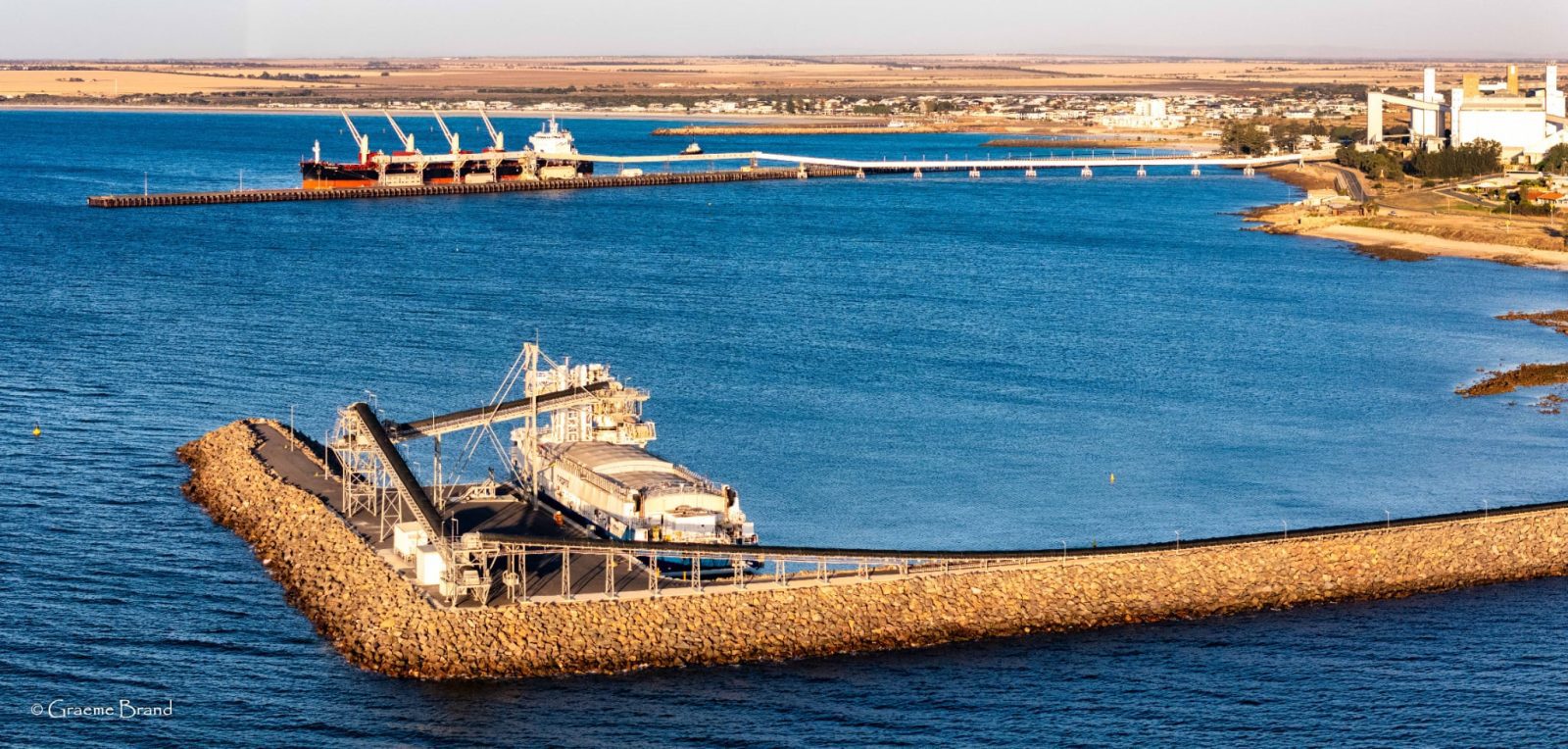
MV Lucky Eyre fills up with lentils at the T-Ports berth in Wallaroo this week on SA’s Yorke Peninsula to load a 30,000t cargo into the Ares at anchor in Spencer Gulf. Behind is the Katiki Point loading 24,864t of lentils at the Bunge wharf. Both cargoes are believed to be bound for India. Photo: Graeme Brand
CHICKPEAS out of Queensland and lentils from South Australian and Victorian ports are featuring heavily in new-crop shipping stems.
Chickpea quality is better than expected after rain on many crops prior to harvest, and container packers and bulk exporters are now pushing to get product to Bangladesh and Pakistan ahead of Ramadan’s start on February 7.
The lentil harvest in South Australia and Victoria got off to a flying start and, despite some rain interruptions, its export program is advancing at pace.
Very few faba beans have been harvested in their key growing areas in SA and Vic and growers are not expected to consider selling before their crops are off.
ABARES Australian Crop Report is due out Tuesday, and will update estimates released September 1 which put the national chickpea crop at 1,049,000 tonnes, faba beans at 859,000t, and lentils at 2,250,000t.
All prices quoted are in Australian dollars per tonne unless stated otherwise.
Chickpeas
Southern Queensland and northern New South Wales chickpeas have come through a widespread rain event with minimal damage to seed.
It means most chickpeas being delivered are making the top CHKP1 segregation, and the delivered Brisbane market is holding at around $1000/t, and up to $1040/t, as exporters look to fill hatches for nearby shipment.
“Bulk vessels have gone out, and the big drivers are the purchasing and positioning for Ramadan, predominantly for Pakistan and Bangladesh,” broker Peter Wilson of Wilson International Trade said.
Despite its 10-percent tariff on Australian chickpeas, India is also a buyer.
Container freight rates into South Asia are believed to be roughly the same as bulk in the current quarter.
Both container and bulk paths are busy ahead of the lull which is expected over Ramadan, and will end with Eid al-Fitr in the second week of March.
“We’re probably in a window now where we won’t see a lot more demand for that Ramadan period.”
Volume accumulated, packed, and exported in recent weeks has been helped by the quality profile of chickpeas being better than expected following 100-200mm of rain on many southern Qld and northern NSW crops on the point of harvest.
The rain came after a prolonged hot and dry period, meaning chickpeas had stopped growing, either as part of their natural phenology, or because of desiccation.
“The big rain we saw fell on mature chickpeas, so they didn’t succumb to disease.”
Rain on pods caused some swelling of seed coats, which in most cases did not shrink back to their original size when dry; this is thought to have lowered the testweight by up to 7-8pc in some cases.
While the Qld chickpea harvest is over, later NSW crops are yet to come in, and the Australian chickpeas harvest is seen at close to 90-percent complete.
Faba beans
Harvest has started in Vic and SA, where the bulk of the Australian crop has been planted this season.
In his report released yesterday, GrainSource trader Simon Hutt said he estimates a 300,000t carryout into 2027-28, based on subdued demand from both the domestic market, and from key export buyer Egypt.
Mr Hutt said the drop in the Australian dollar over recent weeks has been significant for faba beans, lifting delivered port, packer, or domestic consumer bids to around $425-$430/t, compared with closer to $400/t in late October.
“GrainSource is currently bidding for volume at $430/t for No. 2 faba beans delivered Lara or Melbourne west side, with delivery at the grower’s option through to the first week of January,” Mr Hutt said in his report.
“Grower’s option delivery lets beans move when it suits the farm: when a truck comes up a bit cheaper, when a backload can be arranged, when there is time to load, or when the farm truck can do the run.”
He said higher bids are being seen, but for smaller volumes on a buyer’s call basis, or delivered direct to the boat (DTB), and with grade deductions.
“The DTB buyer can call for delivery over about three days with short notice, when freight may cost more and there may be no time to prepare the load.
“The contract still requires delivery in that window, and that can be hard to manage on volume contracts.”
Mr Hutt said domestic buyers have also pushed their timeframes out, with one large feed buyer now bidding for May delivery.
Demand from Egypt is seen as thin, and no faba bean cargoes were to be seen on readable Australian bulk shipping stems as of November 23.
“We are not seeing much demand from exporters overall, and some are missing from the market altogether.
“When exporters return, they are likely to come late in harvest, with a short window to buy before their boat leaves, and they will be competing with each other for tonnes.
“That could produce a short-term price spike, although this is unlikely to be supported by the overseas buyer, so we do not expect it to rally very hard.”
In the 12 months to June 2026, GrainSource said Australia exported 331,000t of faba beans to Egypt, below the average over the past six years of around 404,000t.
GrainSource estimates close to 300,000t of this season’s faba beans will go to Egypt.
Lentils
Southern Australia’s lentil harvest is progressing well, with SA thought to be more than halfway through, and Vic around one-quarter complete.
Mostly light rain, and some storms, have interrupted harvest, but quality is generally holding up well, and so are prices.
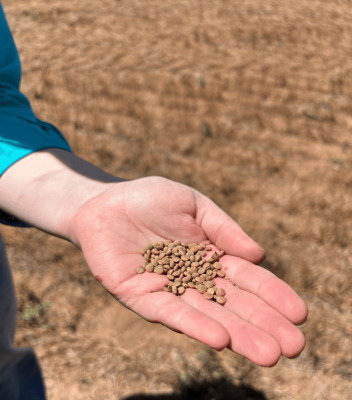
Kongolia Farms in SA’s Murray Mallee finished its lentil harvest on November 9, and the crop yielded well and was of good quality. Photo: Rebekah Starick
Exporters are paying around $600/t for bulk deliveries to SA ports, and Wimmera packers earlier this week were bidding $560-$565/t for the smaller Nipper types, and $600/t for the larger Jumbo types.
“Lentils have been relatively stable,” ETG Wimmera-based pulse trader Todd Krahe said.
“The Aussie dollar dropping has helped maintain grower prices, and in some cases pushed them higher.”
SA’s new-crop lentil shipments have gotten off to a flying start, thanks to growers selling and competition from exporters.
“There was a lot of selling in SA during harvest.
“In Vic, we’re seeing some early sales made, but it has slowed a little bit as harvest moves south, and some is going into warehousing.”
As evidenced by September export figures, India is the market for more than half of Australia’s lentil exports, and is buying as far out as the June 2027 quarter.
“We think that’s…because the whole pulse complex is moving up.”
Contributing to that is a smaller chickpea crop out of Australia than was expected when it was planted in winter, and because India’s own rabi crop now in the ground or being planted is likely to be limited by dry conditions.
Grain Central: Get our free news straight to your inbox – Click here
HAVE YOUR SAY