
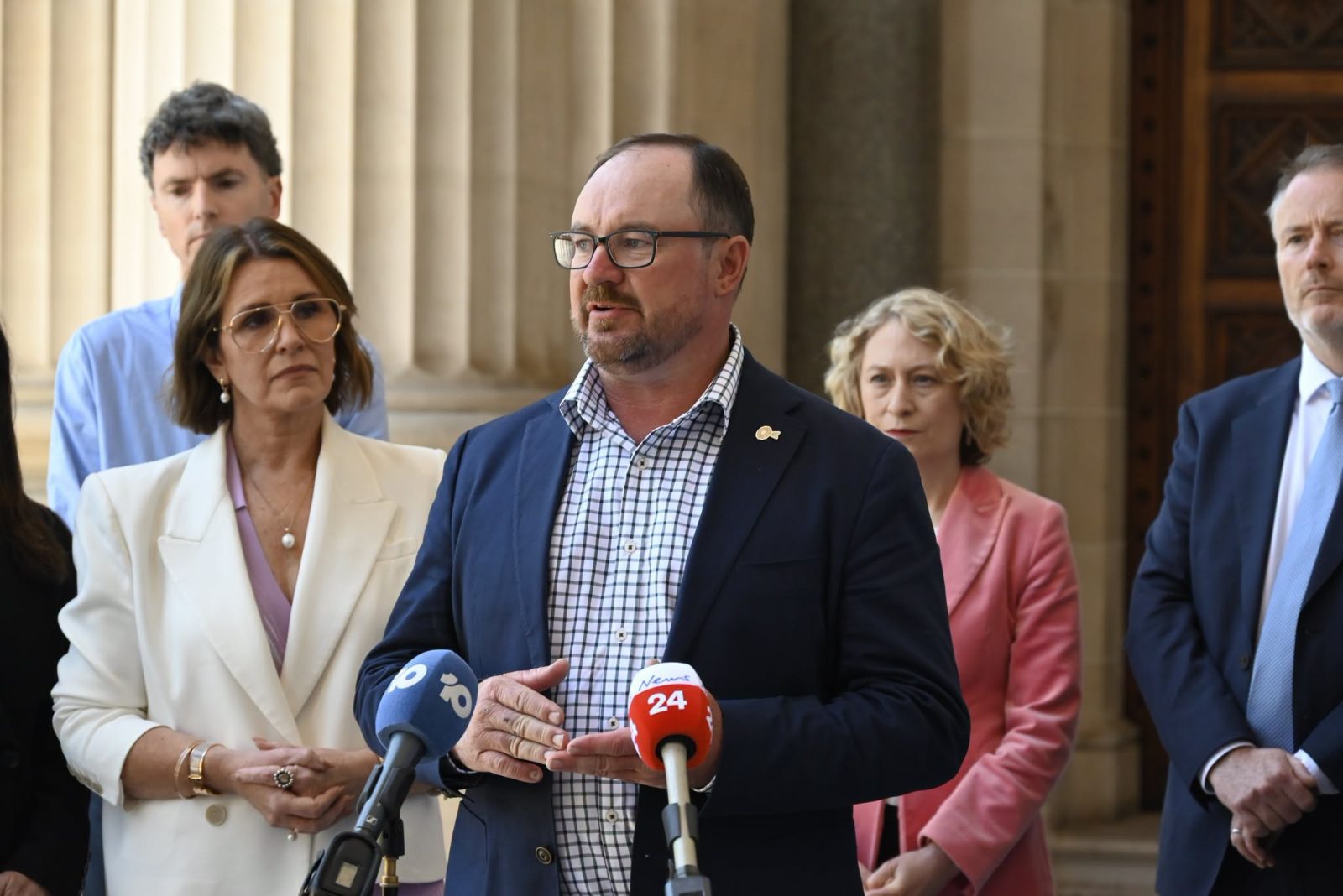
VFF president Ryan Milgate took part in an economy-wide event at Victorian parliament this week calling for the incoming government to deal with the economic challenges facing the state. Photo: VFF
ONE Nation has topped the Victorian Farmers Federation’s election scorecard, released ahead of Saturday’s state election.
The state farming organisation completed the scorecard with the four major parties assessed against the 15 commitments in the VFF’s Back Victorian Farmers election platform.
The platform covers a range of issues from farm business costs and regional roads to farmland protection, water security, biosecurity and regional services.
One Nation scored 17 out of a possible 30 points, ahead of the Coalition on 15, the Greens on 10 and Labor on eight.
VFF president Ryan Milgate said the scorecard was designed to help farmers understand each party’s commitments and make informed decisions at the ballot box.
“Farmers have been clear about what they need from the next Victorian Government,” Mr Milgate said.
“This scorecard shows where parties have listened, where commitments are still missing and will help guide voters when casting their votes.”
Significant gaps
The VFF highlighted that none of the parties had committed to introducing Right to Farm laws, which aim to protect legitimate commercial farming activities.
They said other priorities still needing stronger commitments include a western Victoria water strategy, regional truck wash network, agricultural training pathways, and improved access to childcare, healthcare and housing across regional Victoria.
These issues formed part of the VFF’s five priorities and 15 commitments, announced last month as part of its election call to the parties.
Key points in the platform included:
- Scrap the Emergency Services and Volunteer Fund for good;
- Commit an extra $2 billion to fix Victoria’s crumbling regional roads;
- Appoint a Land Use and Food Security Commissioner and protect farmland in law;
- Take VNI West and the Western Renewables Link back to the drawing board;
- Establish Right to Farm laws and lift wild dog and pest control;
- Deliver the childcare, healthcare and housing that keep farming families in the regions; and,
- Deliver the Western Victoria water security and pipeline strategy and continue the fight against federal water buybacks.
Points of difference
The main differences between the parties in the VFF scorecard appeared to be their commitments to specific projects and policies.
The Coalition and One Nation pledged to abolish the ESVF, while the Greens proposed a review of the policy.
Labor said it would retain the levy but offer concessions, including a rate freeze and for the volunteer rebate to cover farmland.
On the VFF’s calls to halt the VNI West and Western Renewables Link projects, One Nation pledged to cancel both, while the Coalition committed to scrapping VNI West and pausing the Western Renewables Link pending a rigorous review.
Labor and The Greens are pledging to move forward with both projects although the current government has ordered a review of the Western Renewables Link.
Calls to target economic challenges
The VFF joined more than a dozen industry representatives on the steps of Victorian parliament on Tuesday to call on the incoming government to address the economic challenges facing the state and business community.
The event was part of a campaign organised by the Victorian Congress of Employer Associations (VCEA), involving groups including the Australian Retail Council, Victorian Transport Association, Victorian Chamber of Commerce and Minerals Council of Australia.
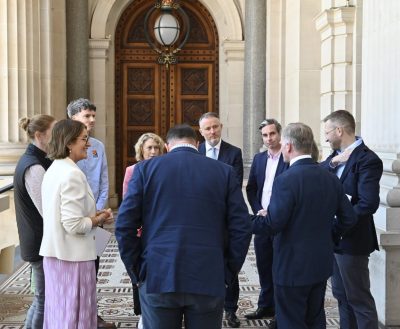
The VCEA event brought together about a dozen industry groups.
Representing all industry sectors, business leaders jointly committed to work in a united way with the next Government, across all economic and industry portfolios.
The VCEA committed to convene a business roundtable immediately after the election to determine how it can support and add value to government policies, with the aim of turning Victoria’s economy around.
Mr Milgate said there was commitment from industry to work with government as genuine partners to build long term prosperity for all Victorians.
“Agriculture is a major source of competitive advantage for Victoria and an economic powerhouse.
“Victorian farmers work just three percent of Australia’s agricultural land, yet produce almost a quarter of the nation’s farm output by value.
“We’re ready to work with the next government to maximise that advantage and grow our world class farm sector.”
Victorian Transport Association chief executive officer Peter Anderson said the organisation supported the call for “renewed focus on economic growth, competitiveness and business confidence”.
“The VTA will continue to advocate for practical policy and legislative reforms that improve productivity across the freight and logistics industry,” Mr Anderson said.
Click here to see the VFF’s 2026 pre-election scorecard in full.
Source: VFF, VCEA
HAVE YOUR SAY