

Weather:
South Australia’s harvest is running later than usual after October rainfall and continued showers in November, with up to 30 millimetres of rain falling on Yorke Peninsula and Adelaide between 18 and 24 November. In WA, rain, hail, lightning and even fire forced harvest bans.
Argentina has better soil moisture, but persistent rainfall, low temperatures and limited sunlight are increasingly slowing fieldwork and raising disease risks. In northern Argentina, persistent drizzle has delayed the start of the wheat harvest and raised concerns over grain quality, even though the BCR raised its 2026/27 Argentine wheat production forecast to 23.8 million tonnes (Mt).
Brazil’s soybean planting had reached 66.8 percent of the projected area as of November 9, with Mato Grosso nearing completion even as persistent rain, hail and waterlogging disrupted wheat, rice and soybean development across the country’s southern growing states. Conab still forecasts 181.6Mt for 2026-27.
For Northern Hemisphere winter wheat, a strong blocking high anchored north of the Caspian Sea maintained dry and warm weather, 3 to 5 °C above normal, across western Russia, although GEOGLAM still rates Russian conditions as favourable. In the US Plains, most of Kansas and eastern Colorado were drought-free in the wake of widespread fall rainfall, and ratings improved from a week earlier in most major hard red winter wheat states.
Markets:
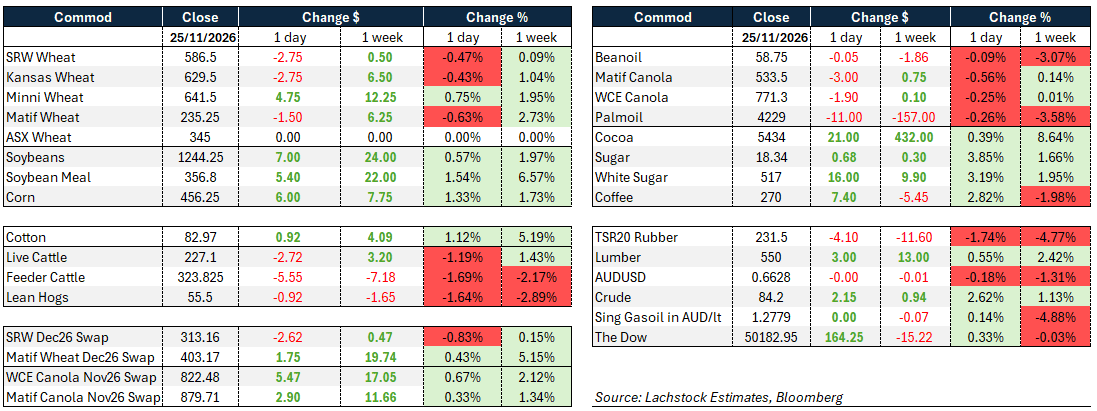
December front-end liquidation pushed Chicago and Kansas City down about 0.45pc and Matif 0.63pc. All three are still higher on the week, and the bigger shift is that US HRW is now competitive into new destinations while French wheat sets the world price.
Corn rose 1.33pc for a third straight gain, back above US$4.50/bu, as the December roll cleared and Ukraine’s port blockade cut its export outlook to 12–14 Mt. Soybeans added 0.57pc on the China flash sale and meal strength.
Vegetable oils were the weak point. Soyoil is at a nine-month low as crush expands, and it dragged Matif canola (-0.56pc), ICE canola and palm lower, while meal (+6.57pc on the week) is carrying crush margins.
The new US tariffs had little effect on ag because rates stay within existing deals and the China truce is intact. Crude rose 2.62pc on geopolitical risk, and the AUD is down 1.31pc on the week, which helps Australian grain prices into thin Thanksgiving trade.
Day Ahead – Australia:
Market is collectively holding its breath to see what and how quality is affected. Dusting up on sprouted limits, falling number and general weather impacts is the main task today.
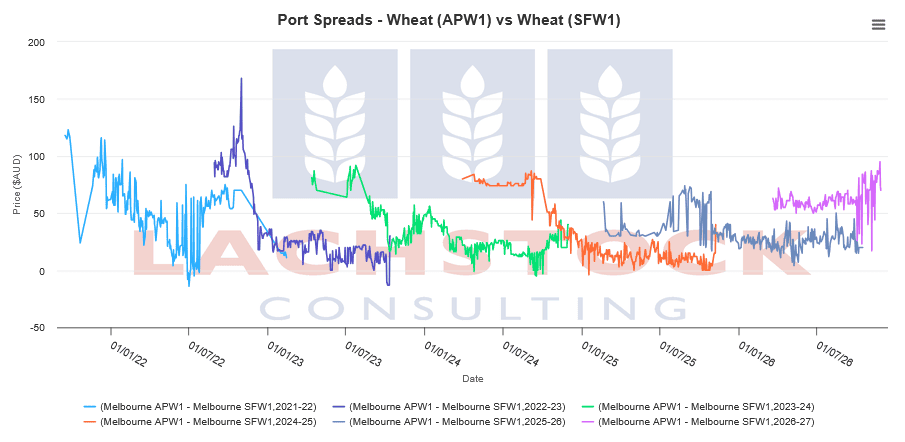
Reports that Argy quality is bad, but there is a push to clear the early harvested wheat to make way for the better quality central grain is hard to validate – spreads between the standard 11.5pc and lower grades suggest this could be right given the weakness.
AUD hates everything – pretty much tells you that the bond market sees Aussie and US rates converging and thats the only story that matters.
No US markets tonight with Thanksgiving.
 .
Trade commentary says the tightness was hard to explain given thin demand, but the scale of the collapse was not expected. The more important point is that US HRW is now being discussed for destinations that recently looked out of reach, and US wheat is competitive for the first time in a while.
French wheat is still setting the world price. The Pakistan tender is expected to go to EU origin, and a vessel is due at Dunkirk in the coming days to load about 70,000t, the first French cargo to China this season. EU soft wheat exports reached 11.40Mt by 22 November, up 5pc year on year.
Russia put its 2026 crop at 140Mt net (142.5Mt bunker weight) and its 2026/27 grain exports at 40Mt, subject to the Black Sea. The Baltic route is taking up the slack: Baltic ports handled 61pc of Russian wheat exports in October against 52pc in September, and Vyborg volumes rose 2.3-fold to 1.5Mt over January to October. Moscow says the route remains open to Egypt and Africa despite recent shipping incidents. SovEcon says ruble prices for 4th-grade wheat have risen about 14pc since early October because farmers are holding grain, although they remain 34pc below a year ago. It warned that Russian wheat may be dearer than buyers expect even after Black Sea shipping resumes. Russia also says it struck a cargo ship east of Odesa. Ukraine’s winter wheat area is 4.19Mha against 4.69Mha a year ago.
Tender activity continues: Jordan is seeking 120,000t of milling wheat (closes 1 December) and Tunisia 100,000t of durum (closes today). US export sales on Friday are expected at around 400,000t.
AgMarket.net’s Cory Bratland expects corn to consolidate and form a base. Ukraine remains the supportive story. Only 422,170t had shipped by 23 November against 860,000t contracted for the month, because the seaports that normally handle about 90pc of corn exports have been effectively blocked since late July. The UAC farmers’ union now sees 2026/27 exports of 12–14 Mt rather than 15 Mt and says contract defaults have begun, which leaves the EU’s import needs obvious.
US ethanol stocks rose 345,000 bbl to 25.3M bbl, the highest since 1 May, while output edged up to 1.129M b/d.
Soybeans shrugged off the new USTR tariffs, helped by a USDA flash sale of 132,000t to China. AgResource said further large Chinese purchases beyond the 25 Mt pledge look likely. The first US–China agricultural working group meeting in Beijing produced constructive language but nothing concrete.
Meal continues to lead (+5.40, +1.54pc, +6.57pc on the week) on firm cash, logistics constraints and extraordinary demand. Brazilian old-crop basis remains elevated, and EUDR remains a talking point until Brazilian meal clears EU customs next year.
Soyoil is at a nine-month low as strong crush adds supply, although rumours of legislative changes have not materialised.
Friday’s export sales estimates are 1.4Mt for beans, 325,000t for meal and 5,000t for oil.
EU soybean imports are 4.80 Mt, down 5pc. ICE January canola fell C$1.90 to C$771.30 after trading as low as C$760, with soyoil, rapeseed and palm all lower.
Thin, choppy trade is expected while US markets are closed. Palm fell (-11, -3.58pc on the week) on soyoil weakness and fading Indian demand for Chinese soyoil, although the MPOC expects CPO to hold above 4,100 ringgit in December .
Macro: USTR proposed Section 301 overcapacity tariffs on 14 economies, set at rates within existing trade deals. China would face 20pc, rising to 40pc if talks fail. The EU, Japan, Korea and Switzerland would face 15pc, and India 17pc if its deal is finalised. A final decision could come as early as January, after public comment, with exemptions for oil, gas and food that cannot be grown in the US. Beijing called the move political manoeuvring but wants to keep the truce, which expires in January, ahead of the Trump–Xi meeting at the G20 next month.
Separately, USTR raised tariffs on Brazil and is considering a higher out-of-quota rate on raw and refined sugar, alongside a 3.85pc jump in sugar.
Crude gained 2.62pc as geopolitical risk rose.
Russian inflation hit a one-year high of 6.87pc in October as Ukrainian drone strikes on refineries pushed up fuel costs, and Putin vowed to retaliate. Alfa Bank expects the key rate to stay at 14pc through Q1.
Poland has asked NATO to consider shooting down Russian missiles over Ukraine, and NATO is sending an AWACS aircraft to Poland.
Iran remains under a US naval blockade nearly nine months into the war.
US core PCE rose 0.3pc for a third month.
The AUD was steady overnight but is down 1.31pc on the week.
Thanksgiving will thin trade: US markets are closed tonight and the CBOT has a half-day on Friday.
Local: In the west, canola bids eased A$5/t to $845, with wheat at $374 and barley at $330 FIS Albany. In the east, canola was $785, wheat $345 and barley $280 track Geelong.
Barley bids out of China have softened slightly this week after holding firm for the past couple of weeks. The weaker AUD has cushioned most of the move, but expect local bids to ease over the next week or so as harvest pressure builds.
Some upcountry sites in the Port Kembla zone are reportedly full for ASW and APW but still have room for higher-protein wheat.
HAVE YOUR SAY