

Weather:
Western Russia remains warm and dry under a strong blocking high north of the Caspian, with temperatures 3 to 5°C above normal. GEOGLAM still rates conditions as favourable, but the soil moisture deficit is building after SovEcon recorded the slowest winter grain sowing since 2013.
In the US Plains, autumn rain has left most of Kansas and eastern Colorado drought-free. Winter wheat is rated 54% good/excellent going into dormancy, up 10 points since its first rating, while soft red winter areas in the eastern Midwest and the Pacific Northwest remain dry.
Brazil’s soybean planting is behind last year’s pace, with patchy rain in the Cerrado and earlier storm and hail damage in Rio Grande do Sul. In Argentina, persistent humidity and drizzle are delaying the northern wheat harvest and raising fusarium and quality concerns, despite large production estimates.
Markets
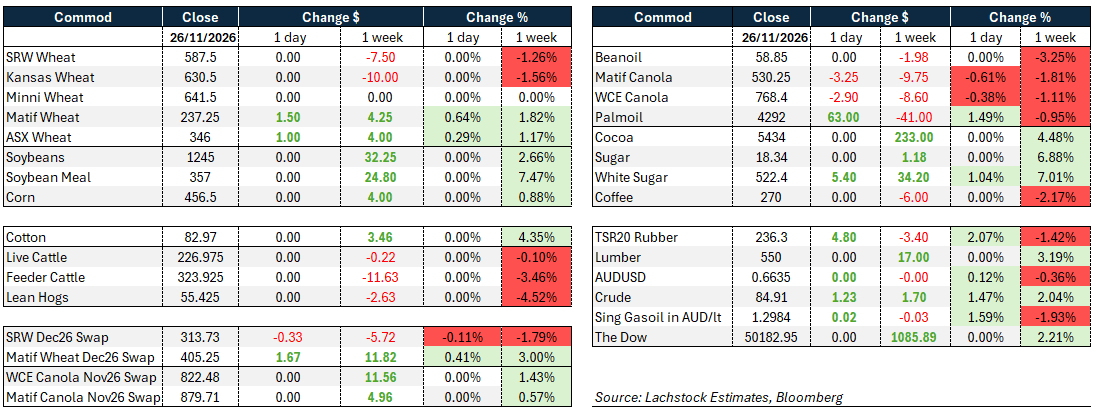
US Thanksgiving closed CBOT, Kansas, ICE and Wall Street on Thursday, so US moves are weekly and Friday’s half session is likely to be thin and dominated by December rolls ahead of first notice day on Monday.
Wheat diverged by region over the week, with Chicago down 1.26% and Kansas down 1.56%, while Matif rose 1.82% and its Dec26 swap gained 3.00% to A$405.25. US competitiveness and improving US crop ratings are weighing on Chicago and Kansas, while Black Sea dryness is supporting Europe.
The oilseed complex split as soybeans rose 2.66% on a 7.47% jump in meal, while bean oil fell 3.25% and Matif and WCE canola fell 1.81% and 1.11%. Australian-dollar canola swaps still held weekly gains on the weaker currency.
Macro risk leaned higher as crude added 1.47% on the Iran–Kuwait attack and the Dow gained 2.21% for the week on the GDP revision. The AUD’s 0.36% weekly dip and a near-certain ECB hike in December round out a supportive backdrop for Australian-dollar grain prices.
Day Ahead – Australia
Rain on the way, no markets in the US, continued conflict, Argy offering lower – yep, dogs breakfast.
Not a political wire – but someone needs to explain to me how the Digital Duty of Care bill was passed. A bill that allows the govt to create fake accounts to combat what they deem as extreme political and social comment, but I won’t be able to criticise the govt as I am not a “professional news outlet”. What I’m saying is, strap in – I have 12 months to speak my mind.
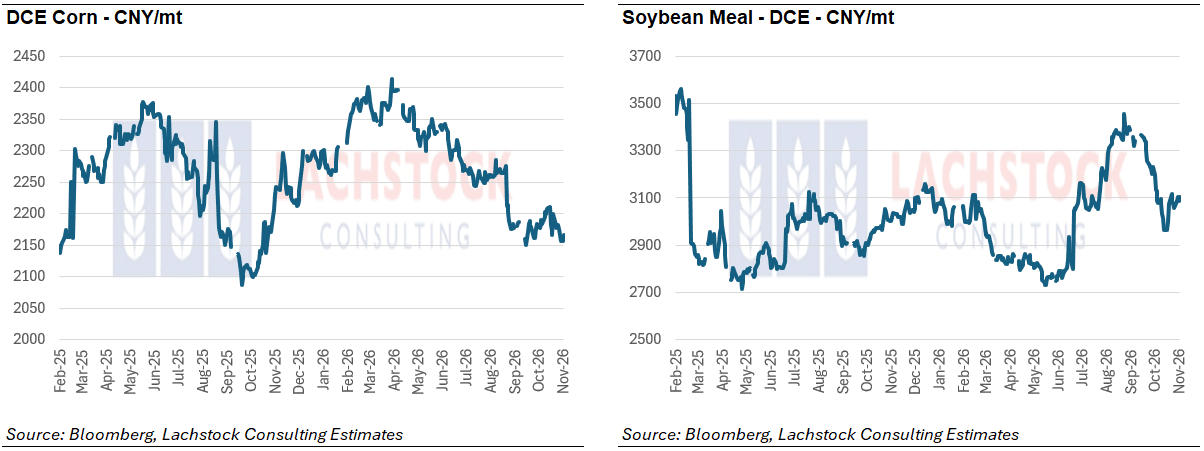 .
On the week, US wheat lagged Europe by more than three percentage points. The spread reflects improving US Plains conditions and US hard red winter wheat now being competitive in destinations it recently couldn’t reach.
On the other side, Matif is carrying a premium for Russian dryness. Russia has put its 2026 crop at 140Mt net, so near-term supply isn’t the issue. The risk is the 2027 crop going into winter under a warm, dry blocking pattern.
Trump said he urged Putin, during their talks in China, to pull back military aggression in Europe, and called a quick Russia-Ukraine deal a “strong possibility”. Russia, however, is still hitting Ukrainian power and logistics infrastructure ahead of winter, so the Black Sea risk premium stays in place.
Friday’s shortened CBOT session leads straight into first notice day on Monday, which should keep US trade focused on rolling positions rather than direction.
Corn added 4.00 to 456.5. Canola went the other way. Matif lost 3.25 to 530.25 and WCE dropped 2.90 to 768.4, with both down for the week despite crude rising.
Palm oil gained 63 to 4292 in Thursday’s session, tracking crude higher.
Brazil’s soybean planting reached 78% by 12 November according to AgRural, against 85% a year earlier.
Conab puts the crop at 181.6Mt, so the planting lag isn’t yet a supply story.
In Australian dollar terms, the WCE canola Nov26 swap is up 1.43% for the week at A$822.48 and Matif canola is up 0.57% at A$879.71. The weaker Aussie has cushioned the offshore declines for local growers.
Macro: With Wall Street shut, the US news was political rather than market-driven. Q3 GDP was revised up to 4.3% annualised from 3.4%, the fastest growth in three years, on a surge in business investment. Consumer spending stalled in October, though. Trump called the original pre-election figures “fake” and demanded an investigation, offering no evidence.
The Dow finished the week up 2.21% above 50,000. Crude rose 1.23 to 84.91 after an Iranian drone attack on Kuwait killed two Italian Rheinmetall workers, which keeps Middle East supply risk front of mind.
Singapore gasoil in Australian dollars rose 1.59% on the day. In Europe, the ECB’s October minutes all but confirmed a 25bp hike in December. Many members would have hiked in October, and holding was conditional on clearly signalling December. There is also a further 25bp pencilled in for March 2027 if the Middle East conflict isn’t resolved.
Euro area lending to non-financial corporates accelerated to 4.5% y/y from 4.3%, while household lending held at 3.1%. Pablo Hernández de Cos, former Governor of the Bank of Spain, is reportedly set to become the next ECB president.
The AUD at 0.6635 is down 0.36% for the week, a modest help to export parity.
In Ukraine, Kyiv says a laser system downed a Russian jet-powered drone for the first time. NASA data also point to a fire at Russia’s Syzran refinery after drone strikes.
Local: Canola was steady in the west yesterday at around A$840/t, with wheat at $376 and barley at $330 FIS Albany.
In the east, canola was bid at $800, wheat at $348 and barley at $280 track Geelong.
Chinese barley bids have slipped to around US$273/t CNF, down about US$5/t for the week. WA barley bids have softened in line with the move.
Rain has started across Victoria today, with the heaviest falls so far around Stawell and Lake Bolac, where around 20mm has fallen. Fingers crossed totals come in below forecast.
HAVE YOUR SAY