
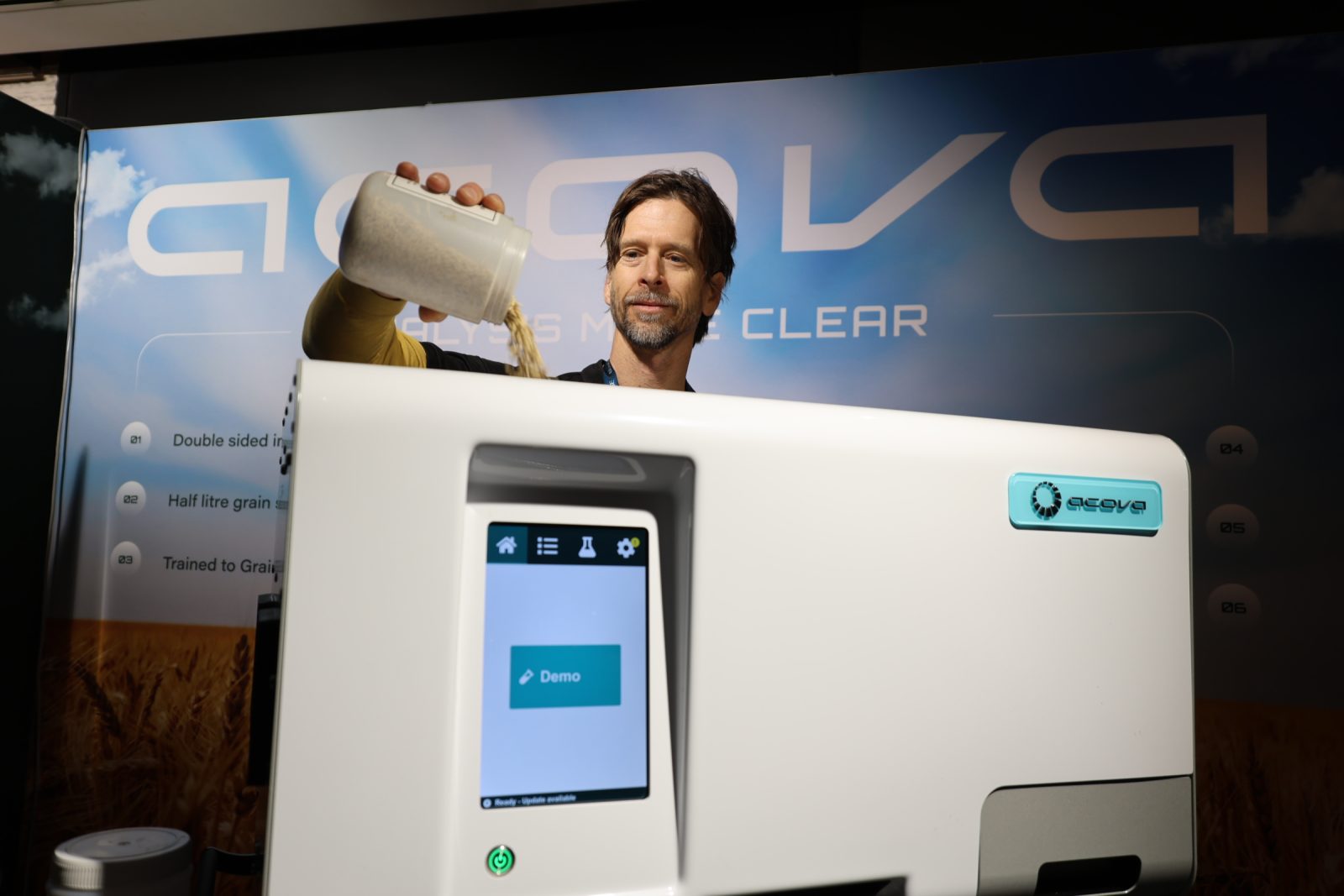
Acova technical engineer Tom Foss tips a barley sample into the unit on display at AGIC 2026.
WESTERN Australia’s CBH Group is rolling out a home-grown visual-analysis system to help it receive ever-bigger harvests quickly, and on standards universal across its network.
Using Acova machines designed and made in Perth through its joint venture with software developer Deimos, the system is expected to be operational across all the co-operative’s receival sites on wheat, barley and oats by the 2027-28 harvest.
It will make CBH Group the first of Australia’s major bulk handlers to have AI-assisted visual-assessment system universally available, and the software-hardware package is dipping into pulses outside WA.
Acova was a first-time exhibitor at the 2026 Australian Grain Industry Conference held last week, as was Seed and Grain Equipment, or SAGE, World, demonstrating a Rhino unit with links to the seed industry.
Alongside return exhibitor Cropify from Adelaide, which is making significant inroads at Australian pulse-receival sites, it shows grain handlers throughout the supply chain are keen to see what AI can offer.
Measured roll-out
CBH’s shift from human to AI-assisted visual assessment has not been done in haste.
In 2013 and 2014, it trialled EyeFoss units made by Denmark’s FOSS, a leading global supplier of grain-testing equipment, at several sites.
While FOSS machines using near-infrared technology are used by CBH and many other bulk handlers to measure metrics including protein, moisture, and test weight, an EyeFoss roll-out did not eventuate.
Instead, CBH looked to Deimos, founded by brothers Andrew and Jeremy Hadfield, which through its Phobos arm has a long relationship with CBH on supply-chain optimisation.
With CBH, Deimos last year established Acova, and Acova chief executive officer Marcus Ashby said the efficiency the units are bringing to wheat, barley, and oat sampling, and the clarity it has delivered on standards, has won over the grower.
“Growers love it; in two and a half minutes, it’s analysed 2500 kernels by taking a photo of the top and bottom of each one,” Mr Ashby said.
CBH Group country quality manager Dale Paddon said the win for CBH and for growers is that bottlenecks do not develop at sites where Acova units are in use because sampling time has been standardised.
“Visual analysis can be so quick with these units,” Mr Paddon said.
They enable sampling staff to conduct other tests with the FOSS unit, and the Perten one for sprouting if harvest has been wet, while the Acova machine runs through its paces.
“It has demonstrated a site-throughput increase, and the strongest thing about it is that consistency of time.”
Mr Paddon said assessments done with the naked eye can be fast, but variables like excessive admixture or staining can slow sampling considerably, and samplers being inexperienced and needing to refer to senior staff can cause further delays.
“Clean samples are fast, but if they’re not, they could take eight minutes instead of three minutes.
“That’s where the machine wins; nothing slows it down.”
Training the model
Acova units use machine-learning models to identify weed seeds and quality defects like staining and cracked and broken grains, and made their harvest debut at two sites in the Albany Zone.
The Albany Zone was chosen because it typically has considerably greater grain-quality variation across its sites than CBH’s four other port zones.
“We wanted to go to a zone with varying quality, and we picked two sites close together, on either side of Lake Grace.
“The next season we did 14 sites in more zones, so there was a greater range of growers and grain quality, and through that we got more feedback.”
Acova’s team in Perth has been busy building units and developing software that learns with each harvest, and as each site is added.
“We looked at our historical data, and what quality defects we saw most of, and we’ve kept expanding.
“The more data you feed [the model], the better it gets.”
Within the receival window, Acova generates data that feeds into CBH’s stack-management database.
CBH has also been able to get feedback to the Acova factory on hardware issues to ensure the units are physically easy to use on site, and Mr Paddon’s praise is high for the feedback loop.
“We’ve done a lot of improvements along the way.
“If we ask them to change something like the position of the drawer…or how the feet sit on the bench, they can do that.”
WA’s most recent harvest set a receival record for CBH of 24.2 million tonnes (Mt), and CBH had 80 sites using Acova units to help it handle the volume.
“We got all the Esperance Zone covered last year, and Albany too.
“Now we’re expanding into all of Kwinana South, and all of the Geraldton Zone.
“That only leaves the Kwinana North Zone.”
Mr Paddon said the staggered roll-out is simply one of availability of units, which are made from scratch in Perth.
“If we had all the machines on the shelf, we’d roll them all out.
“We’ve been ramming it pretty tight with production requirements out of Acova.”
Grower experience
Through CBH’s CDF app, Acova’s software shares with the grower what the unit sees in real time, and the grower can then make a decision about whether to deliver the load based on the segregation options offered from the unit’s assessment.
Mr Paddon said most growers are happy to have objective clarity around CBH’s decision-making process based on Acova’s imaging, but not everyone is happy about moving away from a system that has been in place for decades.
“What it can demonstrate is consistency across sites, but deploying new technology isn’t without hiccups.”
Mr Paddon said CBH has consulted with its Growers’ Advisory Council, and is represented on the Grain Industry Association of WA commodity councils, with feedback “overall very positive”.
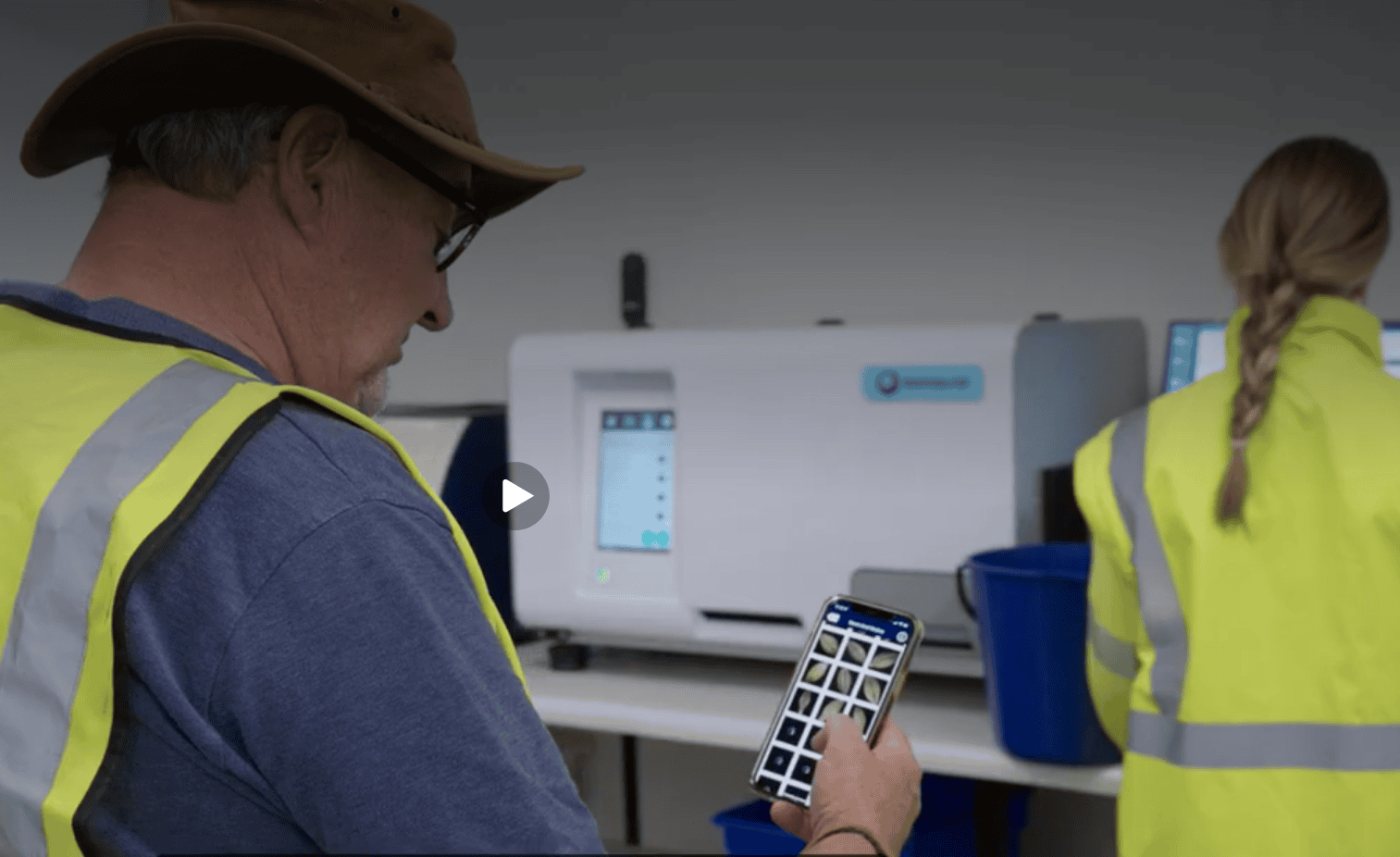
A grower scrolls through Acova images of his sample as captured by the unit’s assessment from a half-litre sample. Image: CBH Group
Ready to grow
At this stage, CBH has no plans to add varietal recognition or commodities to the three cereals Acova has been trained for in WA.
That does not restrict Acova from exploring other options, and Mr Ashby told Grain Central that an Acova unit was currently being trained on chickpeas in southern Queensland.
“The concept has always been that it’s available to other industry players,” Mr Paddon said of Acova.
“These machines will be used globally; we’re developing a lot of the stuff to meet our requirements, but it’s not a CBH-only product.”
Through multi-spectral imaging, Victorian company Sage World was displaying a Rhino unit for the first time at AGIC 2026.
“It was used in the seed industry, and from there, we got more and more interest from feed mills,” Rhino CEO Johan van Asbrouck said.
Insights available through a five-minute assessment include germination testing and variety identification.
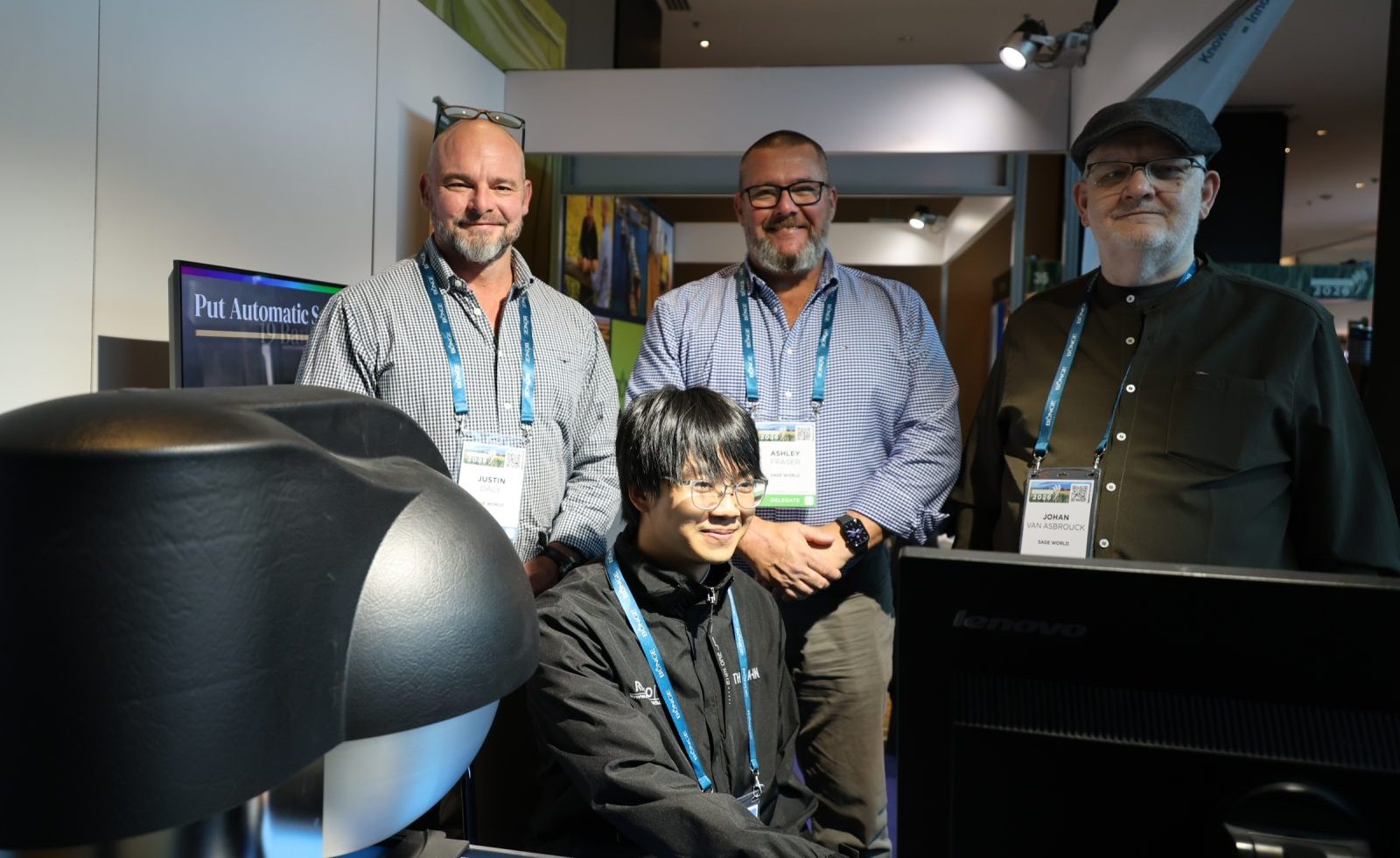
Sage World exhibiting at AGIC 2026, and on hand to field queries about its grain AI system were executive director Justin Daly, managing director Ashley Fraser and Rhino CEO Johan Van Asbrouck, with senior technology manager Boong Thana-in.
Sage World was started by Ashley Fraser, formerly principal of Baker Seed Co and, like the seed business, it is based in Rutherglen.
In recent years up to this one, AGIC has seen delegates and/or exhibitors from companies including GoMicro, Indyn and ZoomAgri, with Acova and Rhino units the latest to go on show.
While some crossover certainly exists, Mr van Asbrouck said the marketplace is big, and the offering is ever broader.
“Every machine does something different,” Mr van Asbrouck said.
Grain Central: Get our free news straight to your inbox – Click here
HAVE YOUR SAY