
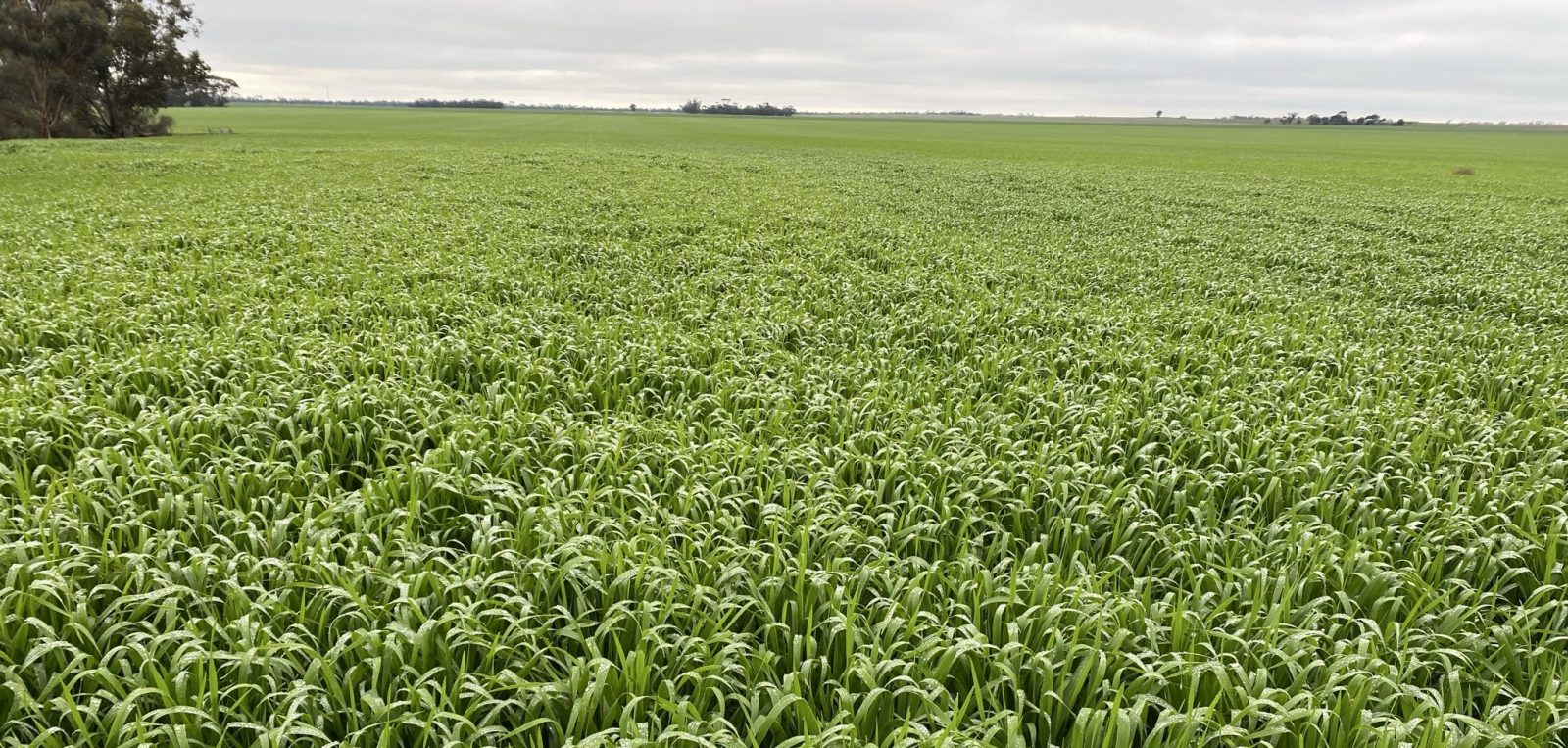
A crop of Neo barley snapped July 20 shows an unprecedented amount of biomass for July at Normanville in Victoria’s northern Mallee. Photo: Bec Marshall
THE NORTHERN feed market has lifted this week in response to a lack of rain as crops head into the last month of winter.
In the south, ample subsoil moisture is bolstering yield prospects as growers advance their new-crop canola sales, and metre out stored wheat and barley to the market to make way for what looks like being a big and early harvest.
Wheat appears to be attracting improved export demand, while barley and faba beans are selling into on-farm feedlots in the south, and barley remains the preferred grain in the north.
| July 23 | Today | |
| Downs barley | $400 | $412 |
| Downs SFW | $395 | $400 |
| Sorghum | $363 | $365 |
| Mel barley | $340 | $340 |
| Mel ASW | $370 | $373 |
Indicative prices in Australian dollars per tonne.
Dry concerns build in north
In Queensland and much of northern New South Wales, crops are looking at below-average yields, and headers are expected to start rolling into wheat crops in Central Qld before the end of August.
The Australian Grain Industry Conference is on in Melbourne this week, and outside the formal sessions, growers and traders from the north-west slopes of NSW to the Qld-NSW border plains and up into the Maranoa are talking about a lack of soil moisture.
Some farms planted only half their intended winter-crop area due to the seasonal break coming in late May, and not being sufficient to allow all cereals to be planted on time into adequate soil moisture.
The word on the floor at AGIC was growers are selling in “dribs and drabs”, and northern growers are eyeing a local rally if the El Niño is as severe as many fear.
Volume consumers are buying modest amounts.
“I think the big feedlots have covered what they need up to new crop,” one trader said.
South jumps on forward canola
Canola remains the forward sell of choice of the southern grower, with delivered up-country depot prices hitting $810/t in the past week at some sites.
In the Riverina market, current-crop wheat has traded at $360/t, while barley is priced at around $300/t on farm.
AgConnex chief executive officer and Riverina-based trader Geoff Barker said global uncertainty around conflict in both the Black Sea region and in the Middle East may have brought some export wheat demand to Australia in an increasingly challenging global environment.
“We’ve become very complacent about how great the industry is at getting grain to places,” Mr Barker said.
The kick in wheat prices has saved some irrigated cereals from being grazed out, or cut for hay.
“What we’re starting to see in our region is irrigating now that growers are getting prices they think are high enough to justify another watering.”
This will save some crops from being grazed out by mixed farmers looking to put some winter weight on sheep and cattle.
Water for the Riverina’s upcoming summer-crop planting window is looking both scarce and expensive, helped none by limited snowfall to date in the Australian Alps, where melt normally helps to fill storages.
While large-scale feedmills seem to be well covered heading into the winter-crop harvest, Southern Stockfeeds CEO Philip Tracy said healthy returns for on-farm feeding operations were helping to support the up-country market.
“All the growth appears to be in beef and lamb feedlots,” Mr Tracy said of current demand.
“Returns are still there in the livestock market.”
In South Australia, a freeze in demand from Egypt has seen growers with faba beans left on farm start to push them into the domestic market.
“We have seen growers flick back to the domestic market for wheat and faba beans,” one trader said.
“We’ve had a run of calls from brokers over the past three weeks looking for homes for beans.”
The trader said barley’s discount to wheat has widened to $30/t or more, enough to start buying it demand in poultry and pig rations.
This has buffered reduced barley demand from beef feedlots now that SA and Victoria are in the depths of winter.
Grain Central: Get our free news straight to your inbox – Click here
HAVE YOUR SAY