

A stacker drops wheat on to a bunker at GrainCorp’s Mt McLaren site in Central Queensland this harvest. Photo: GrainCorp
DRY CONDITIONS, including some widespread frost, have been the domestic contributors to a lift in values for wheat and barley this week.
Local appetite is biggest for wheat for export, as consumers get comfortable with coverage into new-crop positions.
Markets have lifted by at least $5 per tonne to reflect concerns about logistics rather than overall supply at harvest, which will get cracking in earnest in southern Queensland by early October.
| Sep 10 prompt | Today prompt | Today Jan | |
| Downs barley | $405 | $410 | $420 |
| Downs SFW | $417 | $422 | $440 |
| Downs sorghum | $380 | $380 | $380 |
| Mel barley | $315 | $320 | $325 |
| Mel ASW | $370 | $380 | $371 |
Table 1: Indicative prices in Australian dollars per tonne.
North ready for short, sharp harvest
Stewart Grain trader Robert Quinn said the market has firmed in the past week, with freight rates lifted by dearer diesel coupled with dry conditions the main contributing factors.
“Crops here are going backwards; they needed a drink and they didn’t get it,” Mr Quinn said.
“I can’t see too much harvest pressure at all this harvest.”
The north’s tough finish is expected to put some newer barley varieties to the test.
If low testweights are the result of the expected dry finish, light barley may well be held by growers for later sale, blending, or on-farm use.
Expensive diesel has made long hauls to southern Queensland’s Downs and far northern New South Wales unlikely during harvest, but Mr Quinn said growers in adjacent areas may benefit from the northern premium.
“The north is already priced high relative to world values; that’ll help the guys in central NSW.”
Mr Quinn said “the big end of town” is covered for its nearby barley requirements, but drought feeding is still generating some demand.
Sunrise Commodities managing director Scott Merson said values for wheat and barley have firmed this week on thin grower selling and domestic and offshore factors.
“There’s enough going on offshore to make the market look like it will get stronger, and the increase in diesel and freight from the south only feeds into stronger values up here,” Mr Merson said.
The northern harvest is expected to be a fast one, and Mr Merson said contract harvesters and carriers will be “pushing south” for work as soon as they can.
Planting of the sorghum crop is under way, and many northern NSW growers and some southern Qld ones have made a start.
Frost hits in south
Southern crops got a much-anticipated touch-up from frost this week, although damage is expected to be minimal provided coming nights do not see sub-zero temperatures.
“It’s going to have to have caused some sort of damage,” Peters Commodities Wagga Wagga-based trader Peter Gerhardy said.
Daytime temperatures are warming up and, with barley’s depressed price outlook, some crops on the outer slopes of south-central NSW may be cut for hay if their yield potential dwindles as conditions turn dry.
However, most southern crops remain on track for above-average yield potential.
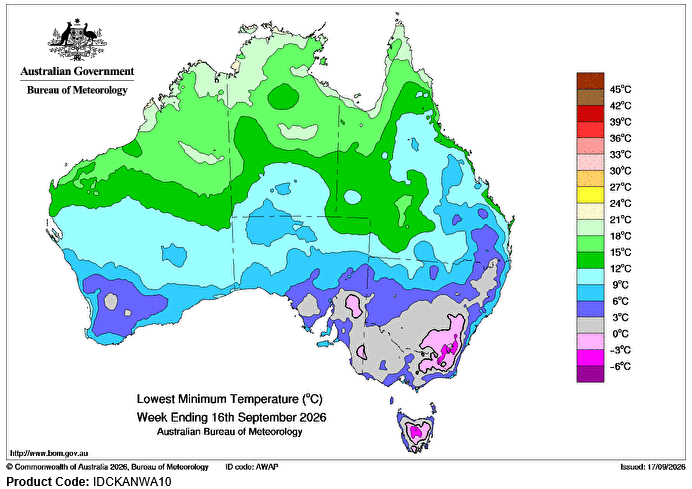
Frost has settled on crops in parts of southern NSW in recent days.
Northern consumers are sure to be looking for barley at harvest, but the local freight task means it is unlikely to come from the south as trucks will be busy transporting grain locally.
“They won’t cart north over the harvest period.”
Mr Gerhardy said grain has gotten harder to buy since Tuesday, now that most growers have their harvest action plan ready and have cleared out storage to make way for new crop.
“Big-volume farmers are saying if they have to cart 15km or more, they’ll look seriously at on-farm storage.”
Likewise, mixed farmers have room to store faba beans and barley for their own use, and are expected to deliver most or all of their canola and wheat to bulk handlers, consumers, or exporters at or shortly after harvest.
Reid Stockfeeds commodity buyer Justin Fay said while current-crop wheat is making its way to export, barley is harder to shift.
“A lot of barley has been coming to market, and we’ve had a lot of inquiry from farmers looking for markets for their barley,” Mr Fay said.
While barley pricing is attractive to domestics consumers, their demand for it is limited.
“Wheat is being drawn for export through the Melbourne, Geelong and Portland ports, and anyone wanting to top up with wheat domestically is having to pay up,” Mr Fay said.
“There’s quite a bit sold for September and October shipment, and all of a sudden, the domestic consumer has some competition.
“With barley, it’s not an issue.”
Mr Fay said Victorian growers were inquiring about selling current-crop faba beans, and pricing some new crop, with the prompt market at around $425/t delivered Western District.
Australian faba bean exports to Egypt, its major market by far, have been displaced by affordable and plentiful Lithuanian product, as another big south-eastern Australian crop nears harvest.
Grain Central: Get our free news straight to your inbox – Click here
HAVE YOUR SAY