

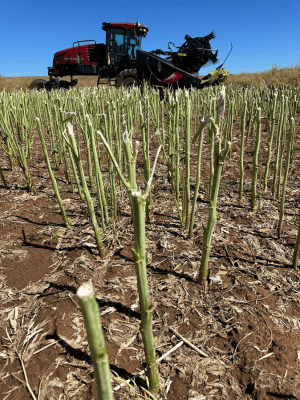
Harvesting PY428R canola in the western Riverina region of NSW last week. Photo: @agrobaz
THE AUSTRALIAN Oilseeds Federation has forecast the national canola crop now being harvested at a record 8.59 million tonnes (Mt).
This production estimate is 7.7 percent higher than the previous production record in 2022-23, up 10pc
on last season, and almost 7pc above the five-year average.
AOF’s October estimate represents an upward revision of 665,000t from the 7.93Mt forecast in its previous report released in July, reflecting generally favourable growing conditions across much of the Australian canola belt.
The estimated harvested area of 4.13 million hectares (Mha) is the second highest on record, while the national average yield of 2.08t/ha is forecast to be the third highest.
Record production is currently forecast for Victoria, South Australia and Western Australia.
Seasonal conditions have been variable, with rainfall during August generally above average across much of the grain-growing region, followed by a drier September across significant areas of the eastern states.
Temperatures remained above average through July to September, contributing to rapid crop development
and unusually early maturity in many regions.
October rainfall has been variable, with useful falls in some areas.
Windrowing canola at more than 50pc colour in southern NSW this week. Photo: @grassrootsag
Windrowing and harvest are now under way across northern growing regions, progressively moving
south.
Early harvest results are generally encouraging, with average to above-average yields and oil contents
commonly in the high 40pc range, although results remain variable in areas affected by less favourable
seasonal conditions.
Disease and pest pressure has been significant throughout the season, requiring active management and adding to already elevated production costs associated with fertiliser and diesel prices.
While the outlook for Australian canola is positive, crops are generally more advanced compared to where
they normally are in late October and thus, heat stress could bring about an abrupt end to late pod fill, even where soil moisture is still available.
Forecast conditions for November and December are for maximum temperatures to be above average, with the high chance of unusually high minimum temperatures.
Final production and quality will depend on seasonal conditions through the remainder of harvest, particularly the timing, duration and extent of rainfall and elevated temperatures across the major growing regions.
| Jly ha | Jly tns | Oct ha | Oct tns | |
| NSW | 764,000 | 1,317,000 | 770,000 | 1,485,000 |
| Vic | 625,000 | 1,602,000 | 644,000 | 1,791,000 |
| SA | 285,000 | 619,000 | 304,000 | 717,000 |
| WA | 2,412,000 | 4,390,000 | 2,412,000 | 4,600,000 |
| TOTAL | 4,086,000 | 7,928,000 | 4,130,000 | 8,593,000 |
Table 1: Lachstock Consulting and GIWA estimates for Australia’s 2026-27 canola crop as of July, and 22 October 2026 . Source: AOF
The AOF estimate sits above ABARES on 7.3Mt as issued in its September Australian Crop Report, Bendigo Bank’s of 7.9Mt released October 26, Rabobank’s 8.1Mt released October 13, and USDA’s 7.8Mt released October 9.
Source: AOF
HAVE YOUR SAY