
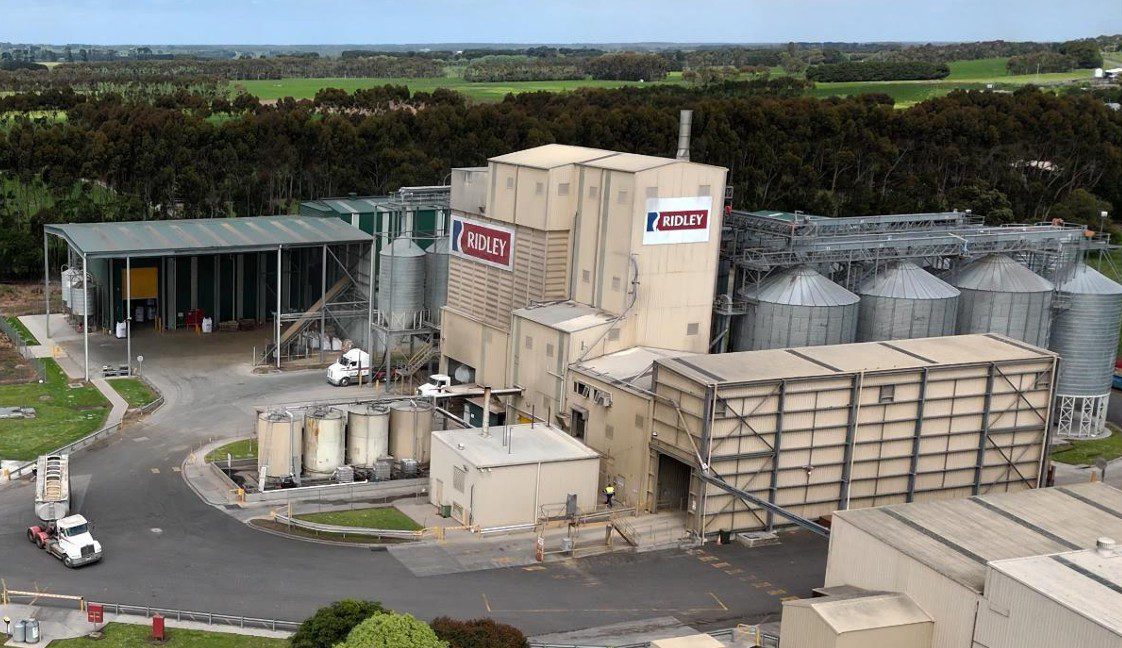
Terang Feedmill in south-west Victoria. Photo: Ridley
ASX-LISTED fertiliser and stockfeed company Ridley has reported earnings before interest, tax, depreciation and amortisation (EBITDA) of $157.8 million for the financial year ended June 30, up 61.9 percent on the previous year.
Revenue from continuing operations jumped 120pc to $2.86 billion, while underlying net profit after tax increased 41.5pc to $61M.
Ridley managing director and chief executive officer Quinton Hildebrand said earnings growth was driven by strong nine-month earnings from the Incitec Pivot Fertilisers distribution business “at the higher end of expectations” alongside “earnings growth in bulk stockfeeds as well as the packaged feeds business units”.
He said the ingredients business “underperformed” during the year as foreshadowed in the half-yearly report.

Quinton Hildebrand
Group result breakdown
The fertiliser business unit achieved EBITDA of $72.2M in its first nine months under Ridley ownership.
“This was a pleasing result, and the IPF team have done a particularly good job in sourcing urea supply on the global market to replace the supply contracts that we had with Middle East producers,” Mr Hildebrand said.
“We benefited from higher margins as global fertiliser prices rose, but this was partially offset by lower volumes as high prices led farmers to reduce demand.
“In the first nine months of ownership, we’ve restructured the business into a regional distribution model and reduced the number of roles in this business unit by 65.”
The bulk stockfeed segment delivered an EBITDA of $50.3M, up 5pc on FY25.
“The drivers for this growth were increasing volumes of 7pc in monogastric sales and 4pc in ruminant sales as we continue to support the growth of our customers and win over new customers.”
The packaged and ingredients segment delivered an EBITDA of $51.6M, down $11.4M on FY25, mainly due to being down $10.1M at the first half of 2026.
Mr Hildebrand addressed some operational issues at Maroota in outer Sydney and Oceania Meat Processors at Timaru on New Zealand’s South Island.
“As described in February, we had operational challenges at Maroota with one process dam inoperable for the full year up until the last week of June, and an ‘own goal’ at Timaru where the design issues have hampered the commissioning of the greenfield plant and we’ve been steadily resolving these over the financial year.
“We also had ovine constraints as lamb slaughter numbers have been down across the industry impacting OMP.
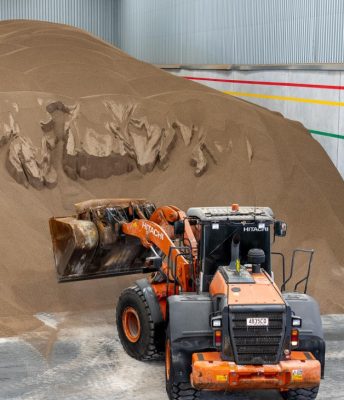
Incitec Pivot’s PDC at the Port of Brisbane’s Fisherman Islands has replaced its former key site at the nearby Gibson Island.
“The bright spot in this segment was the packaged feeds business unit, which grew year on year, with the biggest contributor to this growth coming from the packaged dog food, where we have grown 33pc on the supply of existing and new private-label contracts and the improved throughput rates of the plant.”
Fertiliser market update
Mr Hildebrand made mention during the earnings call of the Federal Government’s Fuel and Fertiliser Security Facility (FFSF), established in May, which he said was now “suspended”.
Ridley, via Incitec Pivot, has been a beneficiary of the program through entering into “contracts for difference” via the government on four urea shipments.
“Under this arrangement, we got protection in a falling market and gave up gains in a rising market.”
He said the company was asked to participate alongside others, and opted to join the program due to the volatile global marketplace.
“Global urea prices reacted after the start of the conflict on the 28th of February, and it became very risky for us and other importers to continue buying very expensive urea for the upcoming season.
“The questions at the time were: when will the war end; when will the price drop; what demand destruction would there be for farmers as they make alternative decisions with the high prices?
“All of this [was] leading to corporate conservatism when making import decisions, so government intervention was necessary.”
He said as none of the product was sold in FY26, the product will be accounted for in FY27.
In its financial statements, Ridley said of the agreements: “[t]he CFDs had a favourable market value of $53.6M at 30 June 2026”.
“This fair value gain is accounted for by the Group as a government grant and deducted from the carrying amount of the related inventory.
“At 30 June 2026, finished goods were presented net of government grants.
“These amounts will be recognised in cost of sales when the related inventory is sold in FY27 and the associated revenue is recognised.”
While no fertiliser cargos are currently planned under the CFD agreement between Incitec Pivot and the federal government, the FFSF is a permanent legislative tool administered by Export Finance Australia, and Grain Central understands loads can be recommenced if the need arises.
Phosphate update
Mr Hildebrand was asked about the impact of the change of Phosphate Hill ownership on IPF operations.
He said the current offtake contract would conclude in March 2027, and discussions were continuing with Mayfair “regarding the extension of that”.
“At this point, we haven’t formally extended that as regards to supply of phosphates into next season.
“We are taking a conservative position and making sure that we’re holding on to MAP and DAP, to the extent that we can, to make sure that we have physical availability for domestic requirements.
“The key demand period would be sort of February, March and so typically we would be exporting out of Phosphate Hill through this period, and then we would buy in to augment the Phosphate Hill supply from sort of December through to February.
“As we sit today, we’ve been a little more conservative on exporting to keep physical availability.”
Fertiliser works lead capital projects
Capital expenditure increased from $31M to $67M for FY26, with $23M to be spent on growth projects.
Mr Hildebrand said the company had capital projects under way and in the pipeline as part of its two-year strategy.
The fertiliser business undertook major capital works aimed at a “reset of the network”.
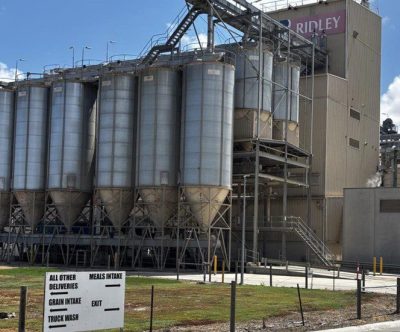
Lara Feedmill near Geelong in Vic. Photo: Ridley
He said this included the completion of the 3P primary distribution centre (PDC) in Brisbane, which was now operational and was “significantly improving on the service to customers” compared with the former Gibson Island PDC.
“In Townsville, we’re finalising the lease of a facility adjacent to our Townsville PDC, which will operate our storage which will increase our storage capacity and consolidate our volumes into a single operation.”
Mr Hildebrand also announced scaling of the UAN offering to the eastern Australian market as a “useful alternative source of nitrogen” to traditional urea.
“We brought this initiative forward and, over the past five months, have spent capital to repurpose tanks in two of our primary distribution centres in Adelaide and Portland, and we’ll bring in a full UAN cargo next month.”
He said the “debottlenecking” project at the Lara Feedmill has been completed.
“We’ve commenced another at Terang in the Western District of Victoria to support our growth in dairy, and there are other expansion options in the pipeline subject to customer offtake commitments.
“On the efficiency side, the raw material segregation is under way at the Pakenham (Vic) mill using our NIR to optimise ingredient usage.”
He said in the packaged and ingredient segment several initiatives were being progressed.
These include “the execution of long-term private-label dog food contracts in packaged feeds, the completion of the OMP facility in Timaru, the sales of own and agency products through Oceania Petfood Solutions – our one-stop shop in Australia – and the establishment of a direct supply chain into Thailand to get our ingredients into this Asian pet food manufacturing hub”.
Grain Central: Get our free news straight to your inbox – Click here
HAVE YOUR SAY