

InterGrain barley breeder David Moody with a plot of Neo CL. Photo: InterGrain
NEO CL has been recommended for the first time as a malting barley variety to be grown in Western Australia next season.
The recommendation has come from the Grain Industry Association of Western Australia, which last week released its guide to growers and consultants planning their 2026 barley cropping program.
Neo CL, which gained Grains Australia malting accreditation earlier this year, joins fellow InterGrain variety Maximus CL, which was the only malting variety recommended by GIWA for planting this year.
Maximus CL came to dominate plantings in 2024, accounting for two-thirds of the total WA barley area, and 80 percent of the MALT1 stacks within the CBH network.
“This year Maximus CL has declined slightly as growers begin exploring alternative varieties,” GIWA Barley Council chair and InterGrain barley breeder David Moody said.
“Despite this shift, the limited diversity in segregated varieties and the low availability of malting-suitable barley that doesn’t require processing aids are constraining global demand for WA malt barley grain and malt.”
This year’s plan sees segregation opportunities for Cyclops, Laperouse, Maximus CL and Neo CL varying by port zone, apart from Geraldton, where no segregation has been recommended.
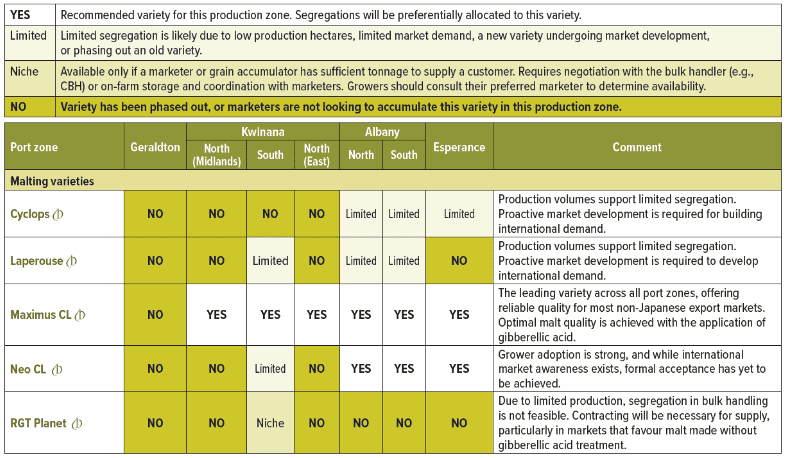
Table 1: WA malting barley variety segregation recommendations by port zone for the 2026-27 harvest. Source: GIWA
Australia continues to play a significant role in the malt barley trade, contributing around 30-40pc of the global supply.
China remains the world’s largest barley importer, accounting for nearly half of global imports in 2023-24, and is Australia’s largest export destination.
Saudi Arabia has significantly reduced its presence in the global barley trade and is no longer a major player.
This shift highlights the growing importance of emerging markets for Australia and the need to diversify its export strategy.
Africa and Latin America show a strong demand for premium single-variety malt barley.
There has been a decline in beer consumption in mature markets traditionally served by Australian barley and malt.
In China, beer production has peaked and is now in decline, although demand for premium beer is rising, which is increasing the need for high-quality malt barley in brewing.
Chinese malt exports are also expanding, driven by lower domestic consumption and significantly reduced labour and energy costs, making Chinese malt more competitively priced than Australian malt.
This shift is placing pressure on Australian malt houses, leading to reduced production levels and tighter business conditions.
International market signals highlight Australian malt barley’s generally low-protein status.
GIWA’s Malt Barley Variety Receival Recommendations plan says growers can help remedy this by targeting grain of 10.3-10.8pc protein for varieties favoured by domestic maltsters and 10.5-11pc for export within the receival window of 9.5-12.8pc.
There are three varieties currently in Stage Two of the Grains Australia Malt Accreditation Program, AGT-Spirit, Spinnaker and Titan AX that have not been included in the WA Malt Barley Receival Recommendations for 2026-27.
Growers should expect a decision on the malt accreditation of these varieties in March 2026, noting that malt accreditation does not guarantee segregation opportunities at receival sites.
“Each year, the GIWA Barley Council works with the WA barley value chain to provide guidance to industry on the management of malt barley segregations in the bulk handling system.”
“I strongly encourage growers and their consultants to take note of the recommendations within the plan when considering their 2026 barley cropping program.”
Developed by the GIWA Barley Council in consultation with the WA barley supply chain, the annual plan provides WA barley growers with guidance on which malting varieties are both sought by the market and agronomically suited to WA.
They therefore point to the varieties likely be segregated by CBH, and flag varieties for which opportunities may exist for niche segregations or direct grower-to-buyer contracting.
Source: GIWA
HAVE YOUR SAY