
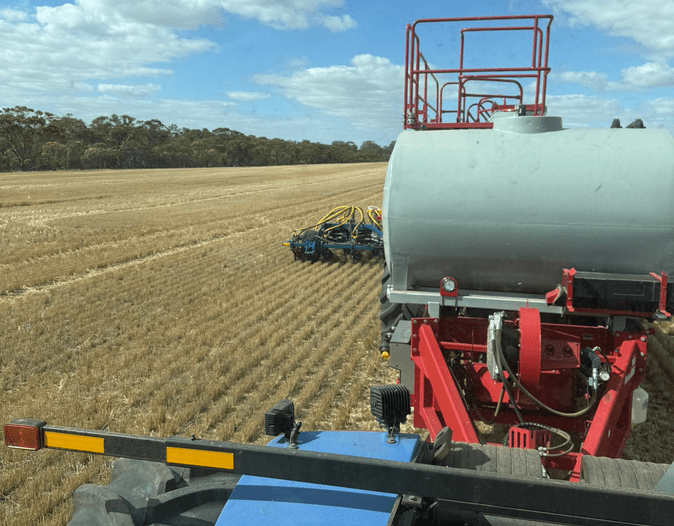
Growers including the Guthrie family of Bolgart, WA, started their seeding program with canola, despite supplies of fertiliser being limited. Ex-TC Narelle delivered 37mm to their country, which allowed them to start seeding a little earlier than normal on March 31. Photo: Curtis Guthrie
LAST Monday, Member of Parliament Rick Wilson gave an update to the House of Representatives about the what the current urea shortage as caused by the war between Iranian and Israeli-US forces may mean for the state of Western Australia.
WA is Australia’s biggest grain producer and exporter, and Mr Wilson’s electorate, O’Connor, covers much of the WA Wheatbelt, as well as CBH Group’s Albany and Esperance port zones.
Recent rain, including some from ex-Tropical Cyclone Narelle already has growers off to an early start with seeding, but Mr Wilson warned the WA crop now being planted could be well below the 27 million tonnes from the record 2025-26 harvest.
“This year, CBH, the main grain handler in Western Australia, is estimating that, without that urea, the crop will be around 15 million tonnes,” Mr Wilson told the House of Representatives.
“That’s about a 45 percent reduction in the crop if farmers can’t get hold of that urea.”

CBH Group CEO Ben Macnamara and chair Simon Stead were in Canberra to partner with the Business Council of Cooperatives and Mutuals for a Parliamentary Friends of Co‑operatives and Mutuals event on March 24, and also caught up with WA MP Rick Wilson (right). Photo: Rick Wilson MP
The figure has not been ratified by CBH Group.
In a statement provided to Grain Central, a CBH spokesperson said CBH has not yet produced any crop estimates.
“We’re modelling a range of scenarios based on fuel and fertiliser supply, with independent outlooks on WA crop production to come from GIWA later in April,” the spokesperson said.
The GIWA, or Grain Industry Assocation of WA, report is due out April 17, and will hold the first official estimate for WA planted area by crop.
While rain has some WA growers off to an early start with seeding after good recent rain for some regions, GIWA’s initial estimate for 2026-27 planting may well be below the 8.81 million hectares seen in its first forecast for the 2025-26 crop and released on April 11 last year.
Lachstock Consulting has WA pencilled in for a canola crop of 3.19Mt, down from 4.31Mt in 2025-26, when most growing regions produced exceptional yields.
Urea situation ‘ugly’
In the same address to the House of Representatives last week, Mr Wilson said farmers were gradually filling their tanks in readiness for seeding amid “very, very tight” fuel supplies.
“They’ve been ordering large volumes and getting small increments, and, hopefully, getting those storage tanks full.”
As the main planting window approaches for WA growers, Mr Wilson said they would be “going flat out” as of early last week, with large tractors and sprayers using around 1000 litres of diesel per day.
“Most farming operations would have three or four of them running, so they will plough through a lot of diesel in a very short period of time.
“Let’s hope that they can keep that fuel up and keep the crop going in.”
Mr Wilson said “the ugly is very much the fertiliser situation”.
Unconfirmed reports say in addition to CSBP, a second WA fertiliser company has just called force majeure on supply contracts with growers.
“Seeding fertiliser, for the most part, is on farm — most farmers have received their seeding or planting fertiliser — and I think that the crop will go in in relatively good shape.
“The really disturbing and worrying situation is the nitrogen component of the crop.”
Urea is the world’s main nitrogen fertiliser, and Australia sources most of its from the Persian Gulf, which is currently unable to despatch cargoes due to the threat to shipping from mines, missiles, and the like.
“My intelligence tells me that, of the 800,000 tonnes of urea required for this year’s crop, about 100,000 is either here, onshore in Western Australia, or on the water, so that’s about 700,000 tonnes of urea short.”
Mr Wilson on March 25 shared a reel on his Facebook page of his discussion with CBH Group chief executive officer Ben Macnamara and chair Simon Stead.
“We chatted about CBH Group’s record harvest last year, and just how important it is for our farmers to have access to the fuel and fertiliser they need to put a crop in the ground,” Mr Wilson’s post states.
Grain Central: Get our free news straight to your inbox – Click here
Having a supply of urea is fine but the timing of rainfall events is the major determinate of yield. Actual amounts of rainfall can become irrelevant if the rainfall window is past.
Thus monthly averages are irrelevant if your average falls in the last week of the month.