
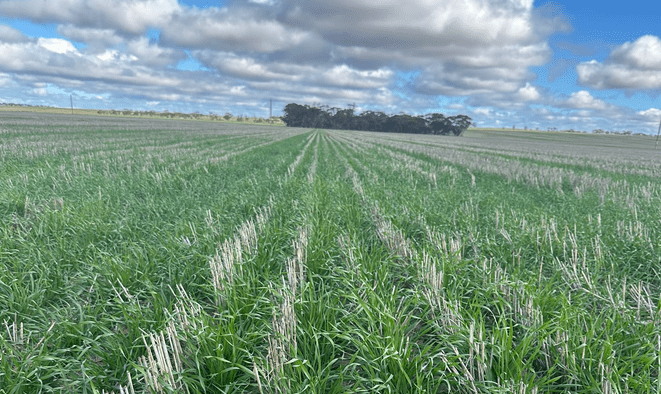
An early sown paddock of Beast barley at Salmon Gums in the Esperance Zone photographed last week. Photo: Tim Starcevich
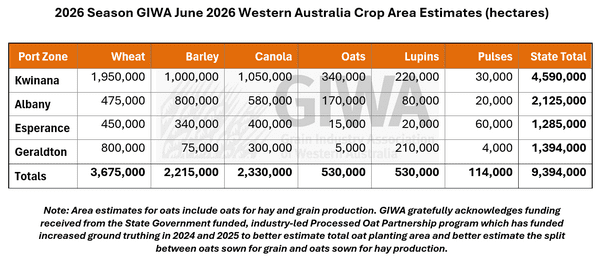
THE GRAIN Industry Association of Western Australia has lifted its winter crop area forecast to 9.39 million hectares (Mha), up slightly from the 9.38Mha expected in its previous report issued May 8.
In its monthly report released today, author Michael Lamond said recent rain across much of the WA grainbelt has freshened up crops following a particularly dry May.
“Crops that had previously not emerged are now up and have a chance of achieving reasonable grain yields, with the warm soil temperatures helping crops bounce out of the ground,” Mr Lamond said in the report.
“Countering the mixed condition of the crops in the central and southern regions, there is a very large crop area sown this year across the state, exceeding the previous record estimated area sown in 2025.”
GIWA’s estimate puts the 2025 cropped area at a record of just under 9.4Mha, which could well be challenged by the crop now being planted.
Rain across much of the grainbelt this week has “filled in the gaps” left by rains in the past two weeks, and Mr Lamond said this latest event will improve the outlook for those areas that received decent falls.
“While based on global climate models, the forecast for a below-average rainfall year and warmer-than-average spring temperatures remains, the current state of the grain crop in Western Australia is good.
“Crop growth stages across large areas of the grainbelt are more advanced than is often the case at this time of the year.”
Swing out of wheat more pronounced
GIWA now estimates wheat area at 3.68Mha, down from 3.73Mha forecast in May.
Increases have been made over the month for barley, now at 2.22Mha against 2.17Mha, and canola at 2.33Mha, up from 2.28Mha.
“There has been a big swing out of wheat into canola this year due to the early rains favouring canola, which is the more profitable crop when planted in April and early May.
“Additional wheat area was also lost to barley driven by barley’s yield-by-price advantage over wheat during seeding.”
Mr Lamond said growers in the low-rainfall regions opted to continue planting rather than swap to fallow where they were able to follow moisture down in the profile in May.
“Earlier predictions of crop paddocks being left out due to the uncertainty of supply and cost of fertiliser and fuel have not eventuated.”
GIWA figures show lupin area, now seen at 530,000ha, down 20,000ha from the May forecast, has not spiked as was predicted earlier in the year.
However, there has been an increase in pulse crop planting as was anticipated, but the total area is “very small relative to that planted to the major crop types”.
“Oat area has also levelled out from 2025, due mainly to the forward price for oats destined for hay dropping below the previous year’s levels.
“The milling oat price has held up, and the traditional milling oat regions have similar planted areas to last year.”
Mr Lamond said early sown crops will be buffered from the predicted drier and warmer year ahead, should it eventuate, but the very dry May has used a lot of subsoil moisture from pre-season rain.
“Crops that have emerged are very clean, having emerged through dry topsoil due to the dry May conditions.”
Mr Lamond said emergence has generally been good, and those paddocks were plant population were “a bit light on” have improved with recent rain.
“Overall, the state is set up for a reasonably good year if rainfall totals are at least close to average from now on.”
Outlook rosiest in Esperance, Geraldton
In the report, Mr Lamond said the Esperance Zone was in “particularly good shape” after one of its best starts to the growing season in recent history.
He said crops in the Geraldton Zone were also in good shape, with large areas well ahead of where they have been in previous record tonnage years.
Conditions are mixed in the Kwinana port zones, with some areas of early emerged crops looking good, while areas in the central and southern portion of the zones are well down on year-to-date rainfall.
“There is a poor strip in the southern portion of the Kwinana west zone running into the eastern Albany port zone that has continued to miss out on rainfall so far this year, and will need a good run from now on to hit average yields.
“There is also a large strip of country from the bottom portion of the East Kwinana port zone down to the border of the eastern areas of the West Kwinana port zone and the eastern portion of the Albany port zone.
“This strip of late-emerging crops is interspersed with smaller good strips that have had more year-to-date rainfall; however, some crops here are going to need some good falls of rain to hit average grain yields.
Further detail on crop conditions in individual WA port zones can be found as part of the full report on the GIWA website.
Source: GIWA
HAVE YOUR SAY