
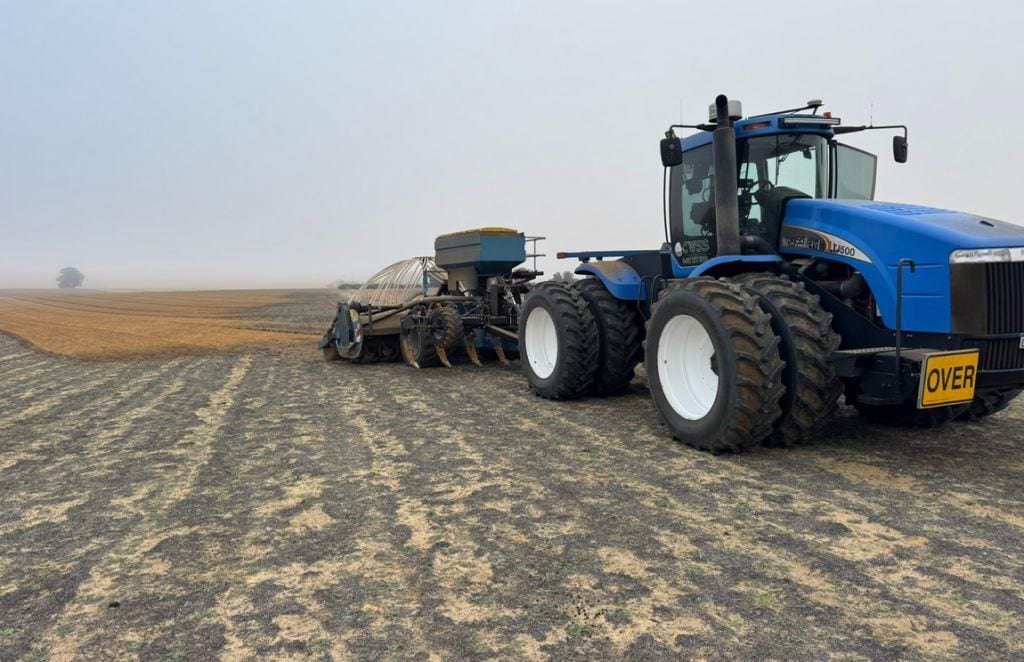
Planting wheat in the Goomalling district. Photo: Nathan Evans, Evanics Diesel Services
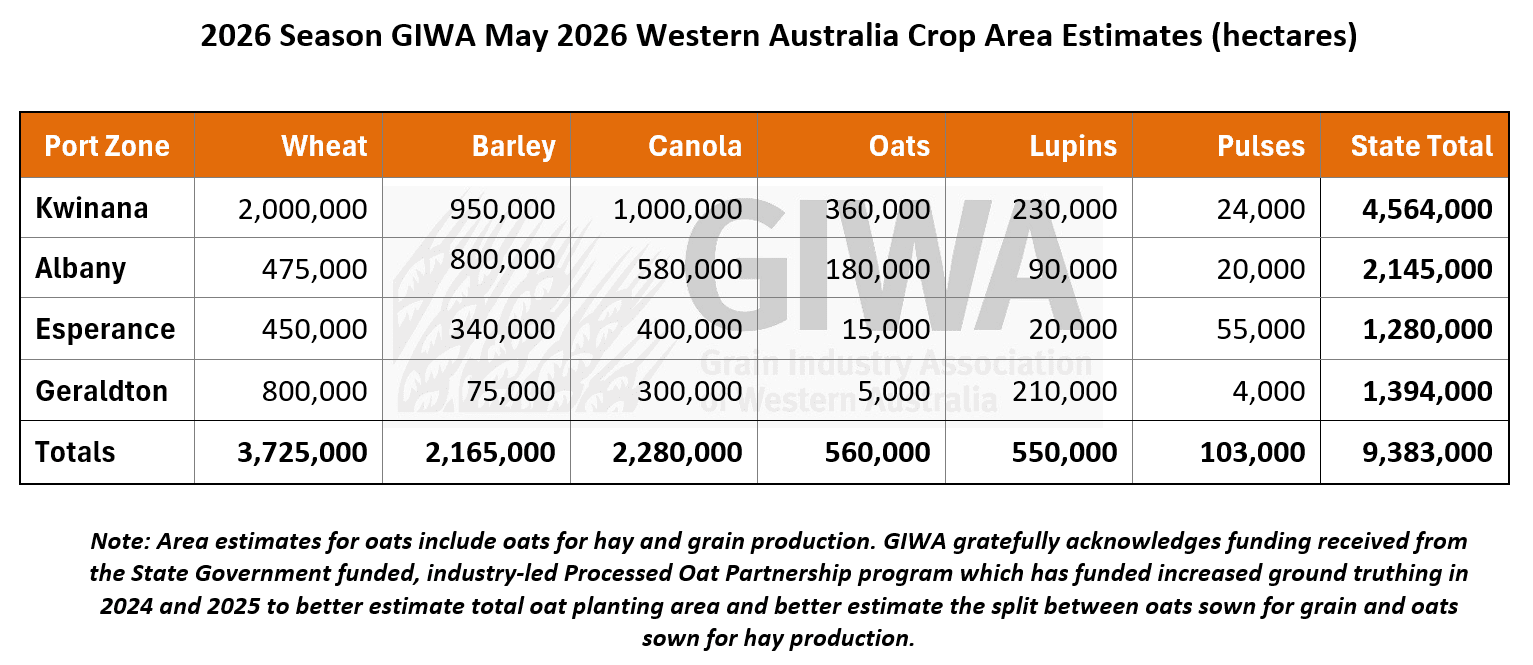
THE GRAIN Industry Association of Western Australia has lifted its estimated area for the crop now being planted in WA to 9.38 million hectares from the 8.93Mha initially seen last month.
In the May Crop Report released today, author Michael Lamond said most of the grainbelt had benefitted from further useful rain in the last few weeks to keep the seeders going.
“A big proportion of the planned crop will be in the ground by mid-May with most of this being sown into moisture,” Mr Lamond said.
He said canola emergence would vary depending on which side of the rain growers were on at sowing.
“Canola sown prior to rainfall events is very good and canola sown after rainfall events in late March and early April, which suffered patchy emergence, has now evened up.
“Cereal emergence is mostly very good across the state.”
Mr Lamond said this season has brought the “earliest start and finish to planting since the very high yielding year in 2022”.
He said this “has provided a welcome boost in confidence across the grain industry which has been severely knocked about by the conflict in the Middle East”.
“Even though input costs are high, they have not blown out as much as was initially predicted prior to the start of seeding.
“The early sowing opportunity for canola has driven renewed confidence as it is the most profitable crop grown in WA, particularly when it emerges before mid-May, which will be the case for most crops this year.”
Cereals down, canola up
Mr Lamond said there was “a big question mark” on cereals, particularly wheat, as margins are slim on current grain prices assuming average yields.
He said this has resulted in wheat area being down on 2026.
“Wheat area as a percentage of the total planted area has been declining for some time.
“In the 2016 growing season, wheat area was 59.2 percent of the total area planted and this year, it is going to be closer to 40pc.
“All cropping zones in WA will have a reduction in wheat area planted relative to the 2025 cropping season, which is likely to end up being about a 14pc reduction in total wheat area.
“This decrease in wheat area has been taken up by barley and canola over the last ten years, with barley area up due to it currently being more profitable than wheat driven by price and barley’s yield benefit over wheat.
“The projected barley area in 2016 has increased from 16.6pc of the total crop to 23.2pc.
“Canola hectares in 2026 will be the largest area planted on record and have increased from 15.5pc of the total cropped area over the last ten years to a projected 24.5pc this year.”
Predictions of hot finish
Mr Lamond said the early sown crops were “at risk at the back end of the season by being more prone to frost”.
“However, most growers are continuing to capitalise on existing moisture knowing that if they dodge frost events, a longer growing season will likely lead to higher yields which are needed to turn a profit.
“The risk is worth it.”
He said at this stage there was projections for a hot finish to the season.
“There is a bit of a reluctance by growers to slow down seeding operations as the forward climate projections are for a hot dry finish to the growing season.
“The majority of climate models agree on this and whenever they align, it signifies that what is forecast is more likely to occur.
“Climate models are forecasting both above average minimum temperatures and maximum temperatures in the spring this year.
“WA has been experiencing above-average minimum temperatures for some time, which has partly contributed to very high tonnages.
“At the same time, there has been an absence of prolonged periods of high maximum temperatures in recent years.
“Higher temperatures help to reduce frost risk, but historically heat shock can shave off more tonnes of grain at the end of the season than frost.”
Mr Lamond said at this stage there was optimism amongst growers despite global instability and input issues.
“While there is a long way to go with seeding still underway, at this stage of the season the sentiment is good and one of relief thanks to the early start of the season.”
Further detail on crop conditions in individual WA port zones can be found as part of the full report on the GIWA website.
Source: GIWA
HAVE YOUR SAY