
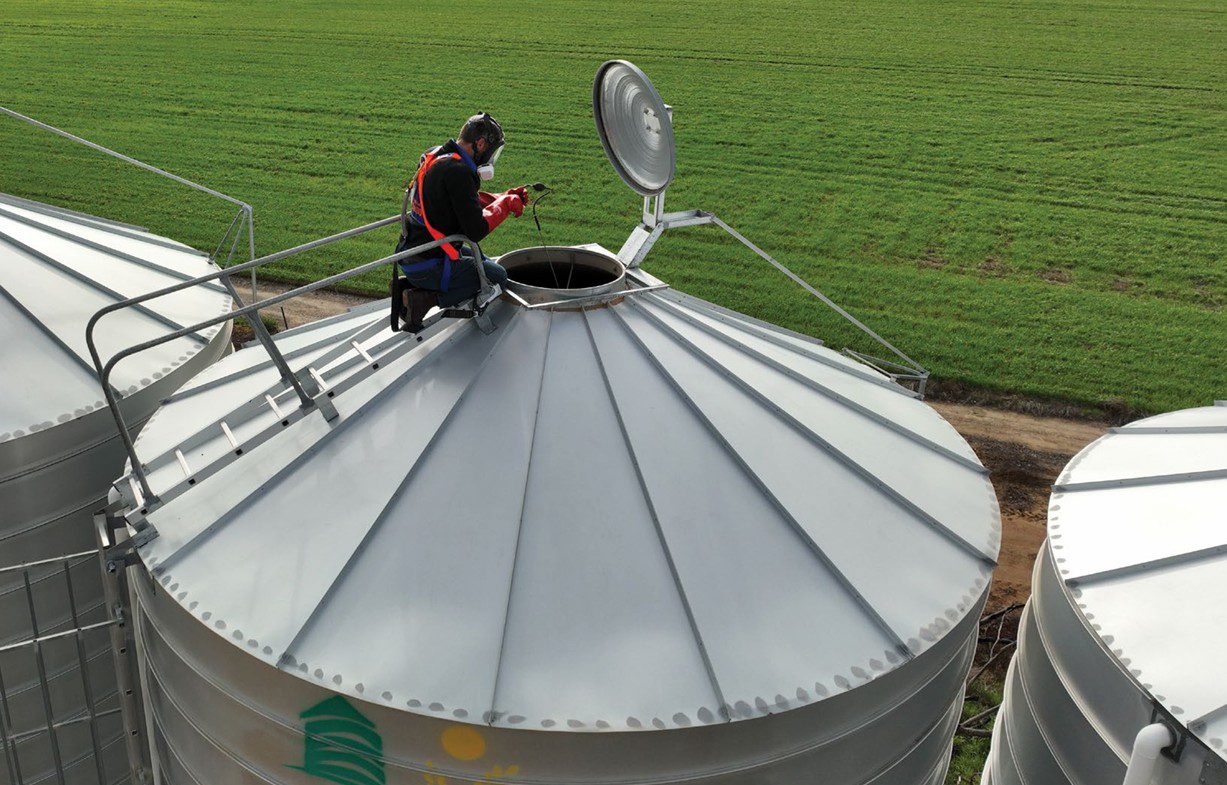
Low-range phosphine meters are used to ensure storages have been vented adequately after fumigation. Photo: Jonathon Kerr via GRDC
A PROPOSAL by the Victorian Government to stick with current standards for airborne phosphine until December 2029 has been welcomed by Grain Producers Australia and Grain Trade Australia.
Announced yesterday by WorkSafe Victoria, the decision delays the commencement of much tightened allowances for the grain industry’s primary insect fumigant due to come into effect in December this year.
An initiative of Safe Work Australia, the Workplace Exposure Limits (WELs) are to be enforced by state governments, and the national announcement has caused both alarm and confusion throughout Australia’s grain supply chain.
Phosphine is one of 15 airborne contaminants SWA has listed as being covered by the WELs, which are to replace Workplace exposure standards currently in place.
Stakeholder feedback to WorkSafe Victoria on the adoption of the WEL list in Victoria identified concerns relating to implementation costs, monitoring capability, access to occupational hygiene expertise, and impacts on small and medium-sized businesses.
In response, WorkSafe Victoria has recognised that new limits require significant adjustments to the systems, processes and risk controls of affected workplaces, which take time to implement.
Its extended transition period is intended to balance improved protections for the health and safety of workers with the practical realities of implementation.
Hopes other states will follow
GPA said while the SWA mass review of contaminants has been under way for several years, the scope of it meant its detriment to the Australian grains sector has only recently been realised.
“GPA [is] deeply committed to safe workplace standards, but this new limit would have seen a real risk to Australia’s biosecurity and trade, with no demonstration it will improve worker safety,” GPA chair and New South Wales grower Matthew Madden said.
“There isn’t really a viable alternative for grain growers to fumigate stored grain against pests, and support our biosecurity and trade, so this looming change, with no workplace safety advantage, has been deeply concerning.
Mr Madden said growers have already faced “monumental challenges” this year through the impact of the US-Iran War on fuel and fertiliser prices and supply.
He said GPA hoped other jurisdictions would follow the Victorian Government in giving industry a reprieve on the proposed WELs.
 Likewise, GTA has welcomed the announcement by WorkSafe Victoria.
GTA said it and other industry participants have been raising concerns with federal and state governments and regulators for some time that revised phosphine WELs have been set without robust evidence that they will deliver a measurable improvement in the health of Australian workers.
GTA chief executive officer Pat O’Shannassy said the Victorian decision was a practical and welcome step.
“GTA and its members are unequivocally committed to the safety of everyone who works in the grain value chain,” Mr O’Shannassy said.
“That commitment is exactly why we have been advocating for a realistic implementation pathway.”
“The proposed WELs apply limits at levels that current monitoring technology cannot reliably measure in practical workplace conditions, particularly the peak limit.
“A standard that cannot be measured cannot be verified, cannot be enforced consistently, and cannot demonstrably improve safety outcomes.”
Phosphine is used to protect stored grain from insect pests across the Australian supply chain, from on-farm storage through to bulk terminals.
GTA said it has no equivalent registered and commercially viable alternative available at the scale the industry requires.
“Without a workable phosphine standard, Australia’s ability to deliver pest-free grain to domestic and international customers is put at risk.
“That is a biosecurity, market access, and trade issue, not just a compliance issue.”
GTA said the proposed limits would place Australia out of step with comparable grain exporting and importing jurisdictions, including the European Union, the United Kingdom, the United States, Canada, and Argentina.
“The additional time proposed by WorkSafe Victoria provides the space for the work that should accompany a change of this magnitude.”
That includes validating measurement methods, understanding the operational and economic impacts, and developing controls that industry can implement.
GTA is now asking SWA and the remaining state and territory WHS regulators to consider a nationally consistent position.
“A patchwork of different regulation across state and territory jurisdictions would be unworkable for a supply chain that moves grain across state borders every day.
“We encourage other regulators to align with the approach proposed in Victoria, so industry has one clear, consistent, and achievable timeframe.”
GTA said it will work constructively with WorkSafe Victoria, the Australian Pesticides and Veterinary Medicines Authority and industry partners up to 2029 on a phosphine exposure standard that is measurable, achievable, and genuinely protective of worker health.
It will also continue to engage with SWA and other state and territory policymakers and regulators to provide similar extensions to validate measurement methods and understand the operational and economic impacts.
Source: WorkSafe Victoria, Grain Producers Australia, Grain Trade Australia
HAVE YOUR SAY