
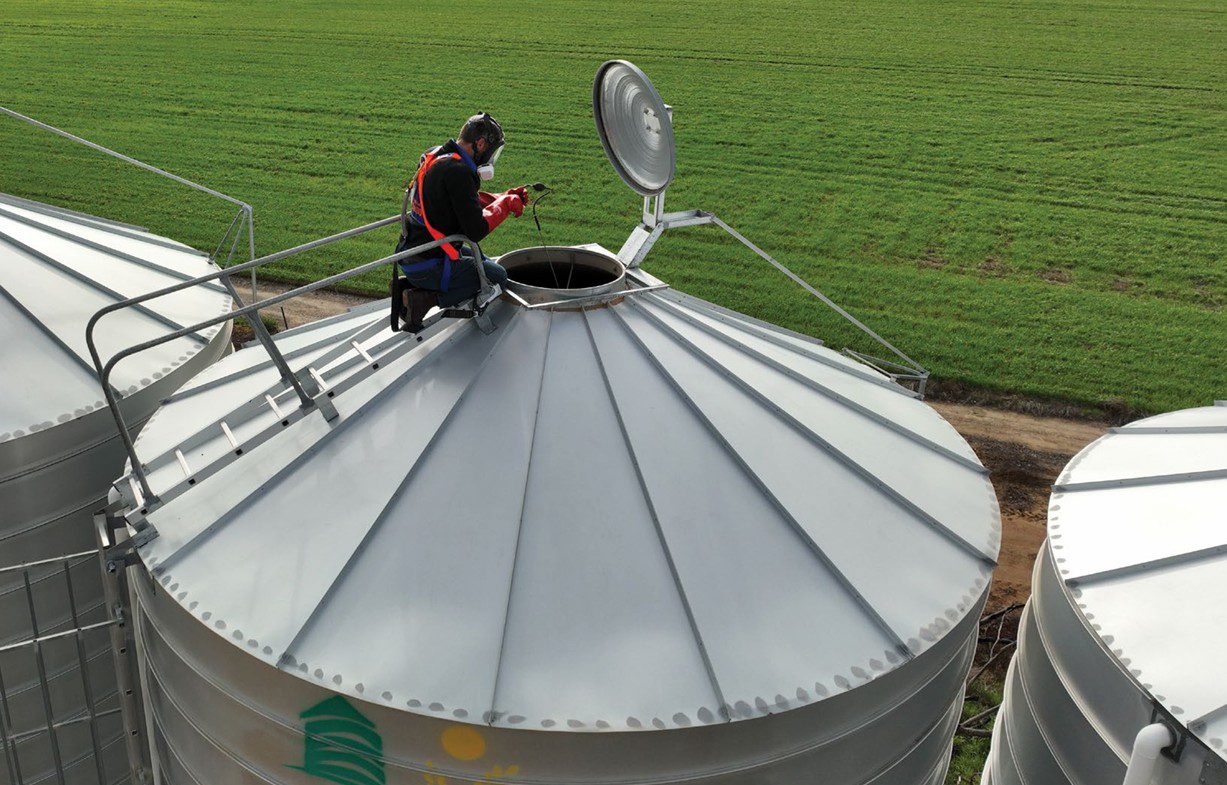
Low-range phosphine meters are used to ensure storages have been vented adequately after fumigation. Photo: Jonathon Kerr via GRDC
INDUSTRY has warned that changes to workplace exposure limits for phosphine, due to take effect from December 1, could significantly disrupt the grains supply chain and restrict insect management options.
Phosphine is a chemical fumigant used to treat all types of pests in stored grain and commodities.
It is the only widely available and cost-effective chemical treatment of its kind, with industry estimating phosphine is used to treat about 90 percent of stored grain in Australia.
Under current workplace health and safety regulations, Australian grain must not exceed a phosphine threshold limit value – time weighted average (TLV-TWA) of 0.3 parts per million (ppm).
This is based on safe exposure levels for an individual working an eight-hour day over a five-day week.
As part of a broader review of chemical exposure limits, Safe Work Australia will reduce the workplace threshold for phosphine exposure to 0.05ppm from December 1 under the Workplace exposure limits for airborne contaminants regulation.
Grain Central understands the proposed threshold would be the lowest of its kind globally.
Over 700 chemicals substances and mixtures with an established workplace exposure standard or workplace exposure limit (WEL) were considered as part of the review, with changes made to thresholds of about 200 of them.
The reviews were based solely on information collected from other relevant Australian sources, such as the Australian Pesticide and Veterinary Medicines Authority (APVMA), and trusted organisations worldwide.
All other trusted international organisations with workplace exposure limits or equivalent recommended levels set those limits at 0.3ppm or higher, except for the American Conference of Governmental Industrial Hygienists, which recommended a threshold of 0.05ppm.

GTA CEO Pat O’Shannassy.
Interestingly, the US Department of Labor Occupational Safety and Health Administration has opted against adopting that level and has set its permissible exposure level at 0.3ppm.
Grain Trade Australia chief executive Pat O’Shannassy said phosphine had been “lost amongst the weeds” during the Safe Work review, leaving industry with little clarity on the decision, its rationale or its potential impacts less than five months before the changes take effect.
Mr O’Shannassy said the industry would support changes if there was evidence they would improve worker safety or that the previous exposure limits posed a risk to workers.
“We’re not trying to undermine any safety issues at all,” Mr O’Shannassy said.
“There’s really no evidence or clarity that there is a safety issue in the beginning and there’s no evidence or clarity to say that going to this level will address that.”
Potential impacts
GTA with support from Grain Producers Australia, Grain Growers Limited, the Grains Research and Development Corporation, and major bulk handlers, has been attempting to quantity the impacts of this decision on the supply chain.
Mr O’Shannassy said the effects of the decision on the grains industry would be “quite profound”.
Grain Central understands the impact of the reduced threshold could vary between operations, depending on whether silos are located on-farm, at commercial grain storage sites, or at ports.
According to industry sources, the changes could impact grain in several ways.
For grain-storage complexes, particularly those located in or near townships and communities, the changes could require closures due to expanded exclusion zones.
The lower exposure limit could also mean grain loads need longer aeration periods before they can be safely handled, allowing phosphine residues to dissipate.
This could mean grain shipments at ports would need to be held for twice as long before they are cleared for export.
“You’re blocking up that port and slowing shipments down, let alone what happens if you find a truckload delivered to port or a container-packing facility above the 0.05[ppm], it’ll just sit there,” one industry source told Grain Central.
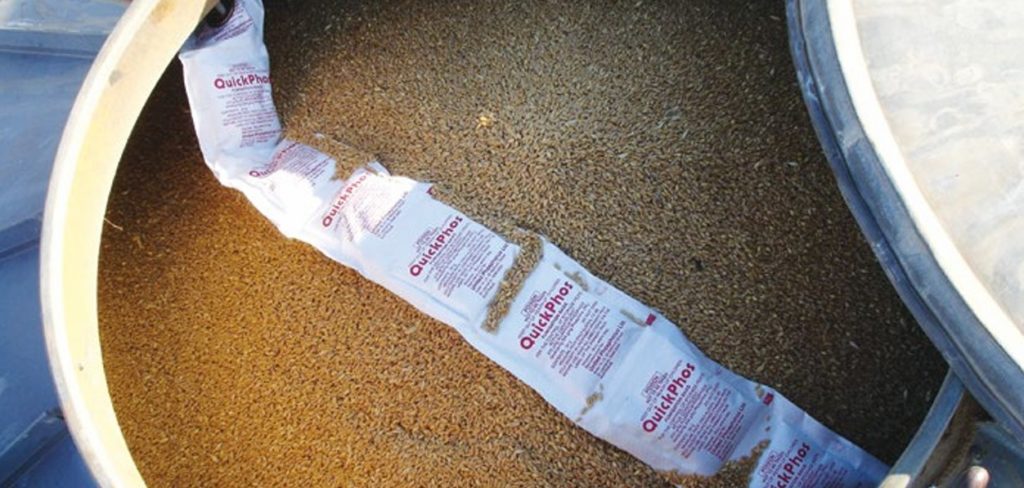
Phosphine is widely used to fumigate grain. Photo: Chris Warrick via GRDC
Accurate measurement
Industry has questioned whether it’s possible to accurately measure the new threshold with the current technology available.
Gas levels are measured using phosphine meters with high-range devices used during fumigation and low range tools used to check if the gas was cleared before out-loading grain.
Low range devices generally measure 0-20ppm, while the high range devices measure 0-2000ppm.
Most monitoring devices are not designed to detect phosphine at concentrations as low as the proposed threshold.
This has put into question whether the new thresholds could even be accurately regulated by Work Safe Australia or the state government counterparts.
“It’s a case of regulations coming forward that can’t be enforced,” a source said.
“We can’t measure reliably down to these levels and there’s not instruments available for everyone economically to actually assess at those particular levels.”
State, territory advocacy
There is some hope the new WEL could also be deferred, after Safe Work Australia last month postponed lower exposure thresholds for nine other chemicals.
These chemicals were: benzene, chlorine, copper, formaldehyde, hydrogen cyanide, hydrogen sulphide, nitrogen dioxide, respirable crystalline silica, and titanium dioxide.
For a deferral to proceed, a majority of state and territory work health and safety ministers would need to agree that further work on the exposure limits is required.
Each state and territory authority has responsibility for regulating WEL and could theoretically choose not to adopt the reduced thresholds.
Mr O’Shannassy said industry was calling for the implementation date to be put on hold while further work was undertaken on the issue.
“At the moment, we’re mostly trying to engage in a collaborative way with the regulators and the governments to sort of see whether we can get some traction.”
Grain Central understands GTA, GPA, GrainGrowers and bulk handlers have been holding extensive discussions with state and territory regulators and ministerial offices to raise industry concerns.
A GrainCorp spokesperson confirmed the company was engaging in the process alongside GTA and other groups.
“GrainCorp shares the Australian grains industry’s concerns about the implementation of the new Workplace Exposure Limits for phosphine and is working with Grain Trade Australia and other industry participants to engage constructively with governments and regulators,” the spokesperson said.
“We support improved transition arrangements, including an extended implementation period, to establish a practical pathway to compliance while protecting workers and maintaining the safe and efficient operation of Australia’s grain export supply chain.”
Bunge and CBH Group were contacted for comment.
Grain Central understands regulators in at least Victoria, New South Wales and Queensland will implement the changes as outlined in the regulations.
A SafeWork NSW spokesperson encouraged industry members to familiarise themselves with the new limits and understand how to comply with them.
“Following a Safe Work Australia process in 2024, work health and safety (WHS) ministers across Australia agreed to workplace exposure limits for airborne contaminants, including phosphine,” the spokesperson said.
“Businesses are encouraged to familiarise themselves with the new workplace exposure limits by identifying, assessing and controlling the risk posed by the airborne contaminant hazard by 30 November 2026.”
GRDC, APVMA involvement
The changes have attracted significant investment from GRDC, which will provide research to support growers and industry with the process.
This work will also assist APVMA with the process.
As the product regulator, the APVMA will be required to update the labels on phosphine products to meet the Safe Work Australia regulations.
A GRDC spokesperson said the organisation had invested “significantly in research, development and extension (RD&E) to provide Australian grain growers with information and resources to support best practice phosphine management”.
“In response to the impending new Safe Work Australia Worker Exposure Limits (WELs), GRDC is investing in additional research to help underpin critical information, such as current worker exposure, monitoring protocols and product label requirements, to assist industry in complying with these changes,” the spokesperson said.
“This program of investments is expected to be complete by mid-2028, and will include a phosphine label update submission to the Australian Pesticides and Veterinary Medicines Authority (APVMA) and a cost effective, on-farm testing procedure that will enable growers to measure phosphine levels at outturn and provide confidence to supply chain participants that WELs can be adhered to.
“The investments are being guided and informed by a steering committee with representation across 18 organisations from across the supply chain including researchers, bulk handling companies, on-farm grain storage experts and chemical suppliers.”
APVMA was contacted for comment.
Grain Central: Get our free news straight to your inbox – Click here
HAVE YOUR SAY