
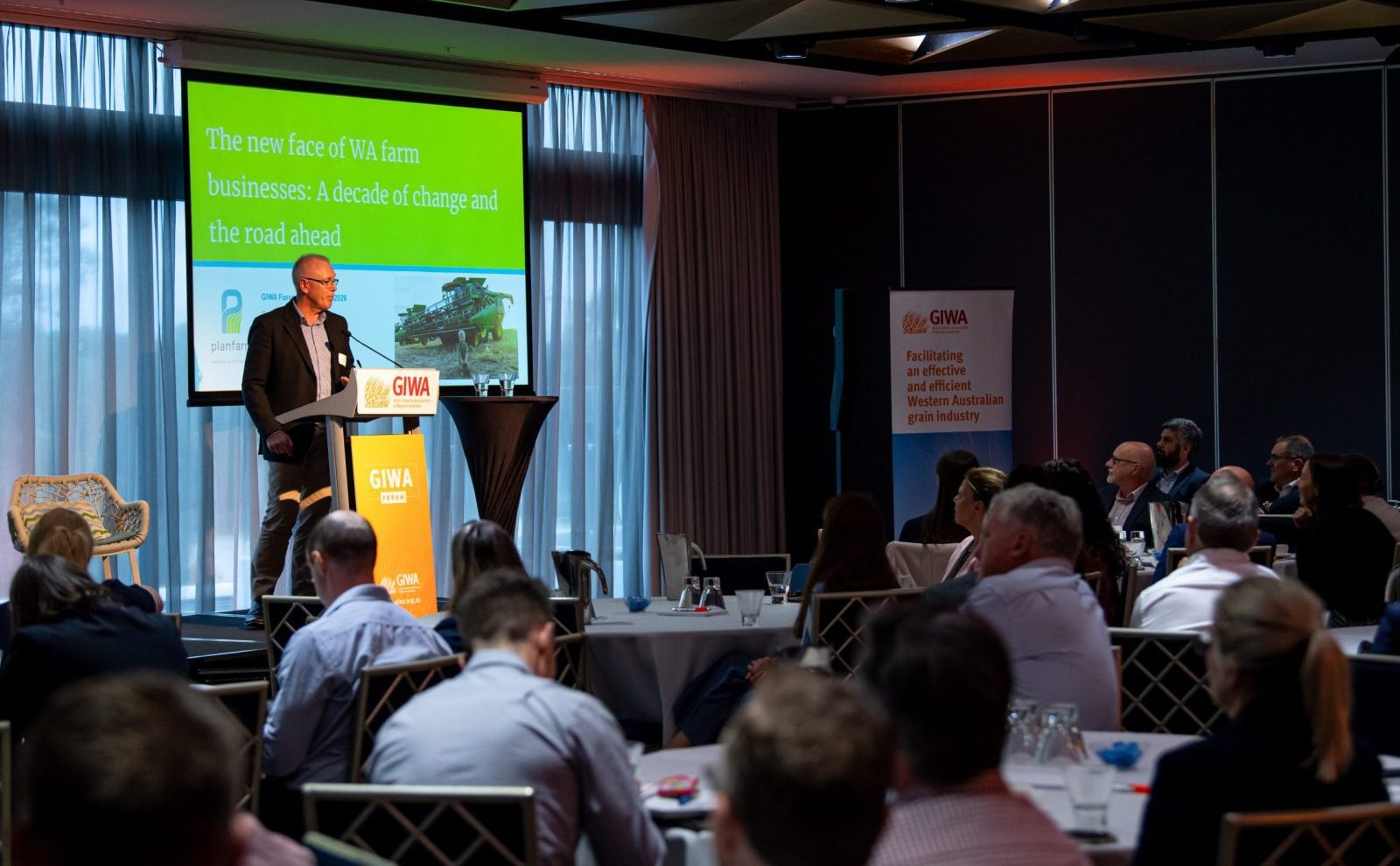
Graeme McConnell presents at GIWA’s forum in Perth last week. Photo: GIWA/Lumens Photography
WESTERN Australia is the powerhouse of Australia’s grain exports, and its changing production mix was the subject of a Grain Industry Association of WA forum held in Perth last Wednesday.
Entitled The new wheatbelt: How costs, capital, climate and consolidation are changing grain farming in WA, the CBH Group-sponsored forum was held in front of an audience of around 120, plus online attendees.
GIWA chief executive officer Peter Nash anchored the forum, and stepped through the changes seen since GIWA started producing its monthly area and production estimates in 2010.
That was when WA planted roughly 4 million hectares of wheat, over 1M ha of barley, under 1Mha of canola, with oats, lupins and pulses “well down the ladder in terms of area”.
“Wheat is now at its lowest planted area since 2010, and is down 1.5Mha on the record planting of 2021.”
“Barley area has more than doubled since 2010 and it’s at a record high.”
“Canola area has almost tripled since 2010 and is also at a record high.
“Oat area has more than tripled since 2010 and is at a record high.
“The question is: should we still be calling it the Wheatbelt?”
Prospects bright for canola
Commonwealth Bank of Australia agricultural economist Dennis Voznesenski said WA was not alone in seeing a trend for increased canola production.
“There has been a strong shift away from wheat to canola planting across Australia in recent decades,” Mr Vosnesenski said in his presentation entitled From wheat to what? Global trends in crop selection.
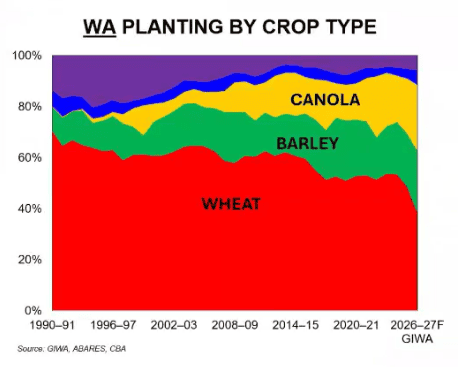
Figure 1: The change in WA plantings by crop type from 1990-91 to 2026-27. Source: GIWA, ABARES, CBA
Driving the shift has been global demand for biofuel, which has supported prices, and he said this demand was expected to stay strong for a “trifecta of factors”.
They include Canada, as Australia’s major competitor in the global canola market, since 2016 crushing more canola to supply US biofuel demand for a better return than exporting whole seed can offer.
Mr Vosnesenski said the means North America, like WA, has seen wheat area decline and canola area lift, with soybeans riding the same wave.
“There’s been a shift into oilseeds around the world”.
Australia exports around 60pc of its canola to Europe for biofuel production, and Mr Vosnesenski said domestic demand for Australian canola could jump if its biofuel industry ramps up.
However, “a bit of a runway” out to 2030 exists between plants on the drawing board and production ramping up.
Mr Vosnesenski said the third factor in the trifecta is geopolitical insecurity, which has created a drive for self-sufficiency, meaning countries like India, China and Egypt are prioritising growing wheat for food.
Challenges from climate drivers
The forum also heard from Bureau of Meteorology meteorologist Jessica Lingard, who looked at the influencers on Australian weather.
They included the Hadley Cell, a large-scale circulation which carries warm air from the equator at high altitudes to the sub-tropical, where it cools to produce rain.
“Typically, our high-pressure belt during the winter period sits around Geraldton,” Ms Lingard said.
“Now that the Hadley Cell is getting bigger, that maybe sits more around Perth.”
Ms Lingard WA had a relatively dry winter because low-pressure systems are sitting further south, as far south as the Southern Ocean.
She said fewer cold fronts, more high-pressure systems, and WA’s lengthening warm season could all point to less rain for growing areas.
A major influencer of eastern Australia’s weather is the El Niño-Southern Oscillation, and Ms Lingard described ENSO as “massive player in weather features all over the world”.
The Indian Ocean Dipole and its oscillation between western and eastern sea-surface temperatures was also discussed.
It is currently expected to move into a positive event before it eases.
“How I remember this is that positive events have a negative impact on rainfall; unfortunately, we’re in that positive phase.”
Ms Lingard said waters around Australia were “incredibly warm”, which may generate some thunderstorms and cyclonic activity, but the rapidly oscillating Southern Annular Mode was another contributor that in its current positive phase did not augur well for rainfall.
Diesel of concern: McConnell
Putting global factors into a local context was consultant and Planfarm director Graeme McConnell.
In his presentation entitled A new face of WA farm businesses: A decade of change and the road ahead, Mr McConnell did not mince his words.
“We’ve got some real challenges coming,” Mr McConnell said.
The most immediate is expensive diesel.
While the closure of the Strait of Hormuz impacted spot pricing since the conflict broke out, he said most of Planfarm’s client base, which covers around 475 businesses across Australia, was buffered in the current season.
“Most growers had fuel and fertiliser sorted before we ran into those issues at the beginning of the year, so it’s still not impacted our budget numbers this year.”
However, elevated prices, as well as a potential labour shortage as seen through the recent visa issue, could well bite in the coming season.
“We are very largely a diesel economy; a lot of the global economy is.
“I don’t think the demand for diesel is very elastic.
“I’m actually starting to get…really worried about the supply of diesel and what impact that has.
“If we see supply tighten up again, I think that’s something that’s going to impact our businesses.
“We’re giving advice to clients now to just increase your storage.”
Mr McConnell said operating costs have lifted “just enormously” in recent years.
WUE lifts wheat
Looking at Planfarm’s data gathered from its client base, Mr McConnell said sheep have gone from 18pc of income down to 8pc.
Overall, farm size and cropping have grown.
Water-use efficiency (WUE) of crops has improved enormously, with wheat the stand-out.
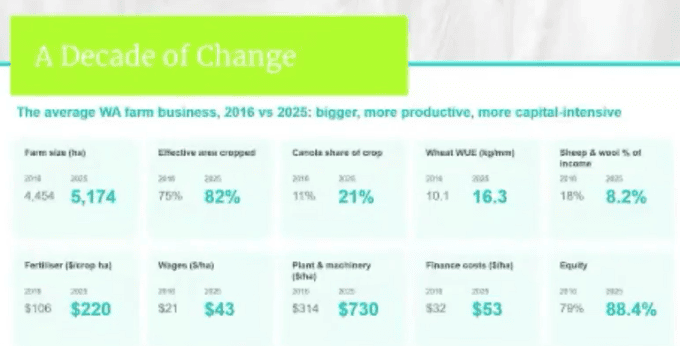
Figure 2: Key 2016 versus 2025 statistics for WA farm businesses. Source: Planfarm via GIWA
Measured by kilograms of grain harvested for every millimetre of in-crop rain, in the Planfarm client base has risen from an average of 10.6kg from 2006-2015 to 13.9kg over 2016-2025, with 2025 averaging 16.3kg, and peaking at 19.1kg/mm.
“That’s what’s driving our ability to sustain production and sustain our systems.”
Mr McConnell said over that period, canola has turned from a rotation crop to a profit driver, helped by its leading gross margin.
“The top 25pc of producers are growing more canola and clearly growing it really well.”
Between 2016 and 2025, wheat area in Planfarm’s client base increased 7pc, barley rose 65pc, and canola 77pc.
With barley, he said its higher yields compared to wheat have made it the more attractive cereal option of the two.
Whatever the production mix, Mr McConnell said enterprises have not been able to escape pressure from rising costs from 2016 to 2026, which include a 175pc increase in the cost of insurance for the farm and its machinery.
“We’ve had these incredibly big increases in our cost of production.”
He said fertiliser and wages have doubled in the same period, and the rise in costs has outpaced inflation.
Against these overheads, challenging years have become more challenging.
“One of the tricks to farming effectively is in a tough year not to lose money.”

The GIWA forum panel comprised CBA’s Dennis Vosnesenski, BoM’s Jessica Lingard, Lawson Grains chair and Boggabilla grower John Woods, and consultant and Planfarm director Graeme McConnell. Photo: GIWA/Lumens Photography
Planfarm’s client base shows a profit before tax on a 10-year average to 2025 ranging from $61/ha to $176/ha to average $143/ha.
Mr McConnell said while income per hectare has double from 2016 to 2025, the capital needed to earn it has more than tripled.
“That’s not a trend that’s sustainable.”
He said the agricultural industry has made “really good use” of the good seasons, including the past decade, which has been “a pretty amazing run of years.”
He said 80pc of Planfarm’s WA ag businesses are at greater than 80pc equity.
“I’ve never seen that before in my time, and I don’t think I’ll ever see that again.”
Three scenarios
Mr McConnell said the current outlook will reward low-cost producers, and those with cash reserves and low gearing.
He said these will hold across three scenarios: the squeeze, the grind, and the second wind.
“The squeeze” will occur if input costs stay high and supply constrained, interest rates remain elevated and grain prices stay flat, and land values plateau or soften.
“The grind” will see costs ease a little, grain selling at a long-run average, productivity gains at trend, and land value flat in real terms.
“The second wind” is the best Mr McConnell can hope for in the current climate, and will include a lift in prices from global demand, easing interest rates ease, a productivity boost from technology step-change, and firming land values.
Whichever one eventuates, Mr McConnell is clear in his overall optimism: “I have enormous confidence in this industry. “
Grain Central: Get our free news straight to your inbox – Click here
HAVE YOUR SAY