
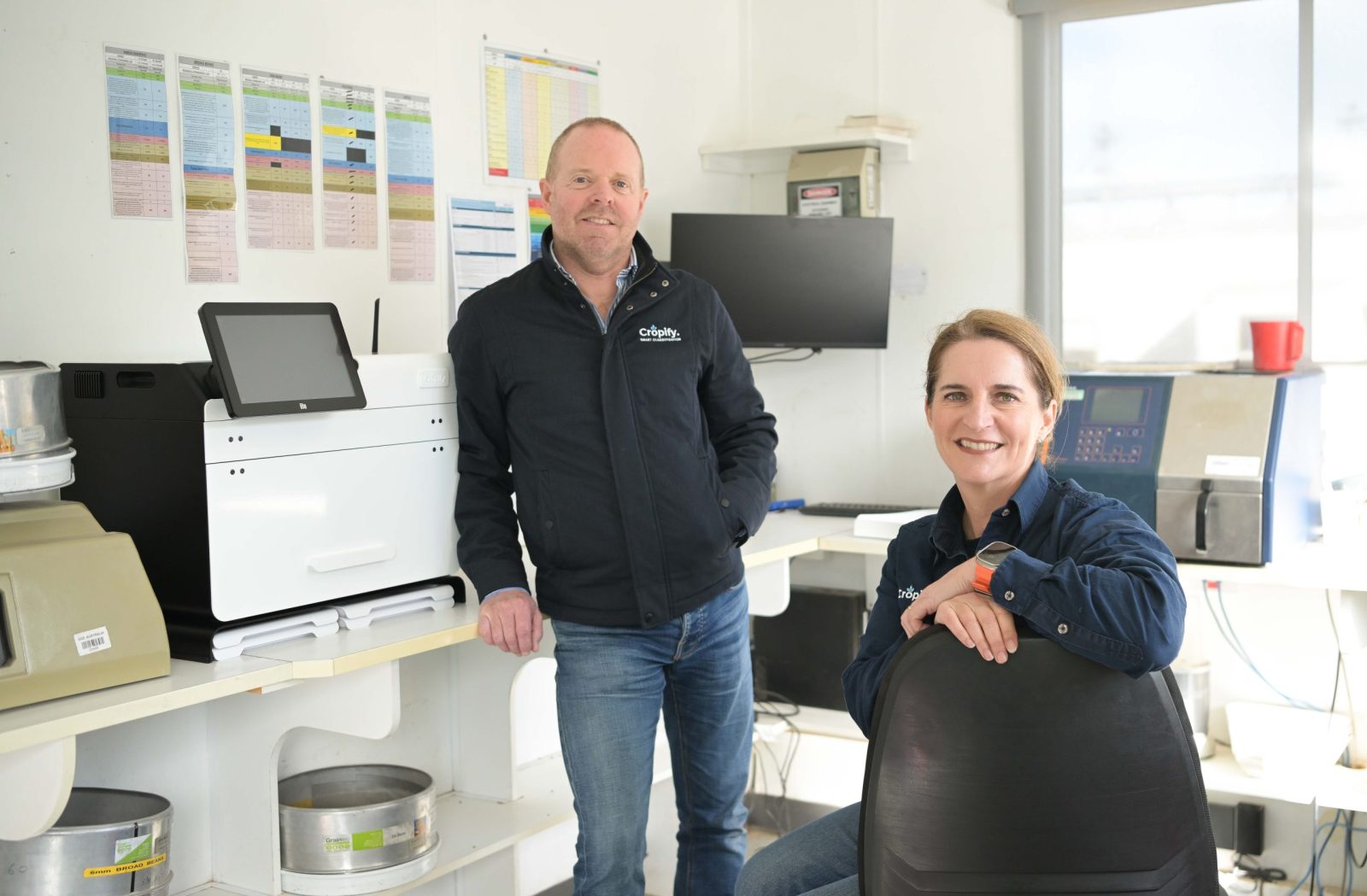
Cropify founders Andrew Hannon and Anna Falkiner with a Cropify Opal unit at a grain-handling facility in Bowmans, South Australia. Photo: Tracey Nearmy
GRAIN Trade Australia’s Trading Standards Committee has deemed Cropify’s visual analysis platform to be worthy of commercial consideration as a field method for bulk handlers receiving pulses.
This recognition is the first of its kind for an AI-based unit which can be calibrated for use in sample stands, and has come in time for the upcoming winter-crop harvest.
The news has been welcomed by Cropify’s founders Anna Falkiner and Andrew Hannon as they seek Seed Plus capital to prepare for expansion beyond both pulses and Australia, and has added an option to field methods used by those in the Australian supply chain to assess intake.
GTA chief executive officer Pat O’Shannassy said the nod to Cropify has paved the way for calibrated AI-based visual analysis to becoming widely acceptable, as are measurements from other calibrated equipment which the industry has come to rely upon without question.
GTA sets and publicises standards for commodities traded in the domestic and export market, and its members include traders, bulk handlers, end-users and brokers of all sizes across Australia.
“We’re living in a world where technology is moving very quickly, and what we’re getting to is a point…where these machines will become like the protein machine or the moisture machine whose ability we don’t question,” Mr O’Shannassy said.
Careful growth
Cropify started in Adelaide, still its home base, in 2019, and Grain Central first reported on the company in 2022.
Cropify initially worked with bulk handlers of lentils in South Australia, and moved into trial and then commercial work in Victoria too last year with companies including GrainCorp, Louis Dreyfus Company, ETG Australia, and Shannon Bros.
Following recent testing in northern New South Wales and southern Queensland, Cropify’s Opal units are available for use commercially for the first time on chickpeas this harvest, and the company has up to 25 additional Opal units available to answer the call.
ETG Australia last harvest used Opal technology to avoid bottlenecks and maintain standards at its Wimpak site at Minyip in Vic’s Wimmera district, and will be doing the same this harvest.
“Harvest moves incredibly quickly; delivery times and truck turn around efficiency are as important to us as they are to our grower clients,” ETG Australia head of trading Todd Krahe said.
“At the same time, every grading decision needs to be consistent, objective and correct as mistakes here can cause logistical and financial issues in the future.
“Cropify gives us fast, repeatable assessments that give us and our growers confidence of a fair and objective outcome when it comes to lentil grading.”
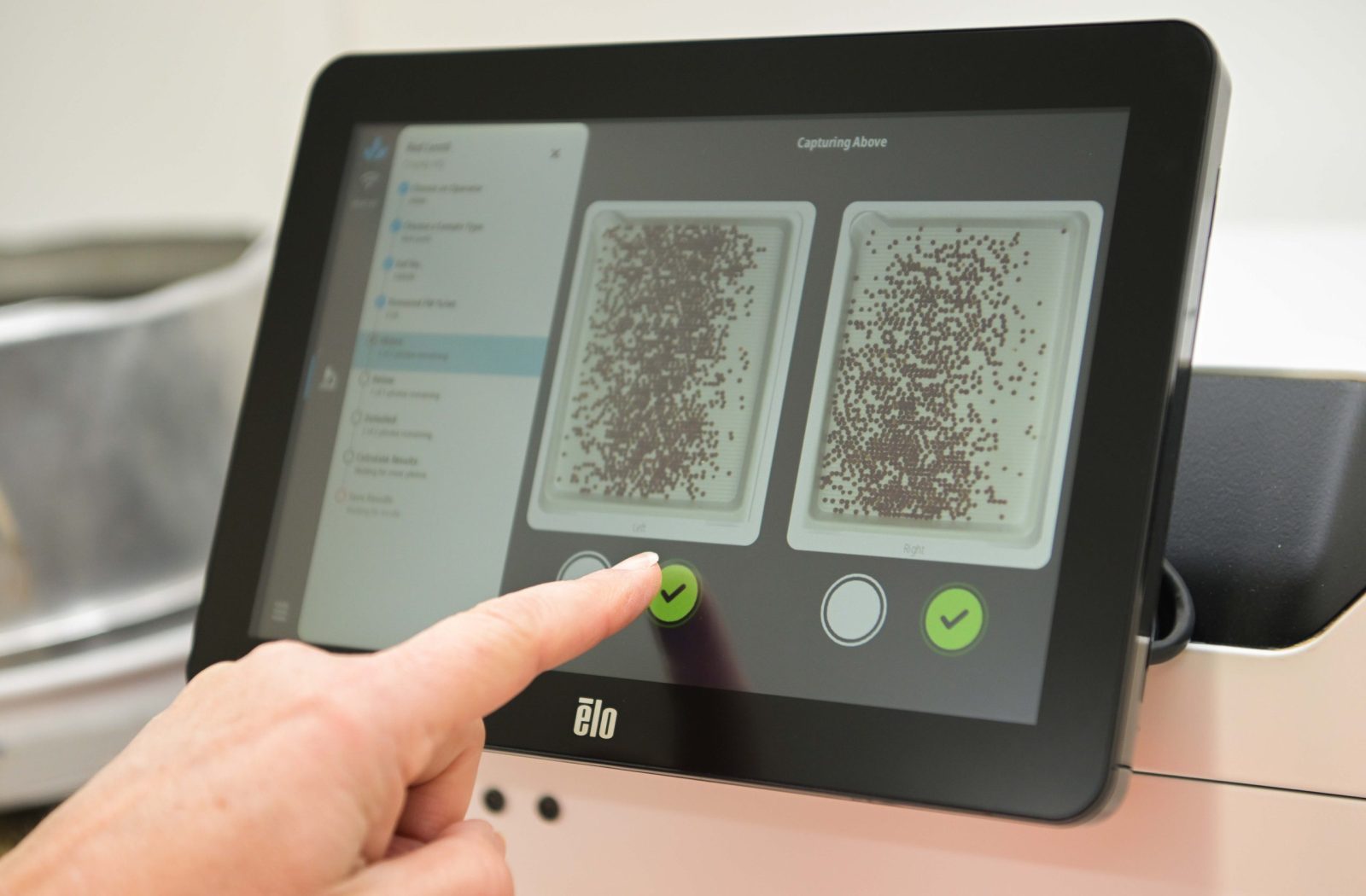
Cropify’s Opal unit assessing lentils delivered in South Australia. Photo: Tracey Nearmy
Mr Krahe said the Opal unit is a worthwhile addition to the lentil sample stand, even when quality is good, and increases in value to the operation when a downgrading event like frost is widespread.
“Because lentils are so small compared to other pulses, that’s when it can really come into its own; it can take up to 20 minutes to assess a sample of frosted lentils in the traditional way.”
GTA’s Trading Standards Committee assessment of Opal technology follows its endorsement last year of Zoom Agri’s Zoom One technology as a method for assessment for specific barley varieties.
Opal’s technology is non-specific to variety, and Ms Falkiner said GTA’s assessment has given the industry confidence that AI is maturing, and is a credible option for grading grain.
“Grain supply chain participants can consider the adoption of the technology, delivering the same consistent standard of assessment every single time.”
The company’s technology analyses samples in minutes, and creates a digital record of every load.
Also in time for this harvest, Cropify is using this digital record to inform a real-time quality-management dashboard that gives bulk handlers vision of grading results across multiple sites.
Time for capital
The Cropify platform has turned heads not just in Australia but also in Canada and the United States, and the business is exploring potential for rolling out its units there, and in other overseas locations.
However, it needs funds to do so if it wants to follow on the heels of expanding Australian agtech businesses like Queensland-based SwarmFarm, which has raised $42 million over two funding rounds combined, and Sydney-based BioScout, which recently attracted $6.75M.
“Those businesses are at scale-up size; we’re not there yet,” Ms Falkiner said.
“We’re trying to raise $2.5 million in capital…through people who want to be part of this great story of Australian agtech.”
Cropify has received support from the SA Government’s AgTech Growth fund and the Australian Institute for Machine Learning at the University of Adelaide, plus the Grains Research and Development Corporation’s call in 2024 to develop AI-based pulse-grading technology.
Grain Central: Get our free news straight to your inbox – Click here
HAVE YOUR SAY