
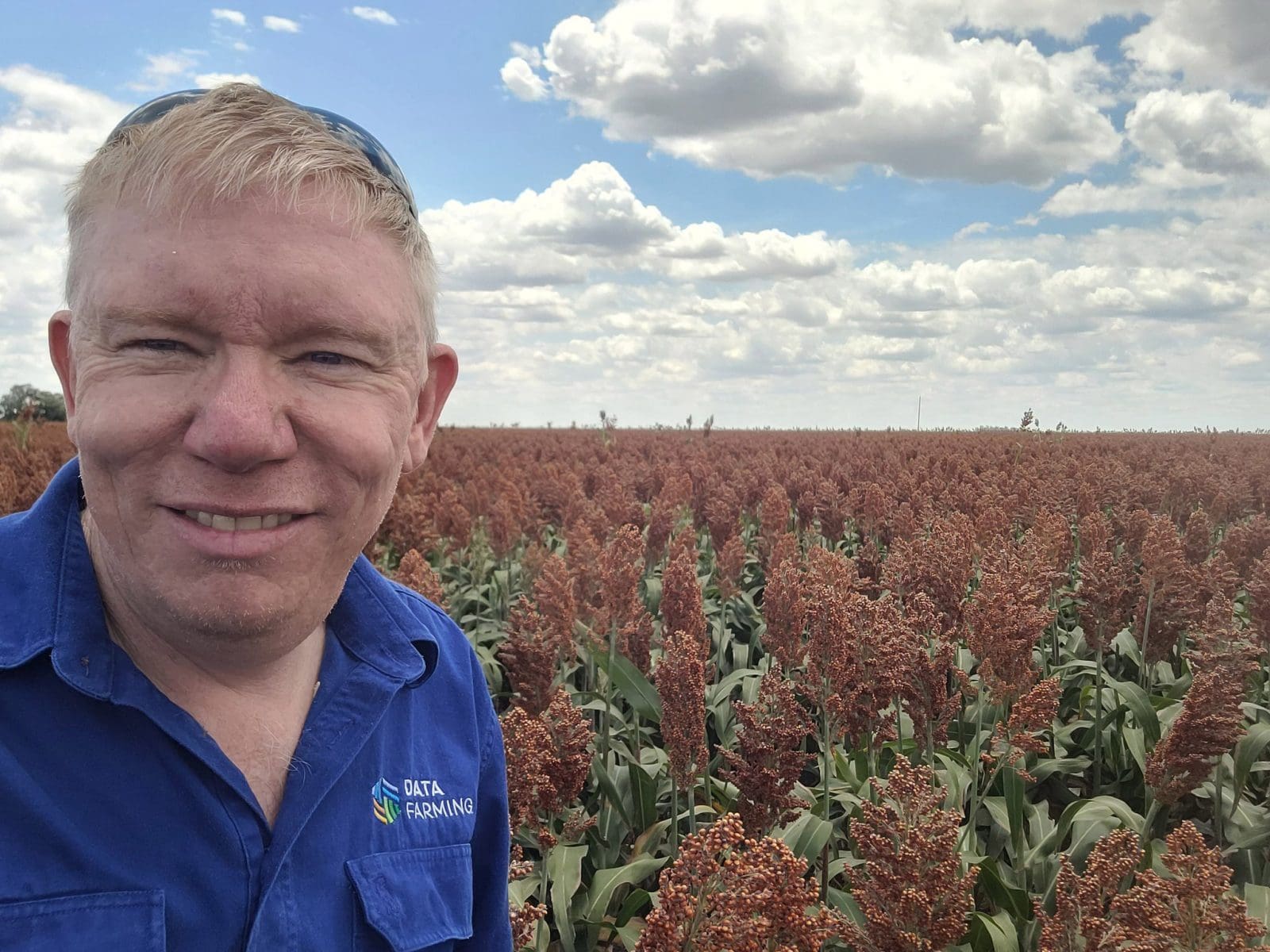
Tim Neale inspects a sorghum crop on the Downs last year. Photo: DataFarming
AGRONOMISTS have an opportunity to harness data science, satellite technology and artificial intelligence to improve productivity and efficiency as workforce gaps deepen, according to DataFarming co-owner Tim Neale.
Mr Neale told last week’s GRDC Grains Research Update in Adelaide that new technologies would enhance rather than replace agronomists’ decision-making.
“I think the role’s really going to change; you probably already know that; it’s not rocket science,” Mr Neale said.
“It’s all about being more effective.”
In his session, entitled The Autonomous Agronomist, Mr Neale discussed a range of technologies in various stages of development which could be used by agronomists to improve decision-making and crop outcomes.
He said all the products were aimed at increasing productivity by better utilising data collection.
“We are losing that attention to detail.
“We’re doing stuff…on large scale, fairly slap-happy.
“I’ve got plenty of examples of where…near enough is good enough to get the crop in, to get things done.”
Mr Neale said combining satellites, drones, AI-assisted analysis and electromagnetic sensing could allow agronomists to target individual paddocks and plants, improving chemical use, and enabling more precise harvesting times.
“We’ve got to shift our paradigm from broad-scale thinking to what does that plant need.
“We need to rethink the way we do agriculture, because we’re losing so much.
“I look at yield maps every day of the week, and all I see is lost opportunities.
“A 300-percent yield variation is everywhere.”
Weed, disease detection
Mr Neale and his team are at the halfway stage of several projects focused on detecting green-on-brown and green-on-green weeds from satellites and section-controlled herbicide applications.
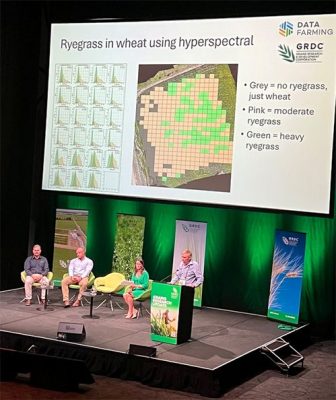
Tim Neale addresses the GRDC Update in Adelaide last week. Photo: Nigel Hart, GRDC
They are in the early stages of using technology for disease detection and for discovering anomalies with crop growth.
“The weed detection stuff’s coming to maturity and we’re excited to get that out to the public.”
However, Mr Neale said the technology’s real value was directing the attention of an agronomist to a specific paddock.
“It’s about helping agronomists get on the paddocks quicker, in the right spots, at the right time.
“We know that agronomists are traveling at least 75,000-100,000km a year in their vehicles.
“If we can help to direct you where to go and reduce that sampling time…that’s a tremendous time saving.”
Mr Neale said there is a case for agronomists then using drone-in-a-box technology to use the information gathered from satellite data to do targeted crop scouting.
“I think we’re going to see this fusion of the satellites, the sensors and the drones come together.”
AI interpretation promising
Mr Neale said AI could help agronomists make more efficient use of data collected through on-farm technologies.
His team is investigating the use of language models/AI to produce pesticide and nutritional recommendations.
In his accompanying GRDC Update Paper, Mr Neale said AI-assisted interpretation of agronomic data is a “proven near-term use case” and that the technology can “rapidly summarise results” while saving time, being consistent and scalable, and providing “support for less-experienced agronomists”.
“AI is going to provide that link where we’ve got huge volumes of data…and understanding all of the things that are going on at one time.
“How many times do you [ask] ChatGPT…a question and it so confidently tells you the wrong answer?
“We’ve got to be very careful about how we deploy AI, and…a human absolutely has to be involved.
“What we’re trying to do is provide more data and more confidence for people to make better decisions.”
Agronomist shortages
Mr Neale said it was increasingly important to find technical solutions to lift agronomist productivity as fewer people enter agricultural careers.
“I talk to all the universities around the country and agriculture enrolments are plummeting.
“So where are we going to get these staff from to actually be agronomists in the future?
“I’ve got agronomists telling me they’ve got a couple of 1000-acre paddocks that they drive through the middle of to give a weed recommendation because they just don’t have time to go and manage it all.
“I think we’re going to have to sharpen up real quick on this…because we’re not going to see the volume of people coming back to the bush unless something else dramatically changes.”
Mr Neale said AI and new technologies wouldn’t “replace” labour, but could “fill some gaps by doing things better”.
More than 550 people attended GRDC’s Adelaide Update event last week, a record number for the two-day conference.
Grain Central: Get our free news straight to your inbox – Click here
HAVE YOUR SAY