

ZoomAgri’s Zoome One technology was recently endorsed as being able to identify a number of barley varieties. Photo: ZoomAgri
AUSTRALIAN companies bringing homegrown innovation to machine vision at grain-receival points are starting to gain traction in the market.
Collectively, their customer base is growing to include bulk handlers, traders and consumers looking for increased accuracy and efficiency.
Ahead of an announcement expected in the near future around the Grains Research and Development Corporation’s call for a business which can develop a process to assess, classify and trade grain, Grain Central has followed up with Cropify, GoMicro, Platypus Vision and ZoomAgri on their latest developments:
Cropify
South Australian company Cropify rolled out its first commercial units in time for the 2025-26 harvest.
Marrying Cropify’s software and hardware, red lentils were chosen as the first commodity to be assessed commercially by the Opal units, most of which have been deployed in Victoria’s Wimmera region.
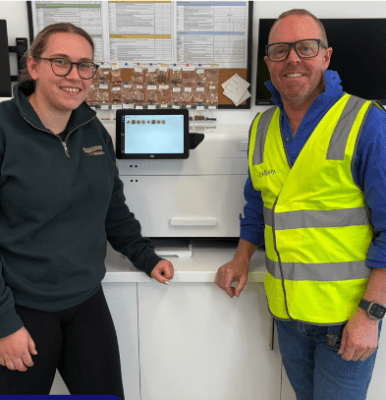
Shannon Bros grower services manager Briley Monahan with Cropify chief operations officer Andrew Hannon on site at Shannon Bros last year. Photo: Cropify
Sites where they were used over harvest included ETG’s Wimpak facility at Minyip, Shannon Bros at Beulah and Horsham, and three GrainCorp sites.
At port, LDC has installed an Opal unit at its Melbourne terminal, where lentils have in recent times joined cereals and canola as a bulk export.
As part of its move from development to commercialisation, Cropify employed Anthony Cutter last year as its Horsham-based field support officer.
“We had a significant amount go through our product this harvest,” Cropify chief executive officer Anna Falkiner said.
“We’re flying with lentils, and we’re really happy with it.”
Through its use of AI to assess defects based on grain colour, size, and shape, Opal units can more than halve the time needed to assess a 200g lentil sample.
Cropify is currently in the process of organising field trials for Opal units capable of assessing chickpeas at sites in Queensland and northern New South Wales.
“We’re aiming to do trials this year before winter hits.”
Cropify will be exhibiting at EvokeAg in Melbourne next month, and will be at the Big Tech Big Ideas event at Dubbo on March 26-27.
GoMicro
GoMicro is an Adelaide-based company that has had success in using mobile phone technology to visually assess wheat, lentils, soy, corn, and chickpeas.
It has an ongoing relationship with Walco Seed Cleaning at Halbury in SA’s Mid North, and is in discussions with Canadian and Australian interests.
“I believe there’s a place for all companies in this,” GoMicro founder Sivam Krish said.
“At the end of the day, we want a competitive environment where everyone is involved.
“There’s a lot of movement in this area; that’s the good news.”
Dr Krish said growers as well as bulk handlers are interested in assessing the quality of deliveries, possibly from as far back in the supply chain as the header bin.
Some farmers are of a scale where they can compete with bulk handlers.
“What is going to fly is continuous assessment [of] whole truckloads, whole shiploads.
“There are some exciting developments taking place.”
Platypus Vision
Sydney-based company Platypus Vision is developing a “low-touch” system which does not require sample preparation or complex loading procedures for all tests required at point of delivery.
Platypus Vision chief executive officer Rob Martin said this is in line with how markets operate over much of the developed world, and would enable moisture, protein, test weight and falling number to be quantified alongside visual assessment.
“When combined with automated sampling systems, this provides the potential for ‘dark room’ operations which can work autonomously without human intervention,” Mr Martin said.
“More importantly, Platypus focuses on processing full sample sets to ensure statistical validity in everything that we do.”
In less than three minutes, the Platypus platform can visually assess a 500ml sample that incorporates around 10,000 wheat seeds or 7000 barley seeds, larger than any of its competitors who can use as few as 300 seeds per sample.
“This image acquisition speed at very high resolution allows for AI model building and testing at very high speed.”
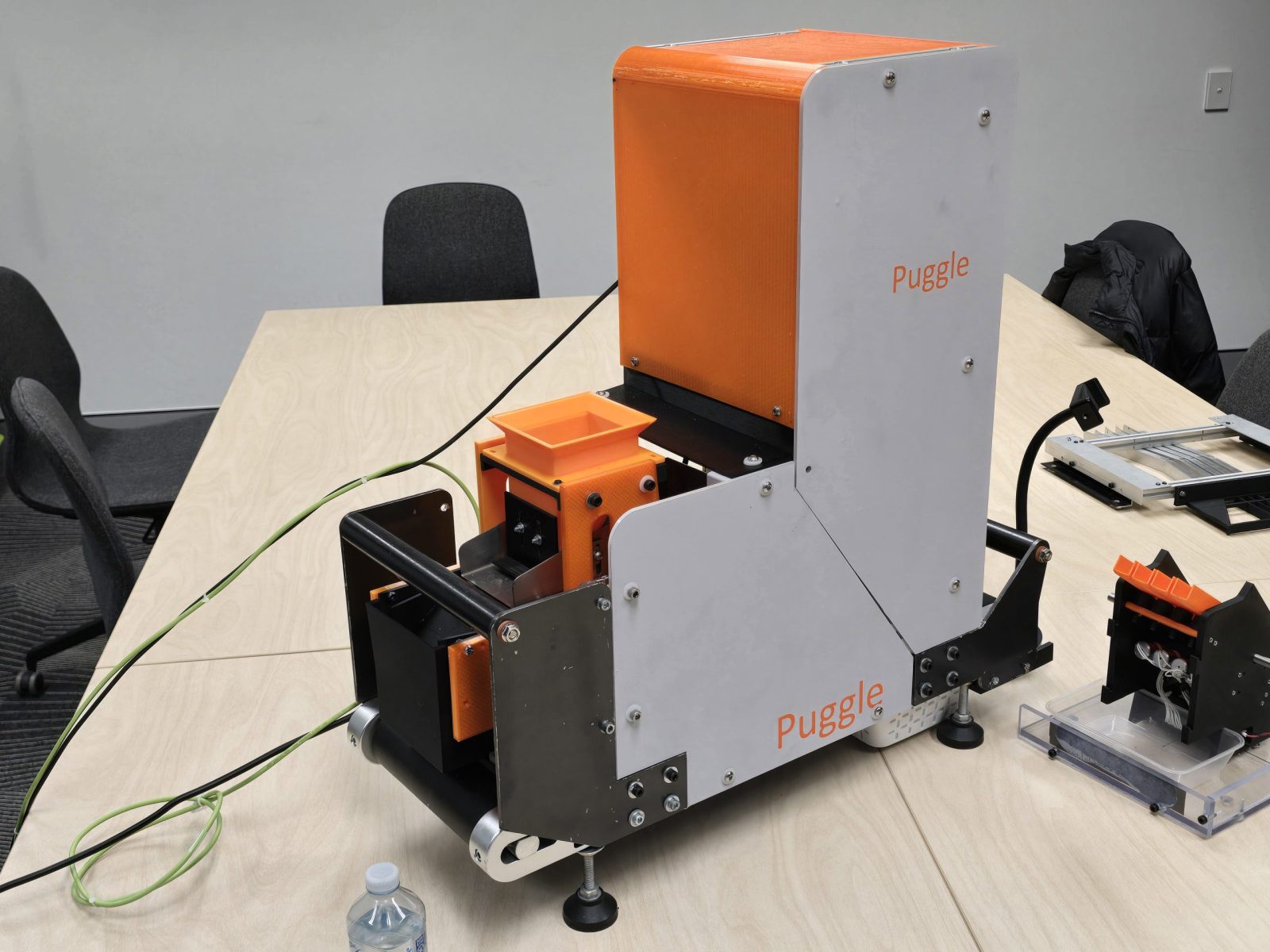
Platypus Visions’ Puggle unit was developed last year. Photo: Platypus Vision
Last year, the company built the prototype Puggle, a smaller Platypus unit designed to be portable and therefore suited for use across harvesting or accumulation sites.
“Puggle uses the same design philosophy as Platypus and will produce identical results as a Platypus unit; it just takes a little more time.”
“Puggle is however, much more compact and is built to allow integration of newly emerging technologies, so your investment will remain, no matter how technology changes.”
Mr Martin said the need to stay aware of how photonics engineering was developing remained paramount.
“Most currently available systems work in the visible light range, but newly developing technologies can extend the spectral range significantly.”
ZoomAgri
In a statement released by GrainCorp on December 18, the company outlined the latest for ZoomAgri, which it describes as a global agtech company bringing AI and machine learning to varietal recognition and quality testing in the Australian market.
In 2023, GrainCorp Ventures co-led a $9-million investment round into ZoomAgri, and since then, GrainCorp has installed more than 40 ZoomAgri devices at its up-country and port sites across eastern Australia.
The ZoomAgri unit is also being used by LDC.
The units are used for varietal recognition and quality testing of barley, and use ZoomAgri’s Zoom One technology, recently endorsed by Grain Trade Australia to assess specific barley varieties for compliance with varietal purity specifications.
This allows a move beyond traditional methods, which rely on visual assessment of the grains and then DNA testing to certify the variety, taking time and additional resources.
The GTA endorsement means that for the 2026-27 season, Bass, Maximus CL, Commodus CL, RGT Planet, La Trobe, and Spartacus CL varieties can be certified based on Zoom One results.
ZoomAgri recently released new technology which also measures physical quality of grains and oilseeds via computer vision and machine learning.
Unlike Zoom One, the new device uses cameras instead of scanners, enabling it to process a larger sample, which is key to validating physical quality, and GrainCorp is using Zoom One units at its Geelong and Port Kembla ports.
“Being able to identify the correct variety at the receival point assists with stock segregation and ensures that we have higher varietally pure malt segregations,” GrainCorp head of quality Mat Samin said.
“By having purer malt segregations, we’re able to deliver a better product for our customers.”
GrainCorp Ventures strategy and ventures manager Zack Atlas said supporting the continued modernisation of the grains industry with the use of AI was a focus for GrainCorp ventures.
“We’re excited to be trialling the new iteration of ZoomAgri devices to see how AI and machine learning powered physical quality assessments improve speed and accuracy,” Mr Atlas said.
Grain Central: Get our free news straight to your inbox – Click here
HAVE YOUR SAY