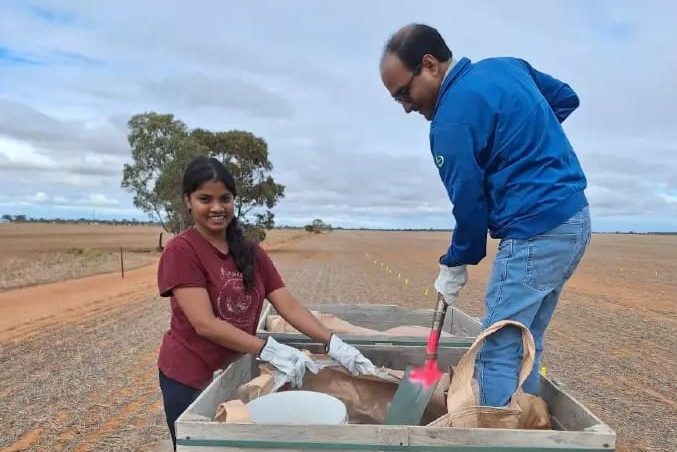
UniSA researcher Dr Binoy Sarkar and a student spread crushed basalt on crops. Photo: UniSA
VOLCANIC rock waste from mines and quarries could help transform Australia’s farming sector, with the University of South Australia leading research testing whether it can act as a natural fertiliser while drawing CO2 from the atmosphere.
UniSA environmental researcher Binoy Sarkar is leading an Enhanced Rock Weathering trial that involves applying crushed basalt to agricultural soils, measuring its nutrient release and carbon capture.
Dr Sarkar, from UniSA’s Future Industries Institute, is collaborating with James Cook University, the Tropical North Queensland Drought Hub, and industry partner Carbonaught Pty Ltd on two projects, funded by the Federal Government and Cascade Climate.
“Australian farmers spend nearly $1.2 billion a year to tackle soil acidification, using expensive liming materials that in themselves contribute to greenhouse gas emissions,” Dr Sarkar said.
“Large volumes of adequately fine rock particles – a byproduct of the mining and construction industry – can be bought for as little as $30 per tonne and applied to soils using existing farm equipment with negligible expense.
“Basalt does not completely replace chemical fertilisers, but it can cut fertiliser amounts needed to grow crops, saving farmers a lot of money and substantially improving their profit margins.”
Carbon-capture potential
Dr Sarkar said farming with basalt solved two critical challenges facing Australian agriculture: improving infertile soils and simultaneously removing greenhouse gas emissions from farming practices that include nitrogen fertilisers, deforestation, and land clearing.
“As a country, we have committed to achieving net zero greenhouse gas emissions by 2050.
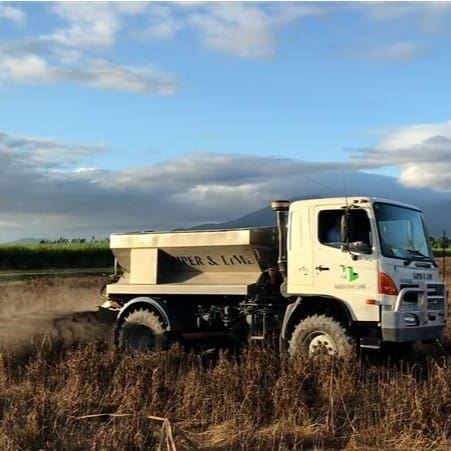
A truck spreads crushed basalt rock from quarries on to crops. Photo: UniSA
“Almost 18 percent of our emissions are produced by the agricultural sector, primarily from crop production and emissions from livestock.
“Lime is commonly used for correcting soil acidity, but it is expensive and contributes heavily to on-farm carbon dioxide emissions.
“Basalt naturally reduces acidity, captures carbon, and it also releases nutrients such as phosphorus, calcium, magnesium and silicon into the soil.”
Dr Sarkar said the research will not only benefit Australia’s agricultural sector, but also the mining sector, where basalt is a byproduct that has to be dug and moved aside before reaching valuable minerals located at depth.
This byproduct is already crushed to make road building and construction materials, but finer fractions are stockpiled, often taking up large amounts of space with negligible commercial use.
Society at large is also a winner, thanks to basalt scrubbing gigatons of carbon dioxide from the air.
Dr Sarkar’s collaborative team is the first in Australia to receive significant R&D federal funding ($5 million) to trial the low-cost carbon-cutting technology nationally.
“I hope we can see a lot more trials in the next few years, to build confidence and propel a large-scale adoption of this rock weathering technology.
“It will also provide opportunities for farmers and quarry owners to sell carbon credits and earn additional profits.
“Our farmers will be able to take advantage of this huge market when we have a strong monitoring, reporting and verification program for the technology.”
Source: University of South Australia
HAVE YOUR SAY