
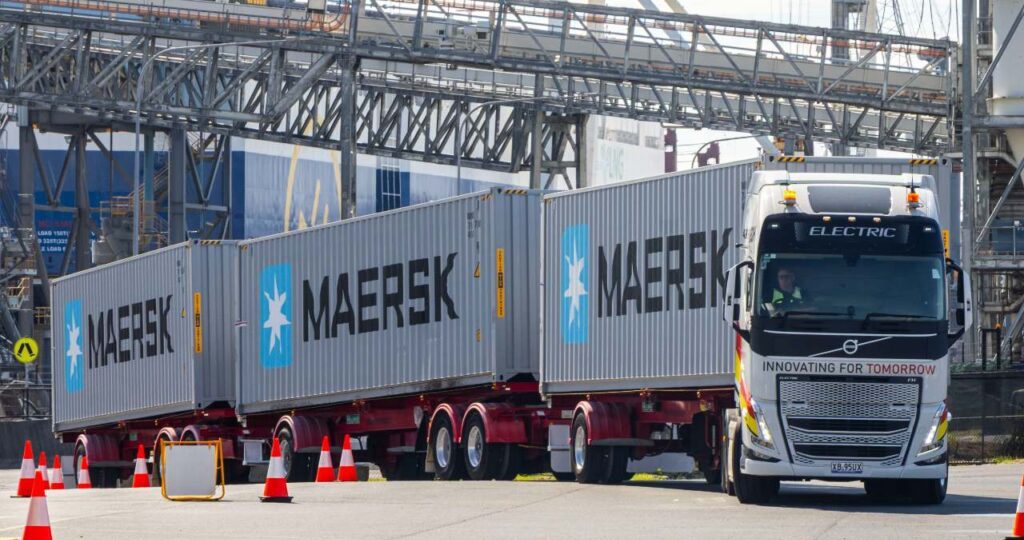
Last year South East Queensland Hauliers (SEQH) unveiled a 53.5m, factory-built electric Volvo FH that will begin operations at the Port of Brisbane. Photo: Volvo Trucks
FARMERS should focus on transitioning to electric machinery and vehicles rather than shifting existing equipment to biofuels, according to a report commissioned by Farmers for Climate Action and written by energy researcher Professor Ray Wills.
It concludes that fuel sovereignty will require a gradual shift away from diesel-reliant machinery, citing lessons from the conflicts in Ukraine and the Middle East.
The report also recommends capping the Fuel Tax Credit Scheme at $50 million per claimant with a significant portion of the savings for a dedicated regional energy shift program that helps farmers adopt best-fit biofuels, electrification and enabling infrastructure.
The stance seemingly contrasts with groups like GrainGrowers, the National Farmers’ Federation and the Queensland Farmers’ Federation, which have advocated for biofuels as a means of reducing emissions while creating additional demand for Australian grain.
Speaking at a Farmers for Climate Action webinar on Thursday, Future Smart Strategies managing director Prof Wills said biofuels may have a role in sectors that are difficult to electrify as a short-term bridge towards full electrification.
“The use of sustainable biofuels are a bridge for existing tractors, harvesters and remote operations,” Prof Wills said.
He said in the long-term, crops were not as productive as solar panels in creating energy.
“If we put a hectare of solar panels out…we’ll make between 1000-1500 megawatt hours of electricity a year from those solar panels, depending on where you are in Australia.
“This is more than a hundred times the amount of energy that you’ll get from one hectare of planted soybean crop.
“If you turn a hectare of soybean crop into biofuels, you’ll harvest about 8.3 megawatt hours a year.

Prof Ray Wills.
“This is a phenomenal difference, and this is why using electricity from solar as we can do it is going to be so important.”
Prof Wills said sugarcane outputs are “about five times the amount of what you’d get from a soybean crop” making it a better option but this was “still only one twenty-fifth of the amount you get from solar panels”.
He said growers had the choice to spend to have the “kit on farm” to produce biofuels or produce electricity via solar panels, or they could transport oilseed crops elsewhere and purchase back the fuel at a discounted rate.
“Do we spend money on biofuels now for the next five years or do we spend money on electrification now for the next 30 years?”
He said biofuels were the “more comfortable path” as they avoided changes to on-farm machinery but argued they were unlikely ever to be cheaper than electricity.
“Electricity gets produced in so much greater quantity from a solar panel than you can get that same…energy from a plant.”
Energy sovereignty sought
Prof Wills said the case for beginning electrification on farms was stronger than ever.
“Whenever there’s a crisis, the oil price goes up and the first peak in this latest series was in fact the Ukraine war, and now the Iranian crisis has actually just really returned oil back to where it was during the Ukraine war.
“Agriculture should not be punished for today’s diesel use because of things that are dropping out of the skies over Iran.
“We need to be able to move beyond that.
“Electrification is the most single biggest opportunity to structurally lower energy costs and improve sovereignty in modern Australian farming.”
He said the shift could start on a “practical sequence” with stationary and short-range jobs electrified first.
“We’ll start small and get bigger, progressively, to heavier mobile plant as products mature.”
Prof Wills discussed one example of seeding a 6000ha crop which, he estimated, would take 35 days and require 30,000 litres of diesel.
He said this was about 320 megawatt hours of fuel in electricity equivalents.
“The question is: Can you even do that with an electric tractor?
“The actual point is, well, no.
“Electric tractors are far more efficient, so they don’t need the same level of energy that you need in diesel and, so therefore…about a third of the amount of energy is required as a source.
“An electric tractor uses 3.1 [megawatts] a day with one hectare of solar plus 2.5 [megawatts] of batteries, you’ve actually already got it covered.”
Case for cap
Farmers for Climate Action acting chief executive Verity Morgan-Schmidt also told the webinar that proposed changes to the Fuel Tax Credit Scheme could help finance electrification.
“We found that farmers overwhelmingly were really keen to ensure that tax money was spent in a way that actually builds out energy sovereignty for rural and regional Australia and for our nation as a whole,” Ms Morgan-Schmidt said.
“It wasn’t just about maintaining that long-term diesel dependence.”
She said it was recognised that the scheme had a purpose and should continue to exist in some capacity.
“Putting a sensible cap of $50M on the Fuel Tax Credit Scheme, while protecting farmers, is just a no-brainer when it comes to accelerating the shift to electrification for heavy machinery.
“In a cost-of-living squeeze, why should we continue to encourage the biggest companies to enjoy unlimited taxpayer-subsidised diesel? There is a real opportunity for these biggest users to shift their focus to an electrified fleet; accelerating technology and bringing down emissions.”
Grain Central: Get our free news straight to your inbox – Click here
HAVE YOUR SAY