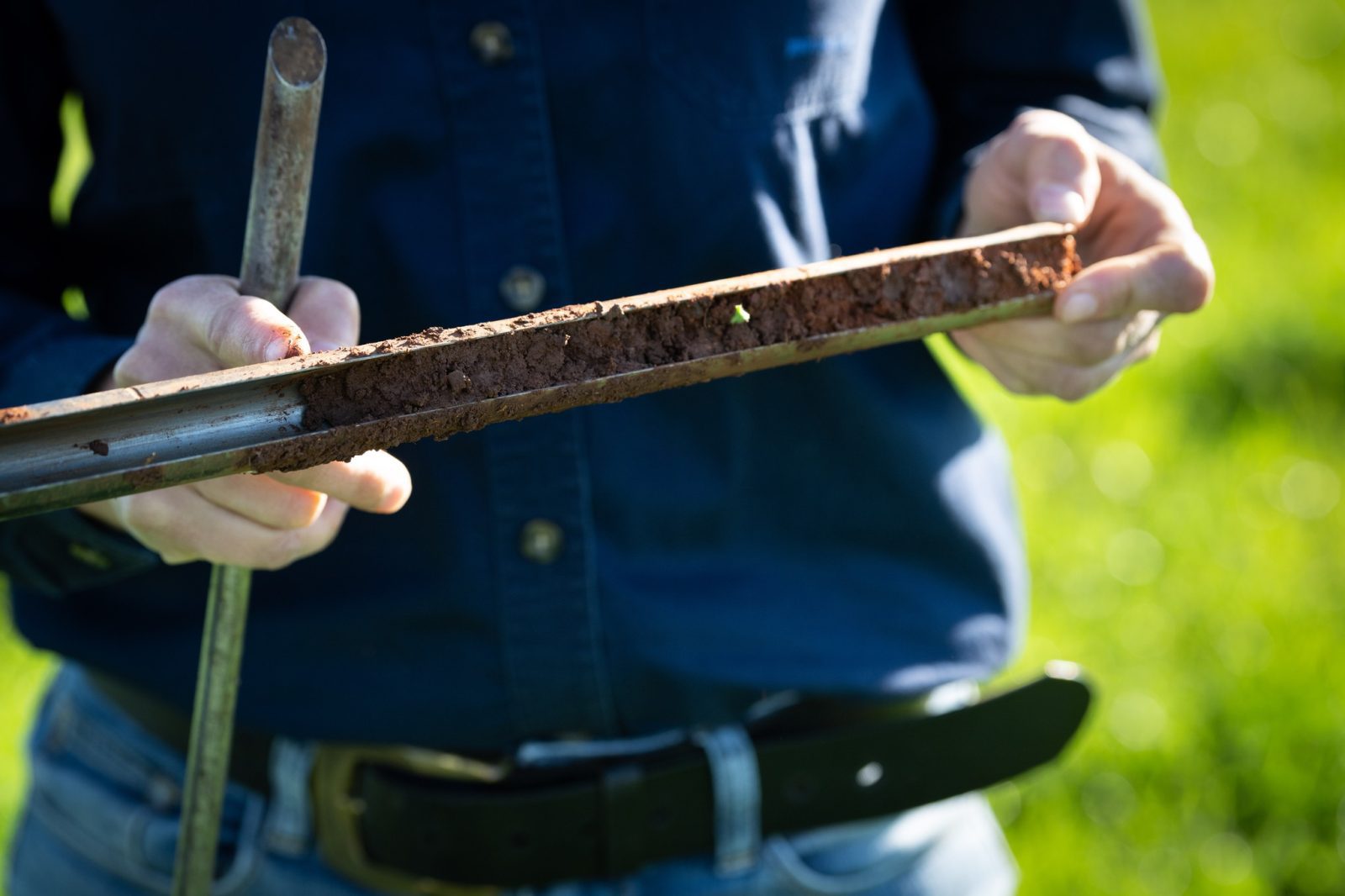
Dr Aurelie Quade takes a core sample in the Toongi district south of Dubbo. Photo: Soil Resilience
SUSTAINABLE farming is no longer a fringe conversation.
Worldwide, it is taking centre stage and Australia is always in the audience.
Our farmers are flooded with advice, conflicting messages, and shifting definitions.
The noise can be overwhelming.
Which practices actually work?
Which ones backfire?
What is the right path when your livelihood, and legacy, are on the line?
It is fair to say most of us are growing a little weary.
Our farming population is aging and the changes we are asking them to make come with conflicting messaging.
This is not just inherent to farming.
Change and choice fatigue are real, especially when the stakes are high.
Let us pause and strip sustainability back to its essence.
Put simply: Sustainable farming means producing as much as we can, while adding as little as we can.
It is not about perfection; it is about resilience.
Like raising a child, it takes daily effort, reflection and adjustment.
It appears messy, it is personal, and it is certainly not a one-size-fits-all.
A sustainable system must reflect your enterprise — your soils, your opportunities and constraints, your seasons, your goals — not someone else’s template.
Cost, efficacy disconnect
Markets are the principal driver of demand and they are looking to meet their customer expectations, whether it is brewers for sustainable barley for their beer, or cotton for high-end fashion houses.

Dr Aurelie Quade.
They in turn need farmers to supply products that have lower emissions cost and help maintain environmental conditions.
This is particularly challenging under weather extremes such as heatwaves, fire, drought, and flood.
While the question of who pays is still contentious, research clearly shows that soils, and improving soil health in particular, is the major precondition to a resilient agronomic system.
However, the real urgency is coming from something farmers see every day: the growing disconnect between input costs and productivity.
That once-reliable return on investment of previous generation is quietly slipping away: Price and efficacy of inputs are heading for a divorce.
Many of us are now applying more to get the same, or less, and margins are therefore getting tighter.
Research is indicating that we need to get better at managing our major input costs, of which fertilisers and agrichemicals are the main component.
When the economics start to falter, we must ask: is there another way?
New metrics sought
It begins with a mindset shift away from measuring success by outputs alone like yield, weight gain, or head count, to understanding how those outputs are linked to soil function.
Your farm productivity will only ever be as good as the soil of your farm.
Your productivity is not linked to how much fertiliser you apply; your productivity is determined by the potential of your soil to retain and exchange those nutrients with the plants.
Here is the kicker: if your soil health is degraded, you could be applying $100 worth of fertiliser and only getting $40-$60 of value.
The focus needs to be on helping farmers understand that it is not what they apply but what their soil can deliver that drives productivity.
Change happens slowly
Transitioning too quickly — from high-input to low-input systems — can be disastrous, and switching back and forth is worse.
It is impacting your system, your finances and confuses your decision-making.
Let me use a parenting analogy: In the past, we might have only disciplined with harsh, firm and immediate consequences.
It was highly effective and it worked every time—but often came with long-term side effects, such as eroding self-esteem and ability to communicate calmly with others.
Today, we talk about gentle parenting.
Does it work? Yes, but only if it is done consistently, with other tools and at the right time.
In the short-term, the results are nuanced and may not work every time.
However, we are fortunately not raising kids based on how well they will be doing next spring.
At times, you cannot suddenly gentle-parent a tired, hungry three-year-old and expect it to go well.
The same applies to your farming system.
Switching to “gentler” inputs without preparing the system leads to stress, poor performance and too often, financial loss.
Sustainable farming is not about rejecting conventional practices. It is about arming yourself with a more diverse toolbox.
It asks: How do I broaden my options, use the best of both systems practically and consistently, and plan for the long-term?
The key measure will be determined by long-term profitability rather than yield.
Plan, observe, persist
There is no silver bullet, but there is a path for those willing to plan, observe, and persist.
You can start by developing a thorough understanding of your soil asset.
It also requires rethinking where and how often you rely on fewer high-efficacy tools that come with costly side effects and gradually integrating a more diverse set of tools that may act more slowly, but deliver long-term benefits with fewer downsides.
Every kid is different and every farm is different.
Every parent and every farmer bring their own values, constraints and opportunities.
Sustainable farming is not about imitation; it is about finding the right help to understand your system deeply and choosing the right tools for the job over time, with clarity and care.
About the authors:
Dr Aurelie Quade is a plant pathologist who has worked in research and carbon programs, and is the principal of Soil Resilience.
Dr John Rochecouste has worked widely in research and extension for the private and public sector, and is currently an independent consultant in rural sustainability.
Grain Central: Get our free news straight to your inbox – Click here
HAVE YOUR SAY