
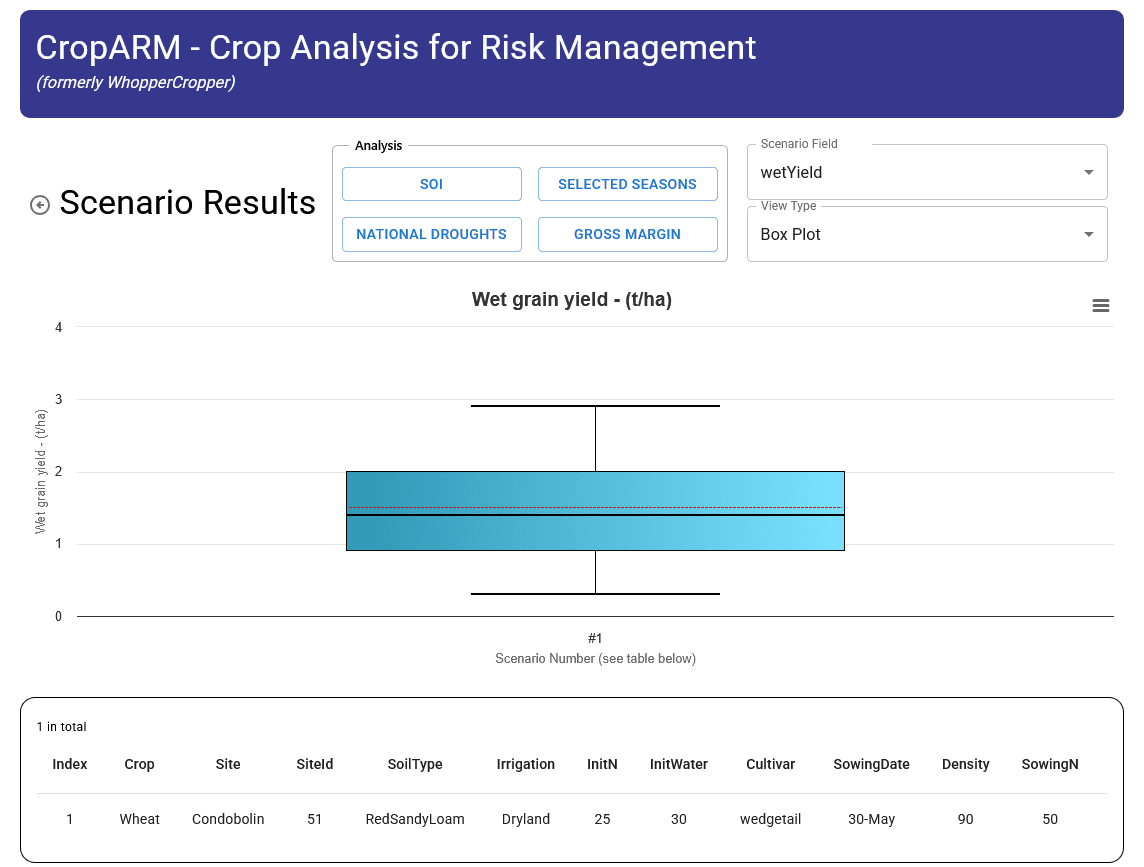
CropARM allows users to create scenarios for 56 sites across Australia, and then input costs including urea, and expected price per tonne for the commodity. Image: CropARM
GROWERS across Australia have some tough decisions to make based on the current expense and scarcity of urea.
As conflict raging between Iran and US-Israeli forces throttles shipments from major suppliers like Qatar, Bahrain, Kuwait, and eastern Saudi Arabia, growers are now running the ruler over what to plant, and what yields to target, with limited nitrogen.

Professor Keith Pembleton.
To assist, the CropARM pre-season decision support tool allows growers to build scenarios for 58 locations across Australia, and includes a gross margin calculator.
Formerly known as Whopper Cropper, the tool was developed by the University of Southern Queensland and the Qld Department of Primary Industries, and uses the APSIM farming systems model as its analytical engine.
Growers in summer-cropping areas have the option of fallowing over winter in the hope that urea supplies increase and prices drop in coming months, and this can also be modelled with CropARM.
UniSQ researchers Professor Keith Pembleton, Dr Uwe Grewer and Roy Anderson from the Centre for Sustainable Agricultural Systems and Cameron Leckie from the Southern Qld and Northern NSW Drought Innovation Hub, and Dr Andrew Zull from QDPI’s Agri-Science Queensland have put together a report to outline how CropARM can be used. View the report here. Urea cropARM report.
Its findings say that despite the projected increase in urea prices, wheat grown using standard urea fertiliser rates is anticipated to achieve higher gross margins than by reducing fertiliser rates.
“In this case, urea supply rather than price may become the key constraint,” the report said, adding that in cases where urea cannot be sourced, chickpeas present a viable cropping option.
However, price volatility and the potential for disruptions to key export markets should also be considered.
The report says transitioning to a summer-cropping program may be a viable option, provided the urea supply disruption is temporary.
“If it continues and worsens into the beginning of the summer-cropping season, there will be considerable impacts on summer crop production and gross margins.
Moreover, with global events affecting supply chains even future crop prices are uncertain, increasing production risk.
“Overall, a balanced application of all these options explored in this analysis will enable grain growers to manage the risks and uncertainties caused by the current urea supply disruptions and price rises.”
Gross margins pressured
The report uses a scenario which looks at dryland cropping at Pittsworth, on Qld’s Darling Downs.
CropARM allows users to input urea costs and expected price per tonne for the commodity grown, and the scenario models urea prices at up to $1800/t.
The winter-cropping after summer fallow scenario was modelled on a Vertosol soil paddock with 190mm of plant-available.
It assumes an initial soil mineral nitrogen status to 90cm soil depth and 50kg/ha of N in soil is 90-percent full of water.
Into it is planted wheat to achieve a plant density of 100 plants/m2 on May 15, and an initial fertiliser rate of N at 100kg/ha; as urea is 46pc nitrogen, this is equivalent to applying 217kg/ha of urea.
On average a dryland crop sown like this should yield 4.1t/ha in a yield range of 3.4-4.9t/ha.
A gross margin analysis using input costs sourced from the AgMargins database and a wheat price of $340/t showed a decrease in the average gross margin of $76/ha from urea prices rising from $850/t to $1200/t.
What happens when inputs drop?
The immediate response of a grain grower to an increase in fertiliser costs may be to reduce the fertiliser application rates.
The impact on average yields from a reduction in fertiliser on yield is clear, with a 15pc yield penalty from decreasing fertiliser from 100kg/ha of N to 75kg/ha.
The impact on the gross margin was also clear, with an 18pc decrease.
Further to the reduced yields and gross margins, the reduced urea application also resulted in a decrease in soil mineral nitrogen at harvest.
The depletion of the soil’s nitrogen bank will need to be corrected through future fertiliser applications to prevent long-term productivity reductions.
If urea supply remains constrained in the long term, this could present potentially considerable reduced yields and economic returns to the grower.
Chickpeas instead?
Growers may consider planting pulse crops that do not have a requirement for urea to avoid the impact of its increased price.
Around Pittsworth, the most commonly grown winter pulse crop is chickpea.
The expected yield and gross margin of an Amethyst chickpea crop sown June 30 under the same conditions as the aforementioned wheat crop points to an average yield of 2.9 t/ha and a gross margin of $1647/ha.
This shows chickpeas to be an attractive option for growers looking to minimise the impact of increased urea prices.
However, caution is required when applying these figures because chickpea pricing is historically more volatile than wheat.
Also worth noting is that if an expansion in the current conflict occurs, key markets for Australian chickpeas like the United Arab Emirates and Pakistan could be impacted.
Moreover, if many Australian grain growers opt out of winter cereal to grow pulse crops, this increase in supply into a relative thin market can drive down prices.
To fallow or not to fallow
For growers in summer-cropping districts like Pittsworth, the option exists to fallow over winter and plant a summer crop in spring in the hope that urea prices and supply have returned to more normal levels by then.
The risk with such a strategy is that the supply disruptions may prevail until then or possibly get even worse.
Consequently, the yield and gross margin of a sorghum crop grown at Pittsworth when the urea price is at $850, $1200 and $1800/t has been analysed to explore this risk.
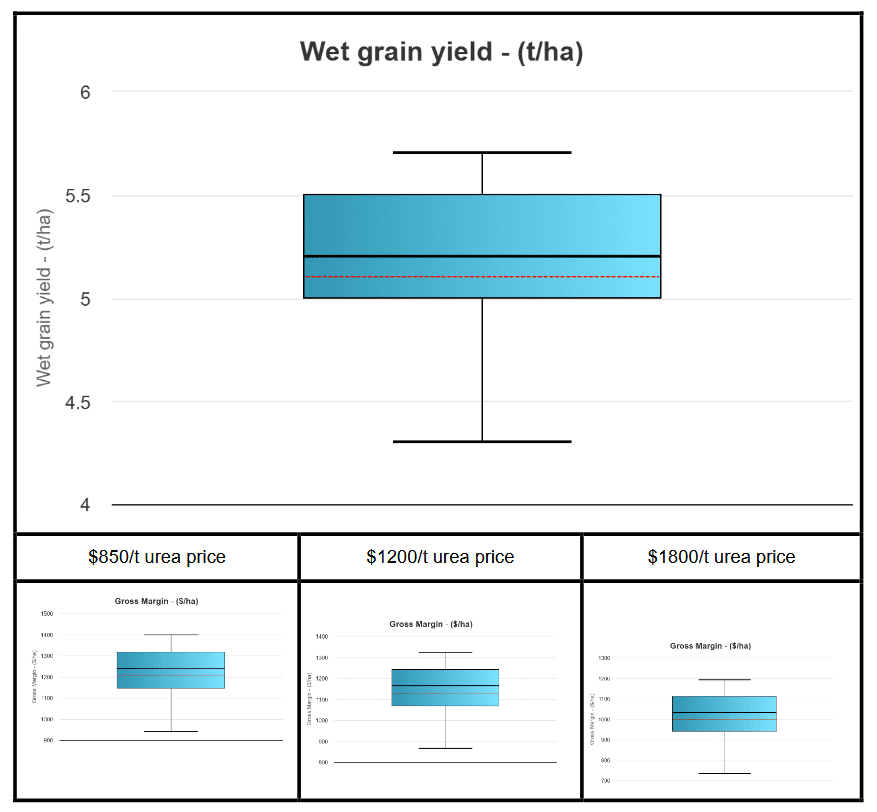
Figure 2: Long-fallowed sorghum yield and gross margin for a urea price of $850, $1200 and $1800/t and a sorghum price of $340/t. Note: Gross margin plots are offset to facilitate visual comparison. Source: CropARM/UniSQ
In this scenario, a medium-maturity cultivar of sorghum is planted on September 15 at a target plant density of 4 plants/m2 and a fertiliser rate of 100 kg/ha of N, or 217kg/ha of urea.
The average gross margin of the sorghum crops reduces from $1204/ha to $1128/ha to $997/ha as urea fertiliser prices increased from $850/t to $1200/t to $1800/t.
Higher urea prices will further decrease the gross margin of sorghum production.
Chickpeas look good for double-cropping
Growers already operating in a summer-crop rotation may be weighing the risks of ongoing fertiliser supply disruptions.
With favourable late-summer and early-autumn rainfall in some areas, they may be considering transitioning by double-cropping into winter crops.
In such situations, fields where a summer crop was grown will generally have lower soil- water content and residual soil mineral nitrogen than fields that remained in fallow.
To explore this scenario, the analysis looked at rainfed wheat and chickpeas grown at Pittsworth after sorghum.
To reflect the reduced availability in soil water and nitrogen when double cropping, the soil-water content was set to 60pc and the initial soil mineral nitrogen was set to 10 kg/ha of N, with the wheat crop receiving 100kg/ha of N.
Chickpeas appear very attractive for this option with an average gross margin of $1370/ha compared to $473/ha for wheat.
Note, although long-fallowing does tend to decrease risk and increase soil-moisture and crop yields, it does reduce cropping intensity and thereby the average farm income per hectare per year.
Source: UniSQ
Editor’s note: Whilst CropARM is intuitive to use, there is online support available for CropARM at the website, including training videos.
HAVE YOUR SAY