
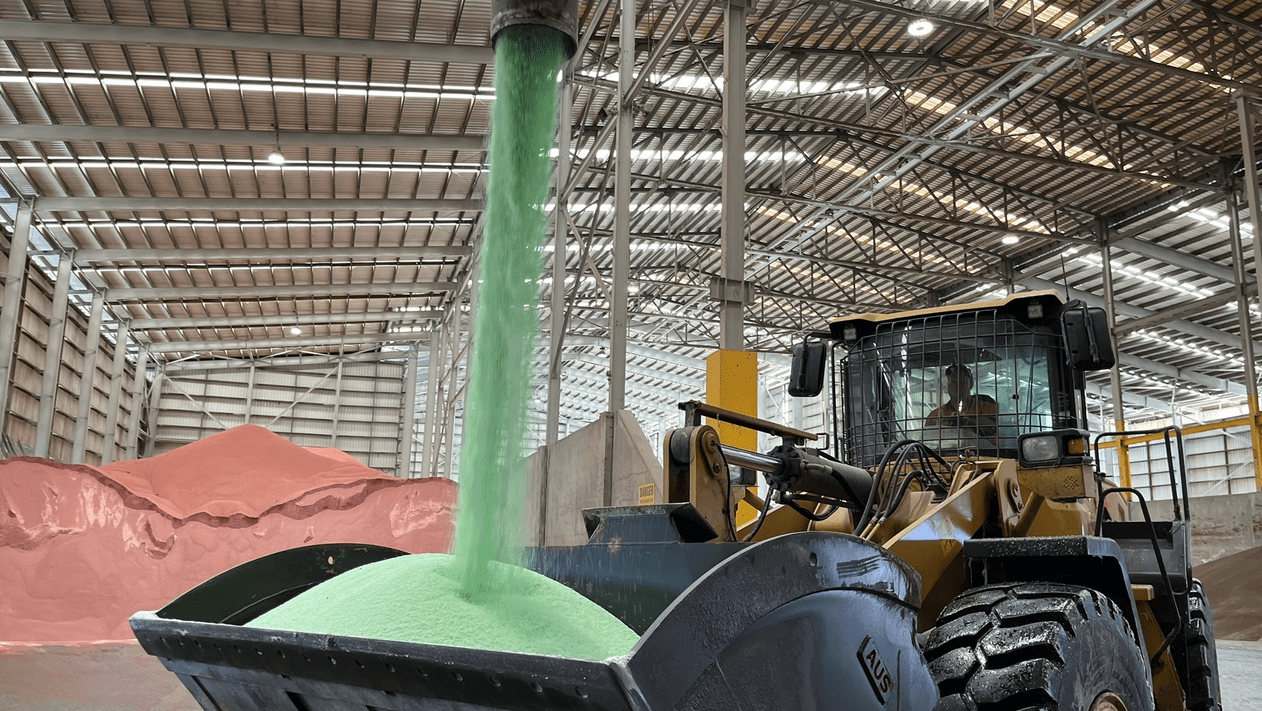
Green Urea NV is one of the products being promoted by fertiliser companies as a more efficient means than standard of urea of getting nitrogen into crops. Photo: Incitec Pivot Fertilisers
TODAY’S news that a two-week ceasefire in the Persian Gulf has been reached are seen as positive for Australian growers, but is no quick fix for depleted fertiliser and diesel supply chains, or high input prices.
The reality for growers is that a contrasting season and seasonal outlook, coupled with the expense and scarcity of two key inputs, has made the decision-making process for winter croppers trickier than ever this season.
Apart from leaning heavily on agronomists and advisors, some growers are turning to decision-making supports and tools, while others are looking at a system change which reduces their reliance on synthetic fertiliser, or increases the efficacy of applied nitrogen.
RiskWi$e workshop
Organisations have been quick to respond with initiatives like the RiskWi$e workshop on tomorrow for South Australian growers.
Hart Field-Site Group is one of the SA Central Action Research Group’s five members for the national risk-management initiative, and has been instrumental in organising the workshop.
HFSG executive officer Sandy Kimber said RiskWi$e had been designed to help growers “get it more right more often” when it comes to decisions, and offered a means of helping growers look at the “upside and downside on any scenario”.
“The major issue for us, across this region and the state, is we’ve picked up some unexpected subsoil moisture,” Ms Kimber said.
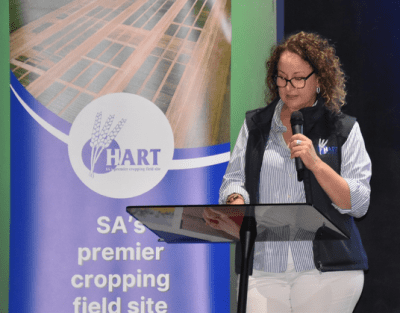
Hart Field-Site Group executive officer Sandy Kimber. Photo: HFSG
While SA growers generally do not plant before Anzac Day, substantial and unseasonal rain in recent weeks means they have the rare option of sowing early.
“Some people are asking: Do I sow early now?”
If they do, they may be sowing a different crop or variety with added risks and rewards.
“There are questions around germination, flowering windows, and frost risk, overlaid with concerns about fertiliser and fuel pricing and supply.
“Some are asking: Should I be switching to a lower-input crop?”
RiskWi$e comprises five themes around decisions tied to strategies around; nitrogen; sowing; enterprise agronomy; financial decisions, and the management of natural resource capital.
Interest in carbon
The shortage and expense of synthetic fertiliser has thrown into focus Australia’s dependence on imported inputs.
Since the Persian Gulf conflict erupted on February 28, businesses including the Orange-based Loam Bio have seen an uptick in interest from growers who are interested in using products including their non-mycorrhizal endophytic fungi developed into the CarbonBuilder product.
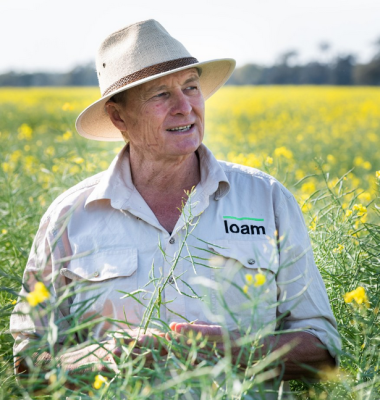
Loam Bio agronomist and co-founder Guy Webb. Photo: Loam Bio
“We’re definitely getting increased interest in this space,” Loam Bio agronomist Guy Webb said.
“Growers are seeing some pretty serious stuff changing across political and economic landscape and it’s driving them to think: What’s my business going to look like over the next five years?
“It circles back to how much resilience they’ve got to keep going.
“That’s financial resilience, but also the very basic stuff — what’s the resilience in your soil?”
Mr Webb said one of the benefits of improved soil carbon was its ability to build nutrient-holding capacity, and soil structure.
He said uncertainty around imported inputs had growers thinking about the benefits of having soil that could hold nitrogen and not lose it through leaching or volatilisation.
“You’re not as exposed to high urea prices if you’ve got nitrogen in your soil.”
Enhanced fertiliser
Fertiliser companies, all of whom have been facing the same cut to availability on urea in particular as a result of the Middle East conflict, have been actively promoting their products which enhance nitrogen-use efficiency.
In a statement, Incitec Pivot Fertilisers executive general manager of agronomy and innovation Charlie Walker said global uncertainty reinforced the importance of informed decision‐making on alternate urea sources and maximising contracted supplies where possible.
“Urea isn’t the only source of N – there are alternative options you can use to meet crop requirements,” Mr Walker said.
“One of the most effective ways to stretch contracted urea supplies is by blending with Gran-Am fertiliser, particularly in crops with higher sulphur requirements such as canola.
“Gran-Am contains plant-available sulphate sulphur and can be blended with urea and applied pre-plant or top dressed in cereals, pasture, canola, cotton, vegetables and sugarcane.
“The N in Gran-Am does not volatilise in most situations and can provide a relatively rapid crop response, while also supplying essential sulphur.
“We know sulphur deficiency is an issue in many southern cropping regions.”
Incitec Pivot analysis from more than 66,000 soil and plant tissues tests conducted over three years has shown 17 percent of soil samples from New South Wales, Victoria and South Australia are low in sulphur.
A further 21pc were found to have moderate levels, meaning they may soon need sulphur replenishment.
IPF also has a range of existing blends to help growers stretch their urea and blend with sulphate of ammonia, with Extra Sul and Green Extra Sul.
Recent Incitec Pivot trials concluded that up to 26pc of nitrogen applied as urea in winter crop was lost through volatilisation, and those trials also showed that Incitec Pivot’s Green Urea NV reduced nitrogen loss by an average of 77pc.
Grain Central: Get our free news straight to your inbox – Click here
HAVE YOUR SAY