
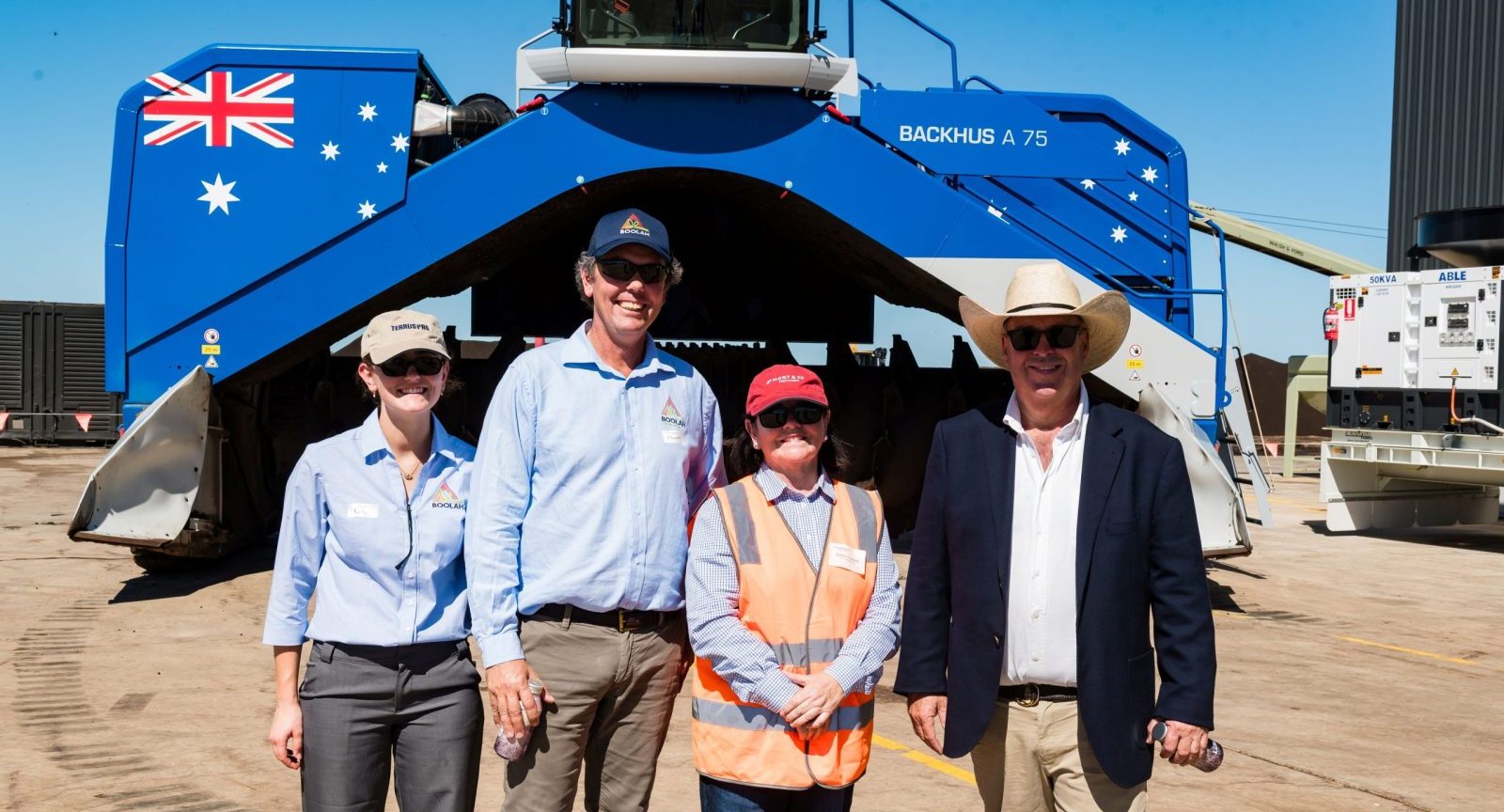
Stuart Tighe and daughter Ruby from Boolah Group with Mort & Co’s Maree Crawford and Charlie Mort. Photo: Matt Ryan
WITH synthetic fertiliser supply chains disrupted by conflict in the Middle East, some growers are turning to organic fertiliser granules to reduce rather than replace traditional inputs.
One option is a range produced by lotfeeder Mort & Co at its $15 million, first-of-its-kind Australian facility at Grassdale on Queensland’s Darling Downs.
The Mort & Co team hosted about 50 visitors last week to showcase upgrades to the fertiliser facility and explain how it converts manure from its beef feedlot into fertiliser granules.
Among them was Boolah Group principal Stuart Tighe, based at Pallamallawa east of Moree.
Boolah has been testing the granules on its trial farm, as well as in commercial cropping.
Mr Tighe said that following successful trials, this year marked the first time he was using the product commercially on both his summer and winter crops.
“We’re substituting granules for a third of the urea and getting the same nitrogen efficiency,” Mr Tighe said.
“You’ve got the benefits of reducing greenhouse gas emissions, as well as just the ability to be able to use less physical urea and spread it out over a larger area.”
Mr Tighe said the trials found the granules were “a really good way” of hosting other biological and biostimulant products as well as urea.
Working with nature
Mort & Co senior manager agronomy and innovation Maree Crawford said microbes were the link between turning the manure into functional organic fertiliser, what she calls “black gold”.
She said nature had been composting “for hundreds of years” but with the help of biology and select microbes, this process could be condensed and controlled.
“We can now break that down and get that into a factory, ready within 14 weeks, and we do that through the introduction of biology,” Ms Crawford said.
She said Mort & Co used a combination a “indigenous and imported microbes” to achieve the desired result.
“There are a million microbes on the market out there, but they don’t all work necessarily in our environment.”
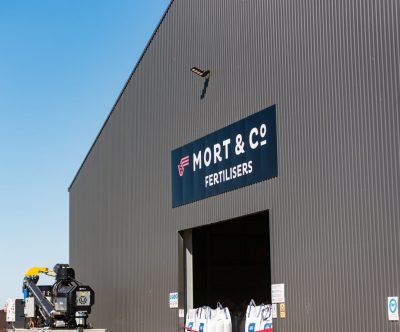
The Mort & Co organic fertiliser facility. Photo: Matt Ryan
Ms Crawford said the product then undergoes a four-stage process, including heating and cooling to eliminate pathogens, followed by a stage where nutrients are added and adjusted.
She said the manufacturing process allowed close monitoring of nutrient levels and the flexibility to adjust them where needed.
“Our P, K and N can get adjusted.
“We can do lots of things; we can add extra zinc, add extra sulphur.
“With the new equipment in this factory, we’ll now be able to customise these granules so much more to deliver good products into the soil.”
Ms Crawford said she was “very passionate” about the role of microbes and biology in supporting soil structure.
“If we think about what’s going on in our soils today, we’ve farmed them, and we’ve farmed them fairly intensively, and we’ve got to a stage now where the soil actually needs a bit of support.
“We’ve got a lot of microbes, native microbes in the soil.
“We’ve got a lot of good biology in the soil, but it’s just not functioning.
“The introduction of the granule into soil actually allows that functioning process to actually start.”
The Mort & Co plant is currently designed to be running at 20 tonnes per hour and has a target production capacity of 40,000t per annum.
Mort & Co Fertiliser chief executive officer Grant Statton said “it’s been a journey” but he was proud to see the “granules performing so well at a commercial level”.
“We’re literally witnessing something that’s incredibly exciting for the future of agriculture,” Mr Statton said.
“There’s a lot of hard work that’s come into it today.
“The innovation platform that this granule provides is something to behold.”
Grain Central: Get our free news straight to your inbox – Click here
HAVE YOUR SAY